
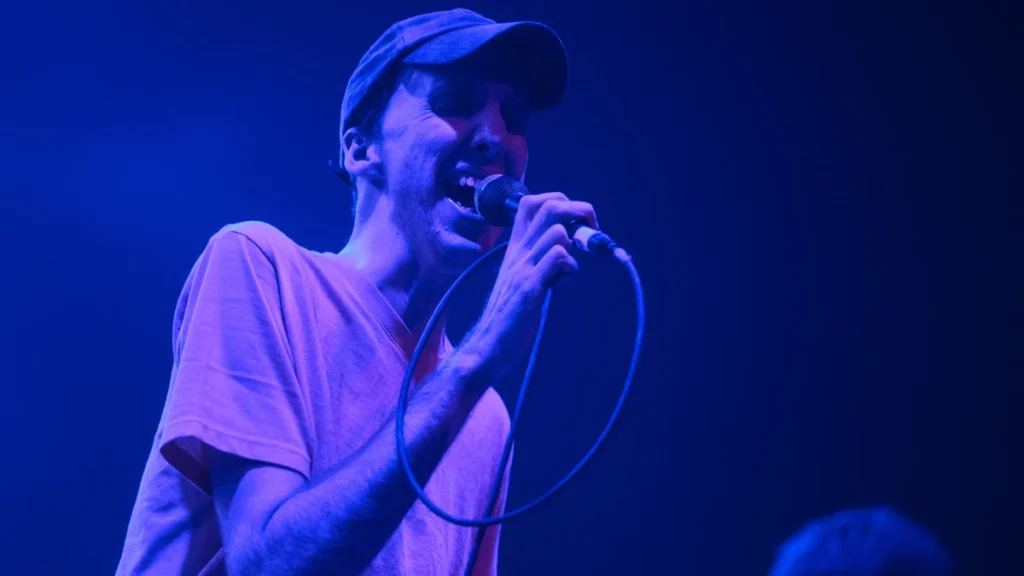
Bradford Cox on stage in December 2015
Bradford Cox made the first Atlas Sound album in 15 years by himself. “Thanatos”, surprise-released on 20 November through 4AD, was written, recorded and produced by Cox in the attic of his home in the Grant Park area of Atlanta, with every instrument played by him and the whole record captured on a Tascam DP-008. The 10-song album is out digitally now, with vinyl due next year.
It is billed as the end of a trilogy that began with Atlas Sound’s “Logos” in 2009 and continued with “Parallax” in 2011, and it arrives after years in which the Deerhunter frontman barely released or performed anything. How it was made, at night and alone in a house full of his own collection, is most of what has been said about it, and Cox has not said it himself.
Every Instrument, One Recorder, One Attic
Cox plays all of the instruments on “Thanatos” and recorded it entirely on his own in the attic, according to Far Out. Even the album’s more familiar guitar riffs came out of that room. Far Out’s review notes that the record was entirely written, recorded and performed by Cox on the Tascam, and that it was made in the dead of night.
Clash described the 10 tracks as “written, recorded, and produced by Bradford Cox on his trusty Tascam”. The rest of the credits are short. Heba Kadry mastered the album, and the sculpture on the cover was made by Chris Reynolds and photographed by Javier Morales. The credits also list Faulkner, Cox’s late dog, as offering him emotional support throughout the process.
For a musician who has led Deerhunter for two decades, as Clash put it, that is a very small circle. Atlas Sound has long been the outlet for his solo ideas, and this time the solo part is literal: no band, no outside producer and no studio.
Cate Le Bon Wrote the Introduction Cox Did Not Give
Cox did not offer a statement about the recordings, Consequence reported. Instead, the press materials carry a biography by Cate Le Bon, the producer and frequent collaborator, and it reads like a description of a working method. “Bradford Cox has always existed in extremes,” she wrote. “Embracing and transcending the contradictions inherent in an artist reaching for all the corners. Impossible to capture or imitate… It is everything I want from him and nothing I expected.”
Le Bon sets him against Virginia Woolf, who, she wrote, “accessed her enormous eye by leaving the house.” Cox, by contrast, “finds it by burrowing deeper inside the familiar shell that is his home.” She describes a house full of objects he has collected and absorbed for decades, and a schedule to match: “He works only in the dead of night.”
On the recorder itself she is specific. She calls the Tascam “a tool to distil the process down to the fundamentals of subtraction and addition”, and describes a method in which nothing is erased: “Nothing deleted but instead painted over with new emotion or the same gesture repeated with the urgency of the moment.” Of the playing, she wrote: “Each instrument played like it’s his last night on earth.”
Alongside the album, Cox shared a video, “A Visit with Bradford Cox”, in which he takes viewers inside his house, shows some of his personal record collection and rummages through collectors’ items and antiques, Consequence reported. In place of an interview, the house itself is on show.
The Road Back Ran Through a Festival in Philadelphia
The album ends a long quiet. Deerhunter and Atlas Sound both played their last shows in 2019, according to Stereogum, and the only set the site could point to this decade was a one-off performance of seemingly improvised noise at a vintage market in Athens, Georgia, in 2023.
Then Atlas Sound was added at the last minute to Philadelphia’s Making Time ∞ festival. On Sunday 20 September, Cox played a solo set on the Transcendental Stage, singing over bass, hand bells and an SP-404MKII, Stereogum reported. He opened by leading the crowd in “Happy Birthday” for his mother, Edie, who was turning 80, and thanked the festival’s founder, Dave P: “Thank you to Dave for having me because if it weren’t for him, I might’ve stayed at home for another seven years.”
The set ran for about half an hour and was entirely new: eight songs that Stereogum heard as “largely soft and ruminative, full of tender synth drones and echo-brushed vocals.” At the end, Cox handed out setlists and lyric sheets typed in blue ink and stamped “DRAFT” in red, signing them for fans.
“Octoberland”, one of the songs he debuted that night, followed on 30 October as the first Atlas Sound song in almost 15 years, a sparse, slow track with a video directed by Cox, Stereogum noted. Three weeks later, the album arrived without warning.
What the Night Shifts Sound Like
Far Out’s review hears the conditions of the recording in the music. “These are no spring morning songs crafted in a studio with jostling buddies,” Tom Taylor wrote, arguing that “on Thanatos, nightfall feels viscerally apparent.” He found Cox “doomier and more avant-garde than ever”, with sounds that move between outsider artist experimentalism and indie riffs.
Taylor’s way in is the opening, where Cox arrives “with a groan and a bontempi-like twinkle”. He pictures Cox in a cluttered cabin strewn with instruments and equipment, but hears moments when he steps out of it, sings of texting friends, and “the olive branch of a more familiar melodic guitar riff emerges”. Those are the passages that sound most like the Deerhunter records, and they are rationed.
The review describes the album as “a weird, haunted, liminal world” and notes that, for all the years behind it, the songs “remain ominously sparse”. It is not uncritical. Taylor wrote that there are “flashes of indulgence where his repetition becomes goadingly annoying”, but argued that those moments give the record “the rare quality of feeling alive and human”.
Its closing question suits a record made alone in the dark: “shouldn’t art feel a little uncomfortable right now?”
The End of a Trilogy Started in 2009
Cox frames “Thanatos” as the final part of a trilogy that began with “Logos” in 2009 and continued with “Parallax” in 2011, with the third instalment taking more than 15 years to arrive. Far Out’s review argued that listeners do not need to have heard the earlier records to reckon with this one, “but the 15-year gap does feel significant.”
It is also Cox’s first full-length studio album of any kind since Deerhunter’s “Why Hasn’t Everything Already Disappeared?”, Far Out noted. Clash describes Atlas Sound as a repository for his solo ideas, and this record keeps that function in its plainest form: one person, one room, one machine.
Le Bon’s text returns again and again to mortality. She describes the house as transformed into “a living burial chamber where he can shed the self”, and asks whether he is “dissolving the boundary between death and rebirth”. Far Out’s review hears the same weight from the other side, ending on an age “in need of rebirth”.
Vinyl Next Year, Festivals in 2027
“Thanatos” is available digitally now, and a full vinyl pressing will follow next year through 4AD, with details still to come.
Atlas Sound returns to stages in 2027. Cox is booked for Big Ears in Knoxville in April, where Stereogum reported a collaboration with his Deerhunter bandmate Lockett Pundt, and Atlas Sound is on the line-ups for Kilby Block Party in Salt Lake City in May and Primavera Sound in Barcelona in June. Far Out described the plan as a limited number of shows to bring the album to life on stage.
One-person records have their own tradition, and the method is not unique to Cox: Radie Peat made her solo debut the way Mike Oldfield made Tubular Bells. What sets “Thanatos” apart is how little its maker has said about it. The credits, the video tour of his house and Le Bon’s text speak for him: one attic, one recorder, the night, and a dog called Faulkner, remembered in the credits.
About The Author

More From NewMusic.News
-
Letter to Myself by Aurora Ardent Gathers Three Faraghers, Horns and a String Quartet
-
The Long Way to Victoria’s Secret: Why Link Strummer Turned the Old Model Fantasy Around
-
Prianca RA: FIRELAND Was Her Name for Life with PTSD Long Before It Was a Single
-
Inside JUNGLE: How KEZIASOUL Built Her Message to the Next Generation From Soul and Spoken Word
-
What Does Parenthood Sound Like to Toro y Moi?