
R&B

Inside Proceed 2: How Kennard Built a Baltimore R&B Album From Loss and Patience

A Baltimore Singer Spent Two Years on Eight Songs About Grief, Love and Old-School Soul

In 2011, after his grandmother died, Kennard thought about giving up music. He kept going instead, and the word he chose for that decision became a personal movement: proceed. Proceed 2, the eight-track album Kennard released on 22 August 2025 after two years of work, carries that name and mixes R&B, neo-soul and hip-hop.

Kennard’s Cater 2 U, Pt. 2 opens Proceed 2 and now sits in the playlist below with the desk’s other R&B and neo-soul picks, while Kennard’s artist profile keeps the full run of coverage. The album came to this desk through PopHits.Co Music Charts, which verifies independent artists and places their releases across its network of music news desks. Press play before you read on.


Inside Proceed 2: How Kennard Built a Baltimore R&B Album From Loss and Patience

Thirteen Months On, Kennard and Proceed 2 Still Carry the Movement He Started in 2011

Thirteen months later, the album is worth hearing again, and the timing makes sense. The Baltimore singer performs regularly in New York and has played events in Philadelphia. He has also named his next project, East vs West, featuring the Los Angeles musician Jamonie Lee. Until that arrives, Proceed 2 is the clearest statement of where he stands.

A Movement Named Proceed and a Debut Single in 2022

The recorded catalogue starts later than the movement. His debut single, 1 Life, came out in January 2022. Hello, Lay You Down, Good Time, Confused and All in My Mind followed across 2022 and 2023. Proceed 2 is the first album in that run, and he took his time with it. His own notes on the record put it plainly: Rome was not built in a day, and music is an art, so there is no reason to rush it.

Eight Songs Recorded at Wright Way Studios in Baltimore, With One Guest Verse From Jamonie Lee

The record runs for about 22 minutes across eight songs. It opens with Cater 2 U, Pt. 2, the shortest track at just under two minutes. Then it moves through Keep Me Company, Simple Things, True Colors, Maintenance, Feel Good Music and Rain before closing on I Just Gotta Know.

The music sits where Kennard says his heart is. He has said he loves old-school music, its stories and its authentic feel, and that he set out to tell a story and bring back the good old R&B. Mesmerized heard that in smooth, bouncy R&B, with modern, tropical and afro-infused rhythms under 90s-flavoured melodies. The site also pointed to the contrast between Cater 2 U, Pt. 2 and Simple Things. Meanwhile, Senocular Media heard lush melodies and slick bass lines, and Mexico’s End Sessions covered the album in September 2025.

Grief, Patience and One Guest Verse From Los Angeles

The writing comes from life. Kennard drew on daily experience and on loss: his aunt died four years before the release, and his uncle the year before. Rain is where that grief sits closest to the surface. Elsewhere, the songs turn to love and to the simple things.

I Just Gotta Know asks a question anyone in a new relationship will recognise: is the other person in as deep as you are? Kennard told BuzzSlayers the song came from watching people move fast in relationships without getting to know each other first. It is also the album’s only collaboration. Jamonie Lee comes in for a verse and plays the other side of the conversation. Like the rest of the album, the track was recorded at Wright Way Studios in Baltimore.


Inside Proceed 2: How Kennard Built a Baltimore R&B Album From Loss and Patience

Why Proceed 2 Still Answers the Question Kennard Asked in 2011, and Where He Goes Next

The first answer is personal. Proceed 2 is what the 2011 decision looks like 14 years later: a singer who kept going, wrote through loss and took two years to get the record right.

The second answer is about lineage. Baltimore has its own R&B history, and Dru Hill is its best-known chapter. The group formed in the city in 1992 and found its audience in the late 1990s with singles such as In My Bed and Never Make a Promise, mixing soul, hip-hop soul and gospel. That 90s R&B is the sound Kennard says he wants back, and Mesmerized heard that decade in his melodies.

The third answer is about neo-soul. D’Angelo, widely regarded as a pioneer of the neo-soul movement, is the reference point for the warmer side of the record. Kennard works in the same blend, moving between R&B, neo-soul and rap across the album rather than switching once for effect.

So who is it for? First, listeners who grew up on 90s R&B and want new songs with the same storytelling. Second, neo-soul fans who like their albums short and personal. Finally, anyone in New York or Philadelphia who wants to hear these songs live.

From the NewMusic.News Curator Team: “Twenty-two minutes is a modest length for an album that took two years, and that is the point: Proceed 2 has no filler to skip. Start with Rain, then go back to the beginning and hear how the record gets there.”

How to Hear Proceed 2 and Where to Follow Kennard Across Every Platform

Play it in order, because the sequence moves from romance to grief and back to the question at the end. Then follow the singles back to 1 Life to hear where the movement started on record. The album is also on Apple Music.

Follow Kennard across platforms:


Return Trip on Film Scenes, Spanish Roots and the Making of ReScore

Return Trip on Film Scenes, Spanish Roots and the Making of ReScore

A Cádiz-Based Composer Writes New Music for Scenes From The Sheltering Sky and Cosmos Laundromat On 17 June 2023, musicians…

The Long Way to CRYING STARS: Alex Shkudun on a Year of Poems, Piano and Three Languages

The Long Way to CRYING STARS: Alex Shkudun on a Year of Poems, Piano and Three Languages

A Ukrainian Songwriter Looks Down on Fallen Empires, Floods and Towers From the Night Sky Before CRYING STARS existed, Alex…

Inside Ghosts: How Abby Power Built a London Rap Single About Staying Yourself with SamXVI

Inside Ghosts: How Abby Power Built a London Rap Single About Staying Yourself with SamXVI

Brett Miller on Self-Doubt, One Second of Hope and the Making of Heaven

Brett Miller on Self-Doubt, One Second of Hope and the Making of Heaven

Rachel Chinouriri Built Her Second Album Around One Night Out

Rachel Chinouriri Built Her Second Album Around One Night Out

The Long Way to Yours Faithfully, OneNamedPeter's Album Signed off Like a Letter

The Long Way to Yours Faithfully, OneNamedPeter’s Album Signed off Like a Letter

WIL.SON on One Guitar, a Stomp-Box and the Making of Blues Tourist: Vol. 1

WIL.SON on One Guitar, a Stomp-Box and the Making of Blues Tourist: Vol. 1

Johnny Marr Road-Tested The Age of Everything Before Recording It

Johnny Marr Road-Tested The Age of Everything Before Recording It

Ada Rovatti on Piloo, Her Late Father and the Making of Done Deal

Ada Rovatti on Piloo, Her Late Father and the Making of Done Deal

Inside Husk: How Scarecrowz Built a Self-Produced Hard Rock Album in Their 25th Year

Inside Husk: How Scarecrowz Built a Self-Produced Hard Rock Album in Their 25th Year

Inside Walking the Tightrope: How Stephanie Phillips Built a Folk Album Between Grief and Joy

Inside Walking the Tightrope: How Stephanie Phillips Built a Folk Album Between Grief and Joy

Inside Into The Night: How Seadog Built a Haunted Dream Pop Single in Brighton

Inside Into The Night: How Seadog Built a Haunted Dream Pop Single in Brighton

Inside On y va: How Hub30 Built a Feel-Good Song From Reggae, House and a Bordeaux Lake

Inside On y va: How Hub30 Built a Feel-Good Song From Reggae, House and a Bordeaux Lake

Erick Castrillon on the Singularity, Generative AI and the Making of The Great Awakening

Erick Castrillon on the Singularity, Generative AI and the Making of The Great Awakening

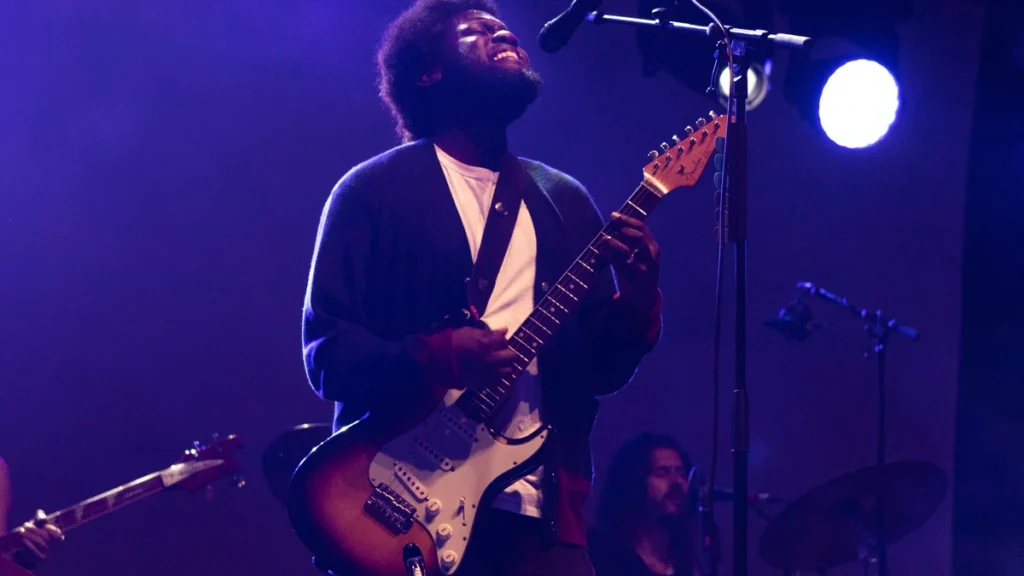
Michael Kiwanuka Built FUDGE in a Shack Outside Southampton

The session had gone nowhere. Michael Kiwanuka and his multi-instrumentalist Joe Connell had spent the day on songs that were already written, and none of them would come alive. So they stopped, had dinner, and came back to the little room near Kiwanuka’s home in Southampton with no plan except to play. What came out was “Love In My Heart”, a seven-minute song that unfolds slowly and, as the label’s notes put it, opens up like a flower.

“It felt moving to me,” Kiwanuka says in the notes that accompany the album. “I wanted to share it with other people. That was the eureka moment.” That jam became the centre of FUDGE, his fifth album, which Polydor releases on 23 October. It is the first time he has taken on production duties himself since his 2012 debut, Home Again, DIY reported, and it was made without his long-time collaborators Danger Mouse and Inflo.

The Hut Outside Southampton

The room matters to the story. Kiwanuka wanted somewhere he could drop into for an hour at a time and keep working without the weight of a big studio booking, and he found it in a one-room building not far from his house, built from cob, a rough-and-ready organic material. “It looks like a medieval hut,” he says. “I needed a creative ecosystem, so I could pop in and do an hour here and there and keep my creative brain awake.”

He spent his Mercury Prize money on a console and filled the room with equipment. The second thing he needed was a collaborator who could play the parts he could not, and he found one around the corner: Joe Connell, the multi-instrumentalist in his live band. “He can play anything. He’s a one-man machine,” Kiwanuka says. They named the studio Dreamers.

The results sounded bigger than the space. “It sounds like we’re in Capitol Studios on Vine Street, but we’re actually huddled in this shack outside Southampton,” he says of “Love In My Heart”. Many of the songs were recorded in single, flowing takes, and they ran longer than his usual writing, which is part of why the album feels loose and unhurried.

A Record Made Alongside Small Changes

FUDGE was never meant to be a separate project. It grew over three years in parallel with Small Changes, the 2024 album Michael Kiwanuka made with Danger Mouse and Inflo as the follow-up to his Mercury-winning 2019 record, KIWANUKA. With that album carrying the expectations, the heat was off the songs taking shape at Dreamers, which were looser and more stream-of-consciousness.

The two records fed each other. When Kiwanuka felt stuck on one, he could move to the other and come back refreshed, and the more he made, the more his confidence grew. It was a confidence he needed. “I’m always one step away from quitting,” he admits. “My brain’s always saying, ‘You can’t do it, you’re not good enough.'”

The push to keep going came from an unlikely place. Scrolling Instagram during lockdown, he found an interview with the late jazz pianist Chick Corea, part of which now opens the album: “You have to learn to be certain about what you like, not what you think sounds good to someone else… Whatever you think is beautiful, that’s what’s beautiful, and you have to pursue that.”

Working Without the Safety Net

Two songs frame the record and say out loud what it cost to make it this way. “Summer Clothes”, which started life as a contender for Small Changes, opens the album, and “Swings and Roundabouts” closes it. Both deal with his anxiety about working without the safety net of his long-time collaborators.

“It sounds like a break-up song,” Kiwanuka told NME of “Summer Clothes”. “It’s me knowing that the creative relationship I have isn’t going to last forever and I’m going to have find my own road. What do I do then? A lot of this record is working that out.”

The method was the point. “I had to do it differently from the last few records, otherwise there was no reason for this record,” he says. “At some point in each song there had to be outpouring of something that wasn’t overthought. It was almost like someone else was making it.” Even the title carries that spirit. “When I think of fudge it’s playful and childlike, which is good for creativity,” he says. “But also it’s a polite way to say I’m just going to do it.”

The Records Behind FUDGE

Michael Kiwanuka built the album around records that share its sense of play. The notes name the Beatles’ Rubber Soul, Neil Young’s On the Beach, whose winding guitar echoes through “You Sent Me Flying”, Frank Ocean’s Blonde (“It doesn’t make sense but it does”) and Shuggie Otis’s Inspiration Information. “That’s probably my favourite record of all time,” Kiwanuka says of the Otis album. “It sounds like a child’s mind in an adult.”

Some of the songs reach back a long way. “Stars”, with its fuzz guitar solos, was first recorded as he came out of the crisis of confidence that followed Home Again, and its lyric names that loss directly: “When I played I used to feel / Now I don’t feel a thing.” “I remember in school music always seemed to make sense,” he says. “And then suddenly when it became a job it wasn’t making sense. My love for playing guitar disappeared for a while.”

Others are written for people close to him. “Drowning in Your Heart” calls back to his teenage love of Elliott Smith, a song for someone “so sad they’ll sabotage everything”. “Across the Sky” takes the slow-burning reputation of Inspiration Information as its theme, and “Sing” addresses his own doubts about whether to keep making music. “It really does make me feel alive to make music and to sing,” he says.

From Dreamers to the Finished Record

When the songs were ready to leave the hut, Kiwanuka took them to the producer Dom Monks, who has worked with Laura Marling and Big Thief, and to his long-standing string arranger Rosie Danvers, known for her work with Coldplay and Adele, to record what he calls “the posh stuff”. Some string arrangements were recorded at Dreamers itself by Henry Rankin and Harry Fausing Smith’s string quartet. The album was recorded in Southampton and Frome, according to the label.

The look is new too. The artwork, which the label calls a whole new look, comes from Kiwanuka’s old friend Stevie Gee, an award-winning illustrator and animator, whose psychedelic cartoon of bright, smiling faces matches the album’s playful spirit. The full tracklist runs: “Summer Clothes”, “California”, “Just Another Moment”, “Drowning In Your Heart”, “Love In My Heart”, “Across The Sky”, “Stars”, “You Sent Me Flying”, “Move In My Direction”, “Steve’s Paradise”, “Sing” and “Swings And Roundabouts”.

Why FUDGE Is Arriving Now

FUDGE was finished before Michael Kiwanuka fell ill, and its release was held back for almost a year. On 23 September he told fans on Instagram that he had suffered a stroke a few months earlier, after a bleed on his brain brought on by high blood pressure, and that the resulting injury was “quite severe”. He said he still faces significant rehabilitation before he can think about touring again. “It’s a long, tough journey ahead but I’m fighting to get better,” he wrote, according to NME.

The news explains why he cancelled his remaining live shows in the summer of 2025, including festival slots at All Together Now, Sziget, Pukkelpop, We Out Here and Victorious, and a run of North American dates supporting Mumford & Sons. His live commitments remain on hold indefinitely, but the album is coming out with his blessing and his pride in it.

Kiwanuka is not the only artist to find a sound in an unlikely room this season; we wrote recently that Olivia Dean found a house where no music had been made. FUDGE carries its hut with it. Kiwanuka ends his notes by going back to Chick Corea’s advice. “You’ve got to keep following your nose. Sometimes it doesn’t make sense,” he says, smiling, “but it will.”

Leon Bridges Finished Half of Happiness Anytime in Four Days

Leon Bridges

The first song arrived before the instrumental was finished. In April 2025, Josh Lloyd-Watson and Lydia Kitto of the British group Jungle played Leon Bridges a skeletal track built around a Wurlitzer chord progression and a relaxed drum pattern, and he started singing as soon as it began. “Straight away he sang the first bit to ‘Your Love Is Electric,'” Lloyd-Watson recalls in notes released with the album. “And I’m like, ‘Whoo, let’s go. This is it.'”

Four days later, the three of them had six songs, half of the finished record. Happiness Anytime, the fifth studio album from Leon Bridges, is out today on Columbia Records: twelve tracks that the Fort Worth singer describes as being about “cultivating pockets of happiness”.

A Writing Session With One Rule

The collaboration grew out of chance meetings. Bridges and the Jungle pair kept crossing paths at festivals and shows, including one in Copenhagen, before deciding to try a low-pressure writing session in Los Angeles. “I always just loved their dance-y vibe, and I felt they were ideal collaborators,” Bridges told an interviewer in a conversation published by Yahoo last week.

The sessions ran on a simple rule. “We aren’t leaving until we have a full track at the end of the day,” Lloyd-Watson says in the album notes reported by BroadwayWorld. “We didn’t want to have, ‘We’ll come back to this tomorrow.’ We wanted fully finished tracks.” He puts the thinking behind it plainly: “First thought is the best thought. That’s where the emotion is.”

Bridges remembers the process as a release. “It was the most freeing experience of creating music,” he said. “We built everything on drum loops and we’d just pass the guitar around until we landed on something cool.” He is quick to credit his co-producer’s voice as well: “Lydia, man, her vocals, in my opinion, really carry a lot of these songs.”

Pino Palladino, Fela Kuti and a Party in Los Angeles

The record was completed across three fast sessions. When the trio reconvened in August 2025, they were drawing on Fela Kuti’s Afrobeat, Brazilian music, soul, disco and South American rhythms. “We’d been listening to a lot of South American music and Sergio Mendes,” Lloyd-Watson says. “We infused it with these Latin rhythms and African rhythms,” he says, aiming for “music that had groove and soul and feeling.”

They also brought in a player with a long reach: the bassist Pino Palladino, whose credits include D’Angelo and Adele, joined them at Chaplin Recording Studios in Los Angeles to complete the album. The label’s notes describe echoes of Fela Kuti, the wanderlust of Paul Simon’s The Rhythm of the Saints and the warmth of Jorge Ben, while insisting the record never feels referential.

For Bridges, the Fela thread started almost by accident. He told the interviewer he knew only a few of the Nigerian musician’s songs until he heard one at a GQ party at the Chateau Marmont, and it sparked more ideas. “What I do a lot is, when I hear instrumental stuff, I’ll start freestyling over it,” he said. That track, he explained, inspired songs like “Illusion” and the deeper, introspective side of the album.

Getting Back Out Front to Dance

The other goal was movement. Early in his career, Bridges was out in front dancing, something that had waned in recent years. “Leon said he wants to have music that he can dance to,” Kitto recalls. “He wants to have moments where he can put the guitar down and just dance and perform at the front.”

Dancing goes back a long way for him. He told the interviewer he fell for it at 11 or 12, practising his moonwalk after taping a Michael Jackson anniversary broadcast, and later danced with a company called Velocity while at Tarrant County College. “I’m always dancing, man,” he said. “I don’t really deem myself an amazing dancer. But I feel like I have my own style and expression.”

That has reshaped the live show. Bridges has been introducing the songs through Leon Bridges Presents Happiness Anytime, a reimagined stage production with a vinyl DJ, a horn section and three backing vocalists, inspired in part by the communal spirit of classic Jamaican dancehall culture. DIY reported that he previewed it in pop-up performances in Paris, Cannes, Los Angeles, at Montreux Jazz Festival and at London’s Jazz Cafe. Earlier this month he performed a medley of “Talk It Over”, “Light The Way” and “Illusion” on The Tonight Show Starring Jimmy Fallon, and “Watch You Dance” premiered on Apple Music 1 alongside an interview with Zane Lowe.

Why Happiness, and Why Now

Bridges is clear that the title is not a slogan about ignoring the world. “For me, happiness is not a feeling that you chase,” he said when the album was announced in July. “I want this album to be something that lingers with people and lingers in people’s bones. There’s this feeling that we have to fix the problems of the world; you feel inadequate or it can be debilitating. My role is to be light.”

He returned to the point in the Yahoo conversation. “It’s not [ignoring] issues of the world. Black people are no strangers to suffering and pain. But we’ve created the most beautiful art that’s come from our suffering,” he said. “If there’s chaos around, you can’t freak out or lose your cool. You gotta stand firm-rooted. That’s kind of what the album is for me.”

Some of the songs look back as well as forward. “Tears of Joy” is a thank-you, a song in which Bridges looks back at the years since his 2015 debut and imagines “10 more years of glory”. Lloyd-Watson hears it as a song about legacy: “What being on the road means. What you sacrifice to give this artistry to the world.” Kitto has the simplest explanation of the title: “It’s music you can put on no matter how you’re feeling, and it makes you feel happy and it makes you want to get up and dance.”

A Release in Three Parts

The album did not arrive all at once. Bridges released it in three instalments of four songs each, starting in July with “Light The Way”, “Tears of Joy”, “Illusion” and “Your Love Is Electric”, according to DIY, so eight of the twelve tracks were already out before today. The full tracklist runs: “Light The Way”, “Tears of Joy”, “Illusion”, “Your Love Is Electric”, “Talk It Over”, “Happiness Anytime”, “All Day, All Night” featuring Lydia Kitto, “Fly Baby”, “Watch You Dance”, “The Way It Goes”, “Take My Hand” and “Please Don’t Say Goodbye”.

Happiness Anytime follows Leon, his 2024 album, which Rated R&B notes debuted at No. 5 on Billboard’s Top R&B Albums chart. The label’s notes position the new record as a return to the warmth of his 2015 debut Coming Home, combined with the adventurous groove of his two collaborative albums with Khruangbin. Across his career, Bridges has earned six Grammy nominations and one win.

What Comes After the Record

Bridges, who is 37, is already thinking beyond his own songs. He told the interviewer his next goal is to help aspiring artists who lack resources. “I actually had this thought to put together a crew of house musicians, almost like a Muscle Shoals vibe,” he said. “Whoever wants to make cool stuff, let’s do it.”

Where a record gets made often shapes how it sounds, and it has been a theme on NewMusic.News this month, from Happiness Anytime’s quick sessions in Los Angeles to the way Olivia Dean found a house where no music had been made.

For Leon Bridges, home remains fixed. “Fort Worth is forever gonna be home,” he said. Happiness Anytime is the sound of him leaving it for a few days, passing a guitar around a room in Los Angeles, and coming back with a record built to move.

Olivia Dean Found a House Where No Music Had Been Made

The decision that shaped The Art of Loving was made before a note was written. Rather than book studio time, Olivia Dean and her collaborators found an ordinary house in East London, set a studio up inside it, and she moved in.

“No music had ever been made there before,” she told Numero. “We found a house and I lived in it for eight weeks… I needed to focus to imagine stories that felt honest and warm.”

Why an Empty House and Not a Studio

The detail that matters in that sentence is the first clause. A recording studio is a room with a history: other people’s sessions, other people’s habits, a house engineer with opinions, and a clock. Every decision made in one is made against the memory of what has worked there before.

A house with no musical past has none of that, and it also has none of the affordances. There is no live room, no isolation, no glass between the performer and the person listening. What you get instead is proximity and time, which are the two things a record about intimacy would actually need.

Living in it for eight weeks removes the other constraint. Studio time is billed and therefore rationed, and the rationing shapes the songs: you arrive with the idea already formed, because working it out on the clock is expensive. Moving in inverts that. The idea can be worked out at two in the afternoon or not at all that day, and nothing is lost either way.

The Record That Came Out of It

The Art of Loving is Dean’s second studio album, released in September 2025, following Messy in 2023. It moves along the line between traditional soul and pop, and it takes love as its subject in the widest available sense: romantic, platonic and self-directed, rather than only the first of those.

That breadth is the choice most second albums do not make. A follow-up to a well-received debut usually narrows, because the artist now knows which parts worked. Widening the definition of the subject instead is a decision to be less certain in public, and the house is where that decision became practical rather than theoretical.

Dean has described her writing as grounded in reality rather than fiction, and her songs as small portions of life. Born in 1999 in Haringey to a British father and a Jamaican-Guyanese mother, she grew up in Walthamstow surrounded by gospel music, and the arrangements carry that inheritance without imitating it.

What the Record Has Already Won

In February 2026 she won at both the Grammy Awards and the BRIT Awards. Two ceremonies in the same month, in two countries with different tastes, is an unusually clean result for a second album.

What that does to an artist’s next move is the interesting part. Awards create an expectation of continuity, and continuity is the enemy of the process described above. The method that produced this record depended on nobody knowing what it was going to be, including her.

The album also introduced a large young audience to a set of sounds it had not necessarily sought out. Marie Claire described the effect as bringing classic, romantic sounds to a generation that found them through streaming rather than through a parent’s record shelf.

The Long Route to a Second Album

Nothing about the path here was quick, which is part of why the house made sense. Dean has been writing since her teens; she has named a song called “Slowly”, written when she was sixteen, as the one that best captures her vulnerability, while pointing to “Carmen” as the more accomplished piece of craft.

That distinction, between the song that is most honest and the song that is best made, is the working problem of her whole catalogue. Soul is a form in which technical polish can quietly remove the thing the listener came for, and a singer who can hear the difference between the two spends a career managing the gap. A record made in a house is one answer to that problem: the arrangements can be careful without the performance becoming careful too.

She has also been candid about the limits of the studio as a social space. Describing a session in Los Angeles alongside far more established figures, she has said that being intimidated by another artist makes creativity difficult, that you freeze and cannot speak up, and that out of ten ideas offered, nine will be bad. The good one only arrives if the bad nine are survivable.

Read that alongside the eight weeks in an empty house and the logic closes. If most of the work of writing is producing material that will be discarded, then the single most valuable property of a room is that discarding costs nothing in it. No hourly rate, no engineer waiting, no other artist in the corner. Just the same four walls tomorrow.

A Second Mercury Nomination, and What It Is Up Against

The Art of Loving is on the Mercury Prize shortlist, the second time Dean has been nominated. The winner is announced on 22 October at the Utilita Arena in Newcastle, where the prize returns after Sam Fender won last year for People Watching.

NME’s rundown of the twelve albums shows what she is against: Paul McCartney on the shortlist for the first time, Dave returning after winning in 2019, Florence + The Machine nominated for a fourth time, RAYE back again, and the War Child charity compilation Help(2) among the nominees. Eligible albums had to be released by British or Irish artists between 30 August 2025 and 17 July 2026.

A second nomination reads differently from a first. The first says an artist has arrived; the second says the arrival was not a coincidence, and it puts a record in front of a jury that has already assessed the person who made it.

What the Method Costs

It would be easy to present the house as a straightforwardly better way to work, and it is not. Eight weeks living inside your own project is a long time to be unable to leave the job, and the absence of a clock removes the pressure that finishes records as often as it ruins them.

There is also the matter of what a house cannot do. Rooms built for recording exist because untreated domestic spaces are acoustically difficult: parallel walls, low ceilings, windows. Choosing one anyway means accepting a specific character in the sound and building the arrangements around it rather than fighting it. On a soul record that trade is usually worth making, because the genre rewards air and imperfection. On a different kind of record it would be a serious handicap.

Dean has spoken about the difficulty of being creative when intimidated, describing a Los Angeles session where nerves made it hard to contribute at all, and noting that most ideas offered in a room are bad ones on the way to a good one. That is the clearest argument for the house there is. A space with no history and no audience is a space where the nine bad ideas cost nothing.

What Happens After 22 October

Whether the Mercury goes to The Art of Loving or elsewhere, the more interesting question is what the third record does with the lesson of the second. The house was a solution to a specific problem: how to write honestly and warmly on demand. That problem does not go away, and the solution is not obviously repeatable, because the value of the room came partly from its being unfamiliar.

What can be carried forward is the principle underneath it, which is that the conditions of making are part of the writing rather than logistics arranged around it. Plenty of records are shaped by a room without anyone deciding it should be; this one was shaped by a room chosen on purpose. Records built around a single deliberate constraint tend to be the ones worth returning to, as with Markus Nokio, The Orphan and the violin that answers the piano.

The Mercury Prize winner is announced on 22 October at the Utilita Arena in Newcastle.

Leon Thomas Won Best R&B Album With a Record He Produced Himself

There is a moment in most producers’ careers where they stop giving the good idea away. Leon Thomas reached it late. He had spent two decades in the industry, much of it writing and producing for other people, and in 2024 he won a Grammy for production work on a single that carried somebody else’s name. Two years later he won Best R&B Album for Mutt, a record he made largely for himself.

The 68th Grammy Awards also nominated Mutt for Album of the Year, which is a different order of recognition. Best R&B Album is a genre prize; Album of the Year is a claim about the whole field. For a record released in September 2024 on EZMNY and Motown, arriving without a marketing campaign of the size those nominations usually imply, that is an unusual trajectory.

The Long Approach

Thomas was born in Brooklyn in 1993 and has been working since 2003. He started as a child actor on Broadway, appeared in The Lion King, then moved into television. The music came alongside, and for years it came mostly on other people’s records. He signed to EZMNY in 2022 and released his own debut, Electric Dusk, the following year, with Victoria Monet, Benny the Butcher and Ty Dolla $ign among its guests.

The acting was not a footnote either. He appeared on Nickelodeon’s Victorious and later on HBO’s Insecure, and his label history runs through Columbia and Rostrum before EZMNY and Motown. He is also a member of the group The Rascals. A career that scattered is usually a sign of someone searching for the right format; the interesting thing about Mutt is how settled it sounds by comparison, as though the searching finished somewhere before the recording started.

That is a twenty-year run-up to a breakthrough, and it shows in the record. Mutt does not sound like a first attempt at anything. The arrangements sit low and unhurried, the vocal is mixed close, and the writing assumes a listener who will stay for a whole album rather than a playlist placement. Those are choices made by someone who has watched a lot of records get built.

What the Album Actually Sounds Like

The palette is neo-soul with harder edges. Across fourteen tracks the record moves between the hushed and the abrasive, with hip-hop drum programming underneath and psychedelic textures at the corners. The Recording Academy’s own write-up reached for D’Angelo, Musiq Soulchild and Maxwell as reference points, which locates the vocal lineage accurately without quite capturing how much rock guitar is in it.

The guest list is used sparingly for a modern R&B album: Masego on Lucid Dreams, Wale on Feelings on Silent, Ty Dolla $ign on Far Fetched, Baby Rose on I Used To. Nine of the fourteen tracks have no feature at all. AllMusic gave it four stars out of five. The production credits run long, including James Fauntleroy, Conductor Williams, Aaron Paris and Khristopher Riddick-Tynes, with Thomas himself among them throughout.

The Title Track Did the Work

Mutt arrived as a single on 8 August 2024, seven weeks before the album, and it became the thing that carried the record. It reached number one on Billboard’s Hot R&B Songs chart, number one on Adult R&B Airplay and on the UK R&B singles chart, and climbed to 13 on the Hot 100. It is certified platinum in the United States.

The record also closes with a remix of the title track featuring Freddie Gibbs, which is a deliberate move: putting a rapper on the last version of the song that broke the album lets the project end by pointing outward rather than resolving inward. The album’s own chart performance was more modest: 35 on the Billboard 200, 8 on Top R&B/Hip-Hop Albums, 30 on the UK R&B albums chart, with a gold certification. That gap between a platinum single and a gold album is the ordinary shape of contemporary success, and it makes the Album of the Year nomination more striking rather than less. The voters were not following the sales.

A Deluxe That Changed the Argument

On 30 May 2025 he released Mutt Deluxe: Heel, adding nine tracks. Deluxe editions are usually a streaming-era manoeuvre, a way of restarting a release cycle with offcuts. This one behaved differently, bringing in Kehlani, Big Sean, Halle and Chris Brown and pushing further into rock textures than the original had.

It also extended the record’s life through the awards window, which matters. Two more singles came off the project long after release, Rather Be Alone in April 2025 and Yes It Is that September, a full year after the album. Sustaining a campaign across eighteen months is how a record that opened at 35 ends up nominated for Album of the Year.

The Producer Who Kept the Song

The 2024 production Grammy is the detail that reframes everything else. Winning as a producer establishes that the industry already trusted his ear; the people making the biggest R&B records were hiring him. What it did not establish was whether he could carry a record as the voice on it.

Plenty of successful producers never manage that transition, and the failure mode is predictable: an album that sounds expensively made and emotionally vacant, because the person assembling it is more comfortable solving problems than exposing anything. Mutt avoids that by being unusually direct about wanting things, being unsure, and behaving badly. The title is not flattering, and it is not meant to be.

The Tour That Sold Out

The Mutts Don’t Heel world tour sold out across the United States, and the live setting suits the material. This is a record built on musicians rather than sequencing, so the songs survive being played by a band without the arrangements thinning out. He has also worked the television circuit hard, from late-night appearances to a Tiny Desk session that became one of the most-watched entries in that series.

The rollout around it was relentless in a way that album campaigns rarely are two years after release: a Billboard Hip-Hop and R&B Power Players cover, MTV PUSH Artist of the Month in March 2025, a late-night debut, and performances of the deluxe material on network television. Recognition arrived in a run: Billboard’s Breakthrough Artist of the Year, Best New Artist at the 2025 BET Awards, then the Grammys. Best New Artist is a strange category to win at thirty-one after twenty-two years of work, and it says more about when an industry decides to notice someone than about when they started.

What It Signals for the Genre

Best R&B Album going to a self-produced record made cheaply, on a small imprint inside a major, is a useful marker. It sits alongside a broader pattern of artists taking ownership of the apparatus around their music rather than only the music, in the same way Igor Levit has just launched his own label from inside a major classical company.

What makes Thomas’s version interesting is that he had the production credentials first and the platform second, which is the reverse of the usual order. Most artists reach for control after success. He had the skills the whole time and spent twenty years applying them to other people’s records before making the one with his name on it.

Michael Kiwanuka Made Small Changes by Not Trying to Prove Anything

There is a particular problem that arrives after an album wins something. The next record has to answer it, and the usual answer is more: more production, more ideas, more evidence that the win was deserved.

Michael Kiwanuka went the other way, and was unusually explicit about why. “I wonder what an album will sound like when we’re not trying to be cool or anything, you know, we’re not trying to prove anything,” he told The Current. Small Changes is the record that came out of taking that question seriously.

What He Was Reacting Against Was His Own Record

Small Changes arrived on 22 November 2024 through Polydor and Interscope: eleven tracks, forty minutes and eighteen seconds, filed as psychedelic soul.

The album it is answering is Kiwanuka, which won the Mercury Prize, and his diagnosis of it is candid. “The production became, especially on Kiwanuka, like really, really relayed with so many ideas and so many sounds,” he said. He put both that record and 2016’s Love & Hate in the same category: “I definitely was in a different space of trying to prove a lot of things as an artist.”

Artists rarely say this about work that succeeded. Describing a prize-winning album as over-furnished is a real risk, and it only makes sense if the follow-up genuinely commits to the opposite. “I sort of went back to that, which was like, for me the right time,” he said. “Strip everything away and find out what it actually is.”

It is worth being precise about the record he is measuring himself against, because the modesty could read as false. Kiwanuka won the Mercury Prize. Following that with a quieter album is not the safe option dressed up as bravery — it is the option that forfeits the obvious way to capitalise on a win, which is to give the audience a larger version of what it just rewarded.

The Same Producers, a Different Instruction

The interesting decision is that he did not change the team. Danger Mouse and Inflo co-produced Small Changes, as they had Kiwanuka, and as Danger Mouse had Love & Hate before that — a third consecutive collaboration.

Changing your sound by keeping your producers is harder than changing your producers. It means the difference has to come from instruction rather than from personnel, and there is nobody new to blame if it does not land.

Kiwanuka’s account of what he learned is about restraint on his own side as much as theirs. “I’ve learned quite a few things that makes the process even a bit easier,” he said. “Just do what you do, which actually is easier for everyone.” On Danger Mouse specifically: “You can just ask any question, and you know you’re gonna get, like, a really interesting answer, or something you’ve never really considered.”

The writing credits show how deep the partnership runs. Every track is credited to Kiwanuka with Brian Burton and Dean Josiah Cover — Danger Mouse and Inflo’s given names — except the closer, “Four Long Years”, written by Kiwanuka and Burton alone.

What Understated Actually Means Here

His description of the goal is specific: “a lot more understated” than Kiwanuka, and “more about the voice, more about my voice, and more about the lyrics”.

That is a mixing brief as much as a writing one. Putting a voice forward is not a matter of turning it up; it requires everything else to stop competing for the same frequencies and the same attention. The eleven tracks are correspondingly compact — “Live For Your Love” at 2:29, “Lowdown (Part II)” at 2:40 — with only “Four Long Years” and “One and Only” pushing past four and a half minutes.

The two-part “Lowdown” is the tell. Splitting an idea into Part I and Part II rather than developing it across one longer track is a decision to let a thing be what it is and then stop, which is precisely the discipline he says he was after.

The rollout matched the thesis. “Floating Parade” appeared on 10 July 2024, the two-part “Lowdown” on 12 September, and “The Rest of Me” on 3 October — three months of singles that arrive and stop, rather than a campaign building toward a reveal. Nothing about the sequence asks the listener to wait for a bigger moment.

Jimmy Jam Is Playing the Organ, and That Is Not a Cameo

The personnel list contains a detail that is easy to skim past. Jimmy Jam — half of Jam & Lewis, one of the most decorated producers in American pop — appears on this record as a session organist.

Kiwanuka is blunt about the scale of it: “All the Hammond you hear, other than maybe one song, is Jimmy Jam. He’s on essentially a lot of the record.”

Engaging a producer of that stature to play rather than to produce is an unusual inversion, and it fits the record’s logic. A Hammond part is a texture decision, and having one player make all of them is how an album gets a consistent character without layering.

He is not the only heavyweight in a supporting role. Pino Palladino plays bass, James Gadson drums, James Payne slide guitar; Rosie Danvers arranged the strings with Pete Anthony conducting, and six named backing vocalists appear. Kiwanuka himself plays acoustic, electric and bass guitar, drums, piano and Wurlitzer, with Inflo on drums, piano, keyboards, Rhodes and synthesiser.

Kiwanuka also plays a great deal of the record himself, which is the other half of the same idea. When the person who wrote the song is the one playing the Wurlitzer part, the arrangement decisions and the writing decisions stop being separate stages that need reconciling.

The Reception Was Warmer Than the Modesty Suggests

Stripping back is usually the move that costs an artist their reviews. It did not here.

The album took a Metacritic score of 83. The Observer gave it five stars and called it “an exquisite return”; DIY and Uncut both went to four and a half; The Independent, Mojo and NME to four; Clash and The Line of Best Fit to 8 out of 10, the latter calling it “a beautifully crafted return”. Pitchfork was the coolest of the majors at 7.0, and AllMusic sat at three and a half.

Commercially it reached number two in the UK and number one in Scotland, with number two in the Netherlands, five in Flanders, six in Switzerland, eleven in Germany and fifteen in Austria. Those are not the numbers of a retreat.

Why the Experiment Worked

The reason a record made with “nothing to prove” did not simply sound smaller is that the restraint was applied to the arrangement and not to the ambition.

Everything expensive is still present — a legendary rhythm section, real strings, a full choir of backing vocals. What changed is that those elements take turns instead of stacking. That is a harder record to make than a dense one, because every part left in has to justify itself against the silence it is displacing.

It is the same instinct as a stable studio partnership: fewer new variables, more attention to each one. Our piece on why guitar bands went back to tracking live covers a related move, from a different direction.

Small Changes is out now.

Ambiguous Desire Rebuilds Arlo Parks Around a New York Dancefloor

There is a particular kind of record an artist makes when the thing they were known for stops fitting. Arlo Parks built a career on proximity: songs that sounded like they were being said to one person, close enough to hear the breath. Ambiguous Desire, released on 3 April 2026 through Transgressive Records, is what happened when she stopped writing for a bedroom and started writing for a room with a soundsystem in it.

Twelve tracks, forty minutes and one second, and a set of credits that looks nothing like her first two albums. It is not a reinvention in the marketing sense, where an artist puts on a costume and calls it a chapter. It is more specific and more interesting than that: a songwriter working out what happens to her actual technique when the tempo doubles and the room gets louder.

What Changed Between My Soft Machine and This Record

My Soft Machine arrived in 2023 and stayed close to the template that made Collapsed in Sunbeams work. The vocal sat forward, the arrangements deferred to it, and the emotional register was confessional in the literal sense: someone telling you a thing they had not told many people.

Ambiguous Desire keeps the writing and moves everything underneath it. The first two singles set the terms early. Ticketmaster’s tour announcement noted that “Heaven” and “2SIDED” both lean into house music and UK garage, sounds Parks reached for after immersing herself in club culture. That is a real structural change, not a texture. House and garage put the vocal in a different relationship to the track: it stops being the thing everything else supports and becomes one element inside a groove that would keep going without it.

You can hear the consequence across the record. Phrases get shorter. Lines repeat where they would previously have developed. The writing has to survive being looped, which is a different discipline from writing something that only has to land once.

The Break-Up That Sent Her to the Club

The turn was personal before it was musical, and Parks has been unusually direct about the sequence. “I danced more than ever as I made this record, I made more friends than ever too, found myself in the weird underbelly of New York juke nights,” she said in the tour announcement.

That detail matters more than it looks. Dance records made by non-dance artists often fail because the writer treats the club as an aesthetic rather than a place they have actually stood in at three in the morning. Parks describes going repeatedly, socially, over a period long enough for it to change what she found interesting. The record reads as reportage from somewhere she had been, rather than a genre exercise assembled from references.

She has framed the album’s organising idea in the same plain terms: “This record has desire at its center. Desire is a life force, it’s a wanting, a yearning, a momentum.” Momentum is the operative word. It is a description of a feeling and a description of a rhythm section, and on this album those are the same claim.

Eight Producers, and Why That Is Not a Warning Sign

The credits list eight producers: Parks herself, alongside Paul Epworth, Rob Bisel, Andrew Sarlo, Buddy Ross, Romil Hemnani, Baird and Dylan Neustadter. On paper that is the shape of a record made by committee, the kind of album where a label throws names at a problem until something sticks.

It does not play that way, and the reason is in the rest of the credits. David Wrench mixed the album, and a single mixer across twelve tracks is what stops a multi-producer record from sounding like a compilation. Wrench is the continuity: whatever came in from whichever room, it leaves through one set of decisions about space and low end.

Epworth also appears as a musician rather than only a producer, credited with guitar, synthesiser, drums and bass, which suggests sessions where things were played rather than assembled. Simon Martinez plays guitar, Ryan Raines drums, and Brad Oberhofer piano. That is a band’s worth of human performance sitting underneath music that could easily have been programmed end to end.

How the Singles Mapped the Turn

The rollout was unusually long and unusually deliberate. “2Sided” came first on 13 January 2026, followed by “Heaven” on 2 February, “Get Go” on 10 March and “Beams” on 31 March, three days before the album. “Senses”, the Sampha collaboration, followed on 22 May, and a “Floette” remix with John Glacier arrived on 4 August.

Read in order, that sequence is an argument. The two most club-facing tracks went first, which is the opposite of the cautious approach, where an artist leads with the song closest to what audiences already expect. Parks led with the change. By the time the album arrived, anyone who had been paying attention had already decided how they felt about the new tempo.

The Sampha feature landing seven weeks after release is the other tell. A guest of that profile is normally spent on launch week. Holding it back suggests confidence that the record could open on its own terms.

What the Reviews Actually Split On

Critical response was warm without being unanimous, which is usually what an interesting record produces. Metacritic settled at 77 from a spread that ran from Hot Press at 9/10 and DIY at four and a half stars down to Paste at B-. Pitchfork landed at 7.1, Clash and Exclaim! both at 8/10, and The Independent and Rolling Stone UK at four stars.

The commercial picture was similarly split by category rather than by quality. The album reached number 13 on the UK albums chart, which is respectable rather than dominant, and number one on the UK independent albums chart, which is the number that actually describes its position. It also charted in Scotland at four, Germany at 43 and Switzerland at 50.

A number 13 peak alongside an independent number one is the signature of a record with a committed audience rather than a passive one, and that is the audience a tour of this length is built for.

The Desire Tour Puts the Record in the Room It Came From

The North American leg opens on 29 August at The Howard Theatre in Washington, D.C., then runs through Philadelphia, Boston, Montreal, Toronto, Detroit, Dallas, Austin, San Diego, Los Angeles, San Francisco, Seattle, Vancouver, Portland, Salt Lake City, Denver and Chicago, closing at Knockdown Center in Queens on 1 October. The UK and Ireland follow, with O2 Academy Brixton on 20 October, and Europe carries it to Stockholm on 2 December.

The venues are the point. These are mid-size rooms with proper soundsystems rather than seated theatres, and a record built on low end and repetition needs the former. Parks’ own framing of the tour was characteristically unfussy: “Let’s laugh, cry and move our bodies.”

What will be worth watching is the older material. A catalogue written for close listening has to survive a set built around a four-to-the-floor spine, and the usual solution is rearrangement rather than omission. It is the same problem, viewed from the other end, as the one this album set itself: how a voice trained for intimacy holds its shape at volume. Readers curious about how that voice gets constructed in the first place may find our piece on how a pop vocal actually gets built a useful companion.

Ambiguous Desire is out now on Transgressive Records. The Desire Tour runs from 29 August to 2 December.

Yaya Bey Built Fidelity Around Three Deaths and One Miami Hotel Room

Most records that get described as personal are personal in a vague way: a mood, a break-up, a season the writer will not name. Fidelity is personal in the way a witness statement is personal. Yaya Bey can tell you the room it started in.

The album arrived on 17 April 2026 through Drink Sum Wtr, sixteen tracks, and it exists because of what happened the week her previous one came out. In the album’s own notes, the Queens songwriter describes being on the road in a Miami hotel room, crying uncontrollably, while do it afraid collected the reviews she had wanted.

The Hotel Room Where the Record Started

What she identified in that room was not exhaustion, though she was exhausted. It was a structural problem with being a grieving person whose job is to be looked at.

“There was no place for that grief to exist that would not become a spectacle,” she has said of the moment. “I had been holding it in. Maybe, to protect myself. Maybe to prove the onlookers wrong. Whatever the case, it was spilling over now.”

That is a more specific complaint than burnout. An artist who writes about loss and is then received entirely through loss ends up in a loop: the more honestly the work lands, the more firmly the audience fixes them in the worst year of their life. do it afraid had been an attempt to move past grief as a subject. It was read as grief anyway.

The question she says followed was sharper than self-pity: “what part of that ache is specifically Black?” She went back into the studio after the summer, and Fidelity is what came out.

Three Deaths, and Why She Named Them

The record is organised around a framework Bey states outright rather than leaving for critics to infer. She calls them the Three Deaths: the personal, the communal, and the loss of innocence.

Naming your own structure is a risk. It invites the reader to check the work against the schema and find it wanting, and it forfeits the ambiguity most songwriters protect. It also does something useful: it stops the album being flattened into “sad record about her dad”, which is exactly the reduction that sent her to the studio.

The communal death is the one that will surprise anyone expecting a straightforward bereavement album. Bey uses it to chart the displacement of native New Yorkers and the fracture of the Black diaspora, from the gentrification of her native Queens and Brooklyn’s Bed-Stuy to what she calls the “diaspora wars” online. She is critical of the rise of Black capitalism, of an “individualism and tribalism” she sees replacing community solidarity.

The third, the death of innocence, is generational: a crash back to reality for people raised on the promises of the 1990s and Y2K, landing instead in pandemics, state violence and an industry she describes as exploiting and disposing of Black artists it once held in high esteem.

What Grand Daddy I.U. Left Her

The personal death is her father. Bey is the daughter of Grand Daddy I.U., the Juice Crew MC, who died in 2022.

That lineage matters to how this record sounds and not only to what it is about. She grew up adjacent to a canonical hip-hop institution, and the album’s willingness to move between rapping and singing reads less like genre tourism than like someone using both of the languages she was raised in. AllMusic files it as alternative rap alongside alternative and contemporary R&B, which is an unusually honest set of tags for a record that genuinely sits between them.

Bey turns the private loss into a question about the industry that surrounded him. She asks why the life expectancy of Black musicians is so short, why consequential artists receive their flowers too late, and why so many are left at the mid-career mark by a system that prefers the “shiny and new”. Her formulation is the sharpest line in the album’s notes: “Why are we more interesting as ghosts?”

Blue Is a Song She Wrote at Rock Bottom

“Blue” was the lead single and, she says, the first song written for the album. Her account of it is unusually specific about craft.

“I wrote it when I was rock bottom coming off the heels of do it afraid,” she has said. “When I realized I had to make a big shift mentally and emotionally or I was gonna drown. The production is really reminiscent of early 2000’s Pop/R&B like something red-haired Kelly Rowland would sing over on one of her solo projects. The nostalgia drew me to it. Almost like I’m coaching my younger self through something. Which I guess ultimately I am.”

That is a producer’s explanation as much as a songwriter’s. The choice of an early-2000s pop-R&B palette is not decoration; it is chosen because of who it addresses. The track sounds like the era she was young in, so the comfort is structural. It is a technique worth noting: using a period reference not for nostalgia’s own sake but as a way of speaking to a former self.

Forty Days, and the Arithmetic of Grieving

“Forty Days” carries the heaviest idea on the record and does it over disco-funk, which is the sort of pairing that fails far more often than it works.

Bey explains the title plainly. “There’s a belief that after a loved one dies you give them 40 days to pass over into the ancestral realm and that got me thinking about what is the time frame for the grieving to transition into a new life that is absent of the lost one’s physical presence. How do both acclimate to new conditions of the relationship?”

The song treats mourning as a process with a duration rather than a permanent condition, which is why the buoyancy is not a contradiction. Grief with an end date can be danced to.

The album’s features work the same way, arriving as encounters rather than as strategy. Fellow Queens native NESTA appears on “Egyptian Musk” after what Bey describes as a chance meeting: “I ran into NESTA at an event the night before and invited him to a session. We had this really dreamy reggae track that sounds like something old with a fresh spin. I named it Egyptian Musk ’cause it reminds me of the scent. Rich, sweet and comforting.” Deem Spencer, Exaktly, Samantha G. and Anastasia Antoinette also appear, a guest list assembled from proximity rather than from reach, which is the opposite of how features usually get used. Readers interested in that shift may want our piece on how features became a career strategy.

Fidelity as a Skill Rather Than a Feeling

The title is doing more work than it looks. Bey defines fidelity not as faithfulness to a person but as what she calls the ultimate Black skill: the ability to fall down and get back up, to be “religiously joyful” while the world is on fire.

Framed that way, the album is a deliberate turn away from mainstream accessibility and toward what she describes as a radical faithfulness to self and community. That is a commercially inconvenient position to take in public, and taking it in the album notes rather than in an interview means it cannot be walked back.

It also resolves the problem she started with. A record about grief that is organised as a set of arguments, with named structures and stated politics, is much harder to reduce to a sob story. She has made the spectacle difficult to perform. On the evidence of Fidelity, that was the point.

Fidelity is out now on Drink Sum Wtr.

Flo Moved Their Album for Vocal Cord Surgery and Still Debuted at Five

On 30 June, six weeks after announcing their second album, Flo told their audience it would not arrive when they had said. The reason was not a mix, a sample clearance or a label calendar. One of the three singers needed surgery on her vocal cords.

Jorja Douglas’s operation moved Therapy at the Club from 24 July to 7 August. The record still opened at number five in the UK.

A Delay Announced Rather Than Disguised

Two weeks is a small move in absolute terms and a significant one in practice. An album release is a chain of bookings — press, radio, television, retail, playlists — and shifting the centre of it forces every link to be renegotiated.

What Flo did with the gap is the interesting part. Rather than let the original date pass in silence, they released their third single, “Remedied”, on 24 July, keeping the campaign alive through the fortnight the album was not there. The delay also bought the promotional run more room, which the group said openly was part of the reasoning.

Stating a medical reason publicly is not the default. The safer move is a vague note about wanting more time, because a singer’s voice is her livelihood and any suggestion of damage to it invites speculation about the future. Naming the surgery closed that speculation down instead of feeding it.

The Chart Result Made It a Footnote

The album entered the UK chart at number five. That placed Flo as the first British R&B girl group to debut both of their first two studio albums inside the top five, following Access All Areas, which reached the top three in November 2024 and also gave the group their first entry on the Billboard 200.

That debut had already brought a Grammy nomination, for Best Progressive R&B Album at the 68th Annual Grammy Awards, which went to Durand Bernarr. An “unlocked” edition of the record followed, adding “Recently Deleted”, “Do Too Much”, “Say Less” and “Conceited”.

A second album debuting close to the first is a harder result than it sounds. The audience that arrives for a debut is partly curiosity, and holding it through a second cycle is what separates a group with a career from a group with a moment.

The Album Started on a Twitch Stream

Flo formed in 2019 and built their audience through two EPs, The Lead in 2022 and 3 of Us in 2023, before the debut album. Writing for the second began soon after the 2025 Access All Areas Tour, which Douglas told Elle was deliberate: the group had come off a long cycle feeling out of practice, and starting early kept the pressure low.

The first public sign of it came on 4 February 2026, when the group appeared on a Twitch stream with the rapper and streamer PlaqueBoyMax. They cut live vocals for “Pose” in his studio, Juicy J turned up on the same stream, and they previewed “Leak It” there, confirming a March release. An NPR Tiny Desk appearance followed, where they aired the title track and “Haterbooth” before either existed as a release.

Debuting album material on a rapper’s livestream and a public radio session, rather than through a magazine exclusive, is a distinctly current way to run a rollout, and it puts the songs in front of listeners in unfinished form.

The Producer Roster Changed Shape

The most telling credit on Therapy at the Club is an absence. MNEK, the collaborator who shaped much of Flo’s earlier sound, produced exactly one track here, “Call Me”. The rest is spread across an unusually wide roster, including Amy Allen, Julian Bunetta, Oak Felder, Pop Wansel and Tommy Brown, with writing from Amma and Sevyn Streeter among others.

Handing a signature sound to twenty-odd producers is a risk, and it is the standard route by which a distinctive group becomes a generic one. The counterweight, according to the group’s Billboard interview, was that they took more creative control themselves: Renée Downer framed the record as a reflection of who Flo are as artists and as women, with speaking up in the studio central to how it came together.

That is the trade being made. More rooms, more collaborators, but a firmer hand from the three people whose names are on the cover.

The move was deliberate and the references were specific. Speaking to Elle, the group named Ariana Grande, Beyoncé and Christina Aguilera as touchstones, with Douglas and Downer pointing to Grande’s Yours Truly and Dangerous Woman as models for moving into pop-R&B. Downer’s reasoning was practical: working with more pop collaborators, they wanted examples of artists who were genuinely good at R&B and still made popular music.

Stella Quaresma described the process to the BBC in similar terms, enjoying the chance to blend genres and make bigger songs. The influence shows in the comparisons critics reached for: “Remedied” was measured against Aguilera’s “Ain’t No Other Man” and Raye’s “Where Is My Husband!”, both records that use live horns to do the lifting.

What the Title Actually Means

The album is pop and contemporary R&B, keeping the 2000s frame of the debut while pushing into jazz, acoustic, dance and synth-pop. It was recorded between July 2025 and January 2026 and runs to forty-six minutes.

The title came from the song rather than the other way round. Amma, who co-wrote for the debut, wrote the title track — a slow piano ballad closer to 1960s girl groups than to anything a club would play — and the group took the phrase from there.

Speaking to Zane Lowe, Douglas explained that “club” points at feeling rather than genre. “You don’t necessarily hear the riffs and runs in the club,” she said. “It’s more just about the emotions that we feel in the club.” Read that way, the record is a breakup album that happens to be set on a night out.

The Songs Range Wider Than the Concept Suggests

The sequencing bears that out. “Side Effects” opens with melodic rap over an R&B base, using drug side effects as a figure for the consequences of love. “Small Doses” turns synth-pop, drawing comparisons to “Unholy”. “Cry Ugly” is a 2000s R&B ballad with a syncopated groove that runs straight into the lead single.

“Leak It” is the clearest departure — an uptempo 2000s pop record that critics measured against Girls Aloud, the Pussycat Dolls and Sugababes rather than any R&B reference. Elsewhere “Pose”, featuring Juicy J, interpolates Technotronic’s “Pump Up the Jam”; “I Can’t Be High Around You Anymore” samples Bone Thugs-n-Harmony’s “1st of tha Month”; and Kwn appears on “Sex in Peace”.

It closes on “Haterbooth”, a doo-wop-inflected pop song that Clash called a Motown-inspired reverie, and which Downer has named as her favourite for being the strangest thing on the record.

Why This Campaign Is Worth Noting

Groups delay albums constantly, and the reasons given are usually unfalsifiable. What makes this one worth recording is the sequence: a specific medical cause, named; a substitute release on the original date so the audience got something; and a chart result that suggests none of it cost them.

It also sits against a wider pattern, where the pressure on a second album is to consolidate quickly and the temptation is to hide anything that looks like a setback. Flo did the opposite, and the top-five debut is the strongest available argument that being straightforward about it carried no penalty. Our piece on what release day means now looks at how much that date still governs a campaign.

Therapy at the Club is out now on EMI.