Month: August 2026

Andrea Bocelli Made a Christmas Album With His Children

Virginia Bocelli was ten years old when she took a solo on her father’s Christmas album. The track is When Christmas Comes To Town, from The Polar Express, and it sits on a Decca release alongside her brother Matteo, then twenty-four, who sings I’ll Be Home For Christmas alone.

A Family Christmas came out on 22 October 2022, produced by Stephan Moccio, and was the first record Andrea Bocelli had made with his children. Thirteen tracks move between English and Italian and between solos, duets and trios, and it went on to be the best-selling Christmas album of that year.

What Is Actually on It

The repertoire is standard by design: Do You Hear What I Hear?, Feliz Navidad, Have Yourself A Merry Little Christmas, Joy To The World, Happy Xmas (War Is Over), and, less predictably, Over The Rainbow.

The inclusion of a song from The Wizard of Oz on a Christmas record is the kind of decision that only makes sense in a family context, where the selection is governed by what three people can sing together rather than by what belongs in a carol service. The same logic explains giving the ten-year-old a solo from a children’s film.

Moccio is a considered choice of producer. He is best known for co-writing Wrecking Ball and Earned It, which is a long way from Tuscan tenor repertoire, and the result is a record that sits closer to contemporary pop production than Bocelli’s classical work does.

How It Performed

It reached number one in Ireland in the week of 23 December 2022 and twenty-two on the Billboard 200, where it spent five weeks across that December and the following January. Those are not spectacular chart positions, and they still made it the year’s best-selling Christmas album, which says something about how thinly that market is spread across a very large number of releases.

A thirty-seven-minute documentary film accompanied it, shot at Castel Savoia in Italy. A Disney+ short with The Simpsons followed on 15 December 2022, and the 2023 deluxe edition expanded the album to twenty-two tracks with nine additions, including that Simpsons collaboration and one with Pentatonix.

Recording with Pentatonix, who now book twenty-eight arenas for six weeks of Christmas every year, is a fairly precise indication of which market the deluxe edition was aimed at. The two acts occupy the same December territory from opposite ends: one an a cappella group built entirely for the season, the other an opera tenor who visits it.

Putting a Child on a Major Label Album

Giving a ten-year-old a solo track on a Decca release is a decision worth examining, because the obvious version of it would be indefensible. A child’s voice on a commercial record is usually either a novelty or a liability, and the industry has a poor history in both directions.

What makes it work here is the choice of song. When Christmas Comes To Town was written to be sung by a child in an animated film; it sits in a comfortable range and asks for nothing a young singer cannot deliver honestly. Nobody is being asked to perform beyond their means, which is the difference between including a child and exploiting one.

Matteo’s position is entirely different. He was twenty-four, already recording under his own name, and a solo on his father’s album functions as a professional credit rather than a family cameo. The album therefore does two separate things at once: it introduces one child and it platforms another.

Where He Came From

Bocelli was born in Lajatico in Tuscany in 1958 with congenital glaucoma, and lost his sight completely at twelve after being hit in the eye during a football match. He began piano at six and went on to learn flute, saxophone, trumpet, trombone, guitar and drums.

He studied law at Pisa and briefly worked as a court-appointed lawyer, singing in piano bars in the evenings for money. The break came in 1994 when he won the newcomers’ section at Sanremo, followed in 1996 by Time to Say Goodbye with Sarah Brightman.

Romanza arrived in 1997 and became one of the best-selling albums ever made. He has since sold more than ninety million records, and Sacred Arias is the biggest-selling classical album by any solo artist. Sì, in 2019, went to number one in both Britain and the United States.

Thirty Years of Romanza

The current tour marks that album’s thirtieth anniversary and is unusually long. It opened in North America in February 2026 with Columbus, Hollywood in Florida, Tampa, Raleigh, Birmingham, Nashville and Chicago, the Nashville date shared with Michael W. Smith and Lauren Daigle.

European summer dates take in Piazza San Marco in Venice in June, Gdansk and the PGE Narodowy in Warsaw in August, and the Ernst-Happel-Stadion in Vienna. A second American leg in September runs from Seattle down the west coast to two nights at the Hollywood Bowl and two at Red Rocks.

Then, in December, the tour becomes a Christmas run in all but name: Boston on the tenth, Buffalo, Montreal, two nights at Madison Square Garden on the sixteenth and seventeenth, Hamilton, Pittsburgh and Philadelphia on the twenty-second.

He also sang at the opening ceremony of the Milano Cortina Winter Olympics at the San Siro on 6 February, which is the kind of booking that follows from having spent three decades as the most recognisable classical voice in the world.

The venue mix across the year is the interesting part. Piazza San Marco and Red Rocks are open-air spaces chosen for their setting; the United Center and Madison Square Garden are chosen for capacity; the Hollywood Bowl manages both. Very few artists can move between a Venetian square and an American ice-hockey arena within a single tour without one of them feeling wrong, and the reason he can is that the show travels with an orchestra rather than a band.

The December Business

Eight arena dates in the twelve days before Christmas is a deliberate structure, and it explains why a family Christmas album made sense commercially as well as personally. An artist who can fill Madison Square Garden twice in December has an annual seasonal audience whether or not he has a seasonal record, and having one converts that audience into sales.

It is the inverse of how the format usually works. Mariah Carey’s Christmas record created her December; Bocelli already had one and made the album to serve it. The children were presumably not a commercial calculation, but putting them on it is what gave the project a reason to exist beyond the calendar.

It also solves a succession problem that most classical crossover artists never address. A voice like his has a finite working life, and the audience that fills arenas in December has been following him for thirty years. Recording an album that introduces the next generation of the family, rather than simply announcing them separately, hands that audience over rather than hoping it transfers.

Whether it works is a question for the next decade. What is already clear is that a record made in a Tuscan castle with a ten-year-old singing a song from a Christmas film outsold every other holiday album released that year, which is not the outcome anybody would have predicted from the description.

Mariah Carey Waited Twenty-Five Years for a Number One

When All I Want for Christmas Is You came out on 29 October 1994, it could not enter the Billboard Hot 100. The chart at that time required a commercially available physical single, and Columbia did not release one. The biggest holiday record of the modern era was, by the rules then in force, ineligible.

It first appeared on the Hot 100 in January 2000, at number eighty-three. It reached number one on 21 December 2019, twenty-five years after release, which is the longest climb to the top the chart has ever recorded.

Twenty-Two Weeks at Number One

Since then it has returned every December. It topped the chart in every holiday season from 2019 to 2025 and has accumulated twenty-two weeks at number one as of January 2026, more than any other record in the history of the Hot 100. It is also the first song to reach number one across five separate chart runs.

The British trajectory was slower still. It spent seventy weeks in the top forty before finally reaching number one on 11 December 2020, twenty-six years after release, which is a UK record of its own. It first topped the Australian chart in December 2018 and the Canadian one in January 2019, having originally peaked at two in Australia.

On Billboard’s Holiday 100, which launched in 2011, it has spent seventy-one of the chart’s seventy-nine cumulative weeks at number one. In November 2021 it was formally ranked the greatest Holiday 100 song of all time. It also holds the longest run at number one in both Germany and Austria, at twenty-two and nineteen weeks respectively, and has topped charts in more than thirty countries.

What Changed Was the Rules

None of this reflects a change in the song. What changed was how charts count.

The physical-single requirement disappeared, download sales were incorporated, and then streaming was added and weighted. A record that is played enormously for six weeks a year but bought by almost nobody was invisible under the old system and dominant under the new one. The song did not climb to number one so much as the measurement finally caught up with the listening.

That makes it an unusually clean case study. Almost every other chart record is entangled with promotion, radio and release strategy. This one is a straightforward demonstration that the Hot 100 measures whatever it has decided to measure.

Recorded in August

Mariah Carey and Walter Afanasieff wrote and produced it, recording at The Hit Factory in New York in August 1994. Carey has described the session as amazing and unlike any other, and has said she is a festive person who has sung Christmas songs since she was a child.

Her brief for the album was practical: a balance between standard Christian hymns and fun songs, with at least a few new ones. Merry Christmas duly mixes Silent Night, O Holy Night, Joy to the World and Santa Claus Is Comin’ to Town with three originals, including Miss You Most (At Christmas Time) and Jesus Born on This Day, and pushes the arrangements toward soul and gospel rather than orchestral pop.

The reviews at the time were mixed. Jon Pareles objected to what he heard as narcissistic vocal display; Steve Morse thought it might be her best record and praised her cutting loose with unbridled soul.

Why the Song Itself Works

Chart mechanics explain the number one; they do not explain why anybody wanted to hear it two billion times. The construction does.

It runs on a wall-of-sound arrangement descended from Phil Spector’s Christmas records, with sleigh bells, piano triplets and layered backing vocals arriving in the first few seconds, which means the song identifies itself almost instantly. That matters enormously for seasonal music, where most listening happens in the background and a track has a second or two to register.

The lyric does something rarer. Almost every Christmas standard is about the occasion itself: snow, bells, home, family, a saint. This one uses the season only as a setting and spends its whole length rejecting all of it in favour of one person. That is closer to a pop love song than to a carol, which is why it works in contexts where Silent Night would not.

The vocal is also, deliberately, not the hardest thing Carey has ever sung. She is known for a five-octave range and the whistle register, and neither is the point here; the melody sits in a range most people can attempt, which is a significant part of why the record gets sung along to rather than merely played.

The Numbers Underneath

The album has sold eighteen million copies, the most of any holiday record by a female artist, and Billboard describes it as the most successful Christmas album of all time. It is certified diamond in the United States and sold 2.8 million copies in Japan alone, where it went to number one.

The song itself is eighteen times platinum in America, having become the first holiday record certified diamond in December 2021, and ten times platinum in the United Kingdom, where it is the highest-certified song by any female artist. It has sold over sixteen million copies, passed two billion Spotify streams, and in December 2022 became the first song to exceed twenty million streams there in a single day.

The Associated Press estimated its royalty earnings at around a hundred million dollars as of 2023. In the same year the Library of Congress added it to the National Recording Registry.

Why Nobody Has Repeated It

Carey is credited with changing what a Christmas album is for. Before Merry Christmas, the form was largely a late-career exercise for established singers; she made one at twenty-five, at the commercial peak of her run, and demonstrated that it could be a serious release rather than a contractual filler.

Every young artist who has since made a holiday record is working inside that precedent, and none has produced anything approaching the same result. The reason is partly that the canon has room for very few additions. The New Yorker called it one of the few worthy modern additions to the holiday canon, and the Guardian ranked it first among fifty Christmas songs while noting that it is a rare modern Christmas song that has become a standard.

The wider career context makes the point sharper. Carey has nineteen number ones on the Hot 100, more than any other solo artist, eighteen of them as a songwriter, and has spent a record hundred and one weeks at the top. Twenty-two of those weeks come from one song she wrote in her twenties about wanting nothing except a person.

The First of November

She now posts a video every 1 November marking the start of the season, which has itself become an annual news event. It is a small piece of scheduling that formalises what the charts already show: for six weeks a year this record is unavoidable, and for the other forty-six it is not.

That is precisely the arrangement Michael Bublé built into a sixteen-million-selling album two decades later, and his version of it includes a cover of this very song. The difference is that his record was designed for the seasonal cycle from the start. Hers created it, without anybody involved intending to.

Michael Bublé’s Christmas Album Keeps Returning to the Charts

In the first week of January 2012, Michael Bublé’s Christmas fell from number one on the Billboard 200 to number twenty-four. That remains the sixth-largest single-week drop from the top of that chart, and the explanation requires no analysis at all.

It is also the most instructive fact about the record. An album that can occupy the top of the American chart for five weeks and then become almost unsellable overnight is operating on a completely different commercial logic from everything around it, and fourteen years later it is still doing so.

Twenty Countries at Number One

Released in late October 2011 through 143 Records and Reprise, produced by David Foster, Bob Rock and Humberto Gatica, it went to number one in twenty countries: the United States, the United Kingdom, Canada, Australia, Germany, Italy, Ireland, the Netherlands, Austria, Denmark, Hungary, Iceland, Norway, Poland, Portugal, Sweden, Switzerland, Croatia and New Zealand among them.

In the United States it was the second best-selling album of 2011 on 2,452,000 copies, behind only Adele’s 21. Worldwide sales have passed sixteen million.

The certifications describe an unusually even global spread rather than one dominant market: six times platinum in the United States, eleven times platinum in the United Kingdom, diamond in Canada, double diamond in Australia, fourteen times platinum in New Zealand and eight times platinum in Italy. It is the best-selling holiday album Britain has ever had.

Six Separate Decembers at Number One in Australia

The recurrence is the part with no real precedent. It topped the ARIA albums chart in December 2011, 2012, 2013, 2014, 2016 and 2019, making it the first album to reach number one there on six separate occasions.

In Britain it became the first seasonal album to place inside the top ten in three consecutive years. It has re-entered charts every year from release through to 2024, and it finished the 2010s at number two on Australia’s decade-end chart, five in the United Kingdom and twenty-four in the United States. On the all-time American holiday albums chart it sits at number two.

An album that sells for six weeks a year for fourteen years accumulates figures that annual releases cannot match, and it does so without any of the promotional spending a new record requires.

Sixteen Tracks, One New Song

The construction is conservative by design. It’s Beginning to Look a Lot Like Christmas opens, followed by Santa Claus Is Comin’ to Town, Jingle Bells with The Puppini Sisters, White Christmas as a duet with Shania Twain, and versions of All I Want for Christmas Is You, A Holly Jolly Christmas, Santa Baby, Have Yourself a Merry Little Christmas, Christmas (Baby Please Come Home), Silent Night, Blue Christmas, I’ll Be Home for Christmas and Ave Maria.

Thalía joins for Mis Deseos and Feliz Navidad. A hidden track carries a spoken greeting. Only one song, Cold December Night, is new.

Fifteen standards and one original is a precise ratio. A holiday album succeeds by being familiar, and the single new song exists so the record has something of its own rather than to carry the release. Later editions added Winter Wonderland, Frosty the Snowman, Silver Bells with Naturally 7, and eventually a seven-track bonus disc for the tenth anniversary in 2021.

The one genuinely contentious decision was rewriting Santa Baby’s pronouns for a male singer, which produced Santa buddy, Santa pally and an instruction to wait up that has been widely mocked ever since.

Why This One and Not Another

Dozens of singers with comparable voices have made Christmas albums, and almost all of them sell for one season and disappear. The reasons this one persisted are mostly structural rather than musical.

The first is timing. It arrived in 2011, at the point where streaming was beginning to make seasonal playlists automatic, so an album already positioned as the default benefited from a distribution mechanism that had not existed for earlier Christmas records. The second is the production team: David Foster and Humberto Gatica had spent decades making exactly this kind of large, warm, orchestral pop, and the record sounds expensive in a way that survives repeated exposure.

The third is the least discussed. A Christmas album has to work as background. It is played in kitchens and shops and cars by people who are not listening to it, and anything demanding or idiosyncratic fails at that job. The relentless conservatism of the arrangements, which would be a criticism of any other record, is the specification being met.

What that produces is an unusual commercial object: an album with almost no critical standing that outsells nearly everything reviewed favourably in the same year, and then does it again annually for over a decade.

He Learned It From Bing Crosby

Bublé was born in Burnaby, British Columbia in 1975, and his interest in this music started at about five, when his family played Bing Crosby’s Christmas album. That is a direct line: the record that shaped him is the one his own record was eventually measured against.

His grandfather, Demetrio Santagà, traded plumbing work for stage time at local nightclubs so his sixteen-year-old grandson could sing. The break came in 2000 at Caroline Mulroney’s wedding, where he performed Mack the Knife and met David Foster, who signed him to 143 Records and later produced the Christmas album.

The Television Half

The album is inseparable from the specials that followed it. NBC broadcast A Michael Bublé Christmas in 2011, a third annual special in 2013 featuring Mariah Carey, Mary J. Blige and Queen Latifah, then Christmas in New York in 2014, Christmas in Hollywood in 2015 and Christmas in the City in 2021.

An annual television slot is what turns a seasonal album into an institution. Each broadcast reintroduces the record to an audience that was not shopping for it, which is precisely the mechanism behind those chart re-entries.

What He Does the Rest of the Year

Nine studio albums have sold more than seventy-five million records between them, and he has won five Grammys, all of them for Best Traditional Pop Vocal Album. His own touring is built around a thirty-six-piece orchestra on tiered staging, and the sixth tour ran to a hundred and fifty-one shows across four years.

He returns to the United Kingdom and Ireland between late June and early July 2026, playing outdoor venues, castles and estates, with a first Maltese date at Ta’ Qali National Park in July. Those are his only British and Irish shows of the year.

Playing castles in July and dominating December is a career shape almost nobody else has. It is a version of the arrangement Pentatonix have built by booking twenty-eight arenas for six weeks of Christmas, with one difference: their touring is the business, while Bublé’s Christmas record does the work whether he tours it or not.

He has also spent the past two years coaching on The Voice, winning with Sofronio Vasquez in his first season and Adam David in his second, which is the modern equivalent of the annual television special: a way of being visible to a large general audience without releasing anything.

All of which points at the same conclusion. The most valuable thing Michael Bublé owns is not a touring operation or a current single but a sixteen-track album of mostly other people’s songs, recorded in 2011, that a substantial part of the world has agreed to treat as furniture for one month a year.

Lang Lang Recorded Game Soundtracks for Piano Book 2

Somewhere across the two discs of Piano Book 2, between Bach and Satie, Lang Lang plays Rush E. That is a piece by Andrew Wrangell written to be effectively unplayable, a joke about virtuosity that circulated as an internet video before anybody attempted it seriously, and it is now on a Deutsche Grammophon release.

The album came out on 17 October 2025 and contains thirty-two pieces. The rest of the list is almost as unusual: Nobuo Uematsu’s music from Final Fantasy X, Yu-Peng Chen’s writing for Genshin Impact and Black Myth: Wukong, themes from Naruto, Amélie, La La Land and Cinema Paradiso, and a jazz standard associated with Thelonious Monk.

Where the Repertoire Came From

The selection method is the point. Lang Lang has said the pieces were chosen from messages sent by listeners, from school music syllabuses, from what he has learned teaching, and from works that matter to him personally. He calls the thirty-two miniature masterpieces.

School syllabuses are the giveaway. This is a record aimed squarely at people who are learning the instrument, which is why the limited CD edition carries an NFC chip linking to downloadable sheet music and tutorials, and why Faber Music is publishing a companion book with the scores, photographs and his commentary.

Very few artists at his level design an album around whether the audience can play it themselves. It reframes the release as a teaching object rather than a recital, and it explains the presence of pieces that no concert programme would touch.

Classical, Contemporary and a Game Composer

The traditional half of the album covers Bach, Mozart, Chopin, Liszt, Rachmaninoff, Satie and Debussy. The first single, released on 5 September 2025, was Liszt’s second Consolation, which is about as gentle an entry point to Liszt as exists.

The contemporary half runs through Ludovico Einaudi’s Fly, Joe Hisaishi’s Spring, and Tony Ann’s Icarus, the last in a new four-hands arrangement made for the album and premiered with the composer at the Beijing launch.

Yu-Peng Chen is the most interesting inclusion. He composes for Chinese games with enormous international audiences, and his music is heard by far more people than most living concert composers manage, almost entirely by players who would never describe themselves as classical listeners.

A Cartoon Started All of This

Lang Lang was born in Shenyang in 1982 to a Manchu family; his father, Lang Guoren, plays the erhu. He began lessons at three, having been set off by the Tom and Jerry episode The Cat Concerto, which is built around Liszt’s second Hungarian Rhapsody.

The Beijing launch event for Piano Book 2 featured an appearance by Tom and Jerry. That is a piece of promotional staging with an unusually direct justification: the cartoon is the reason there is a career to promote.

The rest of the training was conventional and difficult. At nine he was thrown out of his tutor’s studio for a supposed lack of talent. He continued with another teacher, studied under Zhao Ping-Guo at the Central Conservatory in Beijing, won the Xinghai National Piano Competition in 1993, and moved to the United States in 1997 to study with Gary Graffman at Curtis.

What Rush E Actually Is

It is worth being precise about the strangest thing on the album, because the joke only works if you know the setup. Rush E began as a demonstration of what music notation software will happily print but no pair of hands can execute: a cascade of notes at a density beyond human reach, produced to be watched as a scrolling video rather than performed.

It became a fixture of piano internet culture, and a genre of response videos grew around pianists attempting to play as much of it as physically possible. Recording it for a major classical label collapses that whole ecosystem into a single track, and it does so without any explanatory apparatus: it simply appears between pieces by composers who have been dead for a century.

There is a serious point buried in it. The virtuoso tradition Liszt invented was always partly about spectacle and the appearance of impossibility, and Rush E is that instinct running without a human performer at the centre. A pianist of Lang Lang’s standing playing it is a comment on his own tradition as much as on the internet.

The First One Did 1.2 Billion Streams

Piano Book, in 2019, has passed 1.2 billion streams and is among the most successful classical albums released this century. Lang Lang has more than four and a quarter million monthly listeners on Spotify, which is an order of magnitude beyond almost any other classical soloist.

Those numbers explain why Deutsche Grammophon would release a follow-up containing game music. An artist delivering that kind of audience earns the right to define what goes on the record, and the label’s calculation is presumably that the people who streamed the first one are not primarily concert-goers.

Two Labels and Back Again

He recorded for Telarc and Deutsche Grammophon early on, signed to Sony in 2010 for a reported three million dollars, and returned to Deutsche Grammophon under Universal in 2017. His Beethoven first and fourth concertos with the Orchestre de Paris went to number one on the traditional classical Billboard chart.

The institutional recognition has followed: Time named him among the hundred most influential people in 2009, Gramophone put him in its Hall of Fame in 2012, UNICEF made him a goodwill ambassador in 2004, and the United Nations named him a Messenger of Peace in 2013.

The Argument About Accessibility

Lang Lang has spent two decades being described as evangelical about widening the audience for classical music, and just as long being criticised for it. The Lang Lang International Music Foundation, launched in New York in October 2008, is the formal version of that project.

Piano Book 2 is the least ambiguous statement of the position he has made. Putting Final Fantasy and Chopin on the same release argues that the distinction between them is a matter of where a piece came from rather than what it is worth, and pairing it with sheet music makes the argument practical instead of rhetorical.

It is a different route to the same destination as Víkingur Ólafsson recording Bach in a studio under his house. Both are pianists with very large streaming audiences reorganising how the music reaches people: one by removing the recording studio’s formality, the other by removing the repertoire’s.

The counter-argument is the obvious one, that an album containing a viral internet piece is chasing attention rather than serving music. The response is in the track list. Rush E sits among Bach, Debussy and Rachmaninoff, played by somebody who could programme anything he wanted, and nothing about its inclusion prevents a listener from finding the Liszt.

The formats reinforce it. Two CDs, two LPs including a marbled vinyl edition, a score edition, signed art cards, and the NFC chip with the tutorials: this is a release designed to be bought in a physical form and then used. That is an odd strategy in 2025 and a coherent one for a record whose audience is expected to sit at an instrument afterwards.

Kacey Musgraves Opened an Arena Tour on Her Birthday

Kacey Musgraves turned the opening night of an arena tour into her own birthday party. The Middle of Nowhere Tour began at the United Center in Chicago on 21 August 2026, the day she was born, and runs for thirty-six dates ending at the OVO Arena Wembley on 26 February.

Between those two points sit two nights at Madison Square Garden, the Bridgestone Arena in Nashville, the Moody Center in Austin, Crypto.com Arena in Los Angeles and Climate Pledge Arena in Seattle, plus an Australian run at the Longhaul Festival in January and British dates in Glasgow and Manchester.

Eight Opening Acts

The support is unusually broad: Midland, Flatland Cavalry, Carter Faith, Charles Wesley Godwin, Estevie, William Beckmann, Gabriella Rose and The Brudi Brothers, rotating across the run.

Eight openers on a thirty-six date tour means the bill changes region by region, which is a deliberate way of using an arena headline slot. A single support act across a whole tour is cheaper and simpler; rotating eight of them turns the tour into a platform, and several of those names are considerably earlier in their careers than a Crypto.com Arena stage would normally allow.

The Album Takes in Zydeco

Middle of Nowhere, her seventh, arrived on 1 May 2026 through Lost Highway Records, a label relaunched the previous year. The stated range is country, pop, bluegrass, Zydeco and Norteño, which is wider than any of her previous records attempted.

The guest list follows the same logic. Willie Nelson and Miranda Lambert are country institutions from either side of her own generation. Billy Strings is the most technically formidable bluegrass player currently working. Gregory Alan Isakov comes from the quiet, folk end of Americana. Nobody on that list was chosen for streaming reach.

Zydeco and Norteño are the genuinely unusual inclusions. Both are regional American traditions with deep audiences and almost no presence on country radio, and reaching for them on an album that will be played in arenas is a choice that could easily have gone wrong.

The label matters as well. Lost Highway was the imprint that housed a particular strand of serious American roots music in the 2000s before being folded away, and relaunching it in 2025 was a statement about what kind of records it intended to release. Putting a seventh album by an artist of Musgraves’s commercial standing on a revived catalogue label, rather than on a major country division, tells you which audience the record was aimed at.

It also explains the album’s second single sharing the album’s title, a move that reads as confidence in the whole rather than in any individual track. An artist chasing radio picks the most obviously playable song; naming the single after the record signals that the album is the unit.

A Single About Being Bored

Dry Spell led the campaign on 11 March, produced by Musgraves with Daniel Tashian, Ian Fitchuk and Luke Laird. It is a comic song about romantic frustration built on a run of agricultural double meanings, with a chorus that gets to nobody’s tool up in my shed and nobody’s boots under my bed.

She trailed it by posting a question about whether it is possible to die of horniness, asking for a friend, which sets the register accurately. Consequence called the result boldly hilarious and self-aware; American Songwriter said it was full of the witty wordplay that made her famous; Pitchfork called it a playful confession of boredom; Billboard settled for humorous and twangy.

It reached fifty-five on the Hot 100, fifteen on Hot Country Songs and thirty-four on Country Airplay, and charted in Canada, the United Kingdom, New Zealand, Japan and across Europe. The video, co-directed with Hannah Lux Davis, sets her in a grocery store surrounded by visual innuendo.

Why the Radio Number Matters

The gap between fifteen on Hot Country Songs and thirty-four on Country Airplay is the whole story of her career in one comparison. The first chart counts streaming and sales; the second counts what programmers choose to play.

Musgraves has never been a country radio artist in the way her sales suggest she should be, and a comic single about not having sex was never going to change that. What she has instead is an audience that buys tickets, which is why the tour is in arenas regardless of the airplay position.

How the Route Is Built

The North American leg is paced unusually carefully for an arena run. Chicago on 21 August is followed by Toronto on the 24th, Boston at the end of the month and two nights at Madison Square Garden across 31 August and 1 September, then Philadelphia and Baltimore.

A gap follows before Minneapolis and Kansas City on 22 and 23 September, then Nashville and Atlanta at the end of that month, Austin and Dallas in the second week of October, Phoenix and Los Angeles the following week, and Oakland and Seattle to close on 26 and 27 October.

That is roughly two shows a week rather than the four or five a hard-touring act would attempt, with clear rest blocks built in. Spacing an arena tour that generously costs money in crew and venue holds, and it is the sort of schedule an artist sets when the priority is finishing the run in the same condition it started.

The overseas dates are separated by months rather than tacked on. Australia comes in late January, three Longhaul Festival appearances at the Melbourne, Sydney and Brisbane showgrounds on consecutive days, and the British leg follows a month later: Glasgow on 22 February, Manchester on the 24th and London on the 26th.

Three Shows Came Off the Calendar

On 26 July three dates were cancelled without explanation: Chicago on 20 August, Boston on 29 August and the Barclays Center in New York on 2 September. The Chicago cancellation is the interesting one, because it removed the night before the opener rather than a date buried in the run.

Dropping a Barclays Center show while keeping two nights at Madison Square Garden also suggests a routing adjustment rather than a demand problem, particularly since additional dates were added on 8 May because of demand after the tour was announced in April.

Where This Sits

Before August, the only thing on her calendar was three nights at Gruene Hall in New Braunfels, Texas, in early May. Gruene Hall is the oldest continuously operating dance hall in Texas and holds a few hundred people.

Playing three nights there and then opening an arena tour four months later is the same instinct behind Sierra Ferrell playing the State Fair of West Virginia between festival dates: an artist at arena scale deliberately keeping one foot in rooms that cannot possibly pay. Both will be at Bridgestone Arena in Nashville this autumn, from opposite ends of the bill.

What the two have in common beyond the venues is a refusal to let country radio define the ceiling. Neither is a mainstream airplay artist, both fill large rooms, and both did it by building an audience through records and live performance rather than through format. That is now a viable route to an arena, which it was not fifteen years ago, and the thirty-six dates on this tour are the clearest available proof of it.

Hilary Hahn Says Her Career Has a Future Again

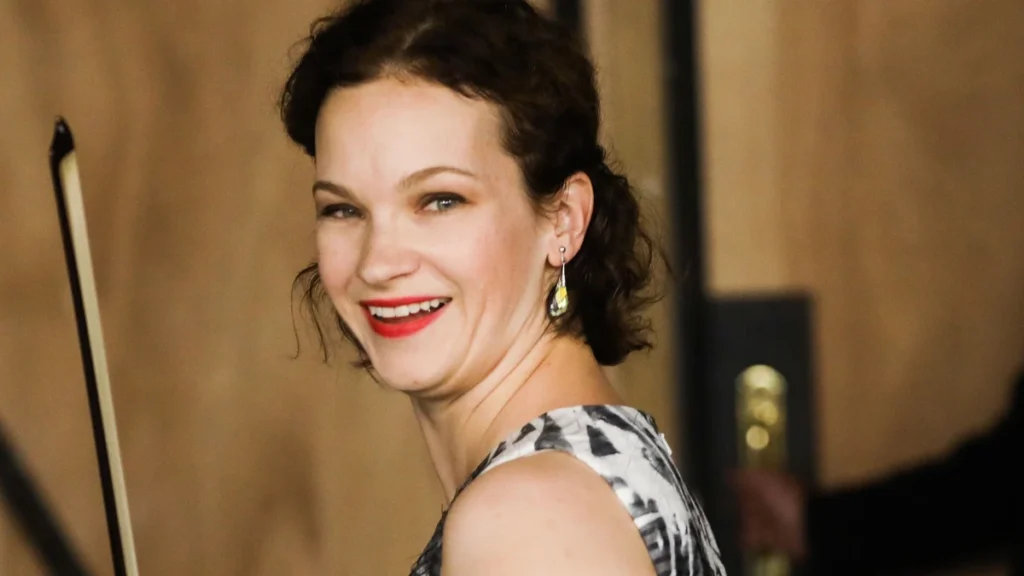
The sentence Hilary Hahn used, posting to her own audience in February, was not the one a publicist would have written. She is, she said, now the proud owner of an artificial disc. Her career has a future again, her neck has healthier alignment than before, and she is pain free.

That is the end of roughly two concert seasons of cancellations. It is also a reminder of something the violin repertoire never mentions, which is that the instrument is held between a jaw and a collarbone, and everything else depends on what is happening in the neck.

What the Two Years Looked Like

She withdrew from concerts from July 2024 with pinched nerves. In her own account the first herniation of a cervical disc, about eighteen months before the surgery, was debilitating: muscle atrophy alongside ongoing nerve stress. She recovered from that one without an operation and went back to work.

The return came in late February 2025 with the New York Philharmonic and the conductor Herbert Blomstedt, playing the Brahms Violin Concerto across four performances at David Geffen Hall, with Schubert’s sixth symphony completing the programme. She described it as a homecoming and called the orchestra family.

She was also explicit at the time that the schedule would be managed rather than resumed, saying she was taking a measured approach with adequate rest between concerts, and that this meant cancelling dates that had already been announced. Then, over the summer of 2025, the same disc herniated again and compressed nearly all of her remaining nerve space.

The Surgeon Who Played the Violin

At that point conservative treatment was no longer an option. The disc was replaced with an artificial one, and Hahn noted, in a detail that is either a coincidence or an extremely good piece of referral, that her surgeon used to play the violin.

It matters more than it sounds. A cervical fusion and a disc replacement produce different outcomes for range of motion, and a violinist needs a specific and unusual amount of lateral rotation and flexion to hold the instrument at all. A surgeon who has done it understands what the requirement actually is rather than treating the patient as a generic neck.

The Scarves

She has told audiences to expect scarves for a while, because she has a surgical scar on her neck she wants to protect both offstage and on. She added that it might be a style she keeps.

Announcing that in advance is a practical solution to a problem that only exists in performance. A soloist stands lit from the front for two hours in front of two thousand people; anything visible becomes a subject. Naming it first turns it into a wardrobe decision rather than a rumour.

What She Is Rebuilding

Her stated task now is getting strength and micro-coordination back while the nerves settle. The second word is the one violinists will recognise. Gross strength returns predictably; the fine differential control of individual fingers under a bow arm is a separate faculty, and it is the one that separates a professional from an amateur.

She has been careful not to overstate the position, noting that surgery brings longer-term consequences and that nobody can know the future, while describing the prognosis as really good. Given how much of the past two years she spent not knowing whether the career would continue, that is a measured way to put it.

The Programme She Built for the Comeback

The 2025 return is worth looking at in detail, because the choices were not those of someone easing back in. The Brahms concerto is one of the longest and most physically demanding works in the violin repertoire, roughly forty minutes of sustained playing with a first movement that gives the soloist almost nowhere to rest. Nobody chooses it to test a recovering neck.

Then, on the second night, she added a late-night set with Philharmonic musicians and the New York City Ballet principal Tiler Peck: Max Richter’s Mercy, Jessie Montgomery’s Musings, two pieces by Carlos Simon, the Ysaÿe Ballade, a Bach courante and movements from George Walker’s cello sonata. Playing a full concerto and then a chamber programme of mostly living composers, in the same week you return from a seven-month absence, describes a particular relationship with the work.

Curtis at Ten, and an Ysaÿe Lineage

Hahn was born in Lexington, Virginia in 1979 and admitted to the Curtis Institute in 1990, at ten. She studied there with Jascha Brodsky, who had studied with Eugène Ysaÿe, and later with Jaime Laredo, graduating in 1999.

That teaching line is not decorative. Ysaÿe wrote the six solo sonatas that are among the hardest things in the repertoire, and Hahn has recorded them; when she programmed a late-night set during her 2025 return she included the third of them, the Ballade, alongside Bach, Max Richter, Jessie Montgomery and Carlos Simon.

The Grammys came in 2001 for the Brahms and Stravinsky concertos, in 2008 for Schoenberg and Sibelius, and in 2013 for In 27 Pieces. Sixteen albums have appeared since 1996 across Sony Classical, Deutsche Grammophon and Decca.

The Commissioning Is the Career

In 27 Pieces: The Hilary Hahn Encores is the clearest statement of what she actually does. She commissioned twenty-six living composers to write short encores, among them Jennifer Higdon, Nico Muhly, Du Yun, David Del Tredici and Max Richter, then ran an open contest for the twenty-seventh, won by Jeff Myers. She toured the results between 2011 and 2013 before releasing the album.

The list of other commissions is long: a concerto from Edgar Meyer in 1999, Jennifer Higdon’s violin concerto, which won the Pulitzer Prize in 2010, six partitas from Antón García Abril premiered across 2016 and 2017, and a sonata from Lera Auerbach in 2019.

Very few soloists at this level spend that much of their working life on music nobody has heard. It is the same instinct as Víkingur Ólafsson building a studio under his own house, which is a decision to make the conditions rather than accept them. In Hahn’s case the conditions being made are the repertoire itself.

An 1864 Copy

She plays an 1864 Jean-Baptiste Vuillaume modelled on Paganini’s Guarneri, the instrument known as Il Cannone, and also owns an 1865 Vuillaume based on the Alard Stradivarius. Neither is a priceless original, which is a quietly characteristic choice from a player whose reputation rests on control rather than on tone as an inheritance.

Vuillaume was a nineteenth-century Parisian maker whose copies were good enough that soloists have used them by preference rather than by necessity for a century and a half. Choosing one over a period Italian instrument also removes a practical anxiety: a working violinist who tours constantly is carrying the thing through airports, and an instrument that is merely excellent rather than irreplaceable is a different daily proposition. She has lived in Cambridge, Massachusetts since 2016, having previously been based in New York.

The best line from the whole episode came a year before the surgery, at the first return, when she wrote that she intended to keep making music for as long as possible, and hoped to manage it until she was ninety-seven, like Maestro Blomstedt. She then added, in brackets, no pressure. On the current evidence the joke has become a plan.

Molly Tuttle’s Pop Record Topped the Bluegrass Chart

The album has a rock producer, an all-woman band with a drum kit in it, and a cover of Icona Pop’s I Love It. AllMusic called it an acoustic musician’s big pop move. It went to number one on the US Bluegrass Albums chart.

That is the funniest and most revealing fact about So Long Little Miss Sunshine, which Nonesuch released on 15 August 2025. Molly Tuttle made a deliberate move out of a genre, and the genre’s chart claimed her anyway.

Made With a Rock Producer

Jay Joyce produced it across October and November 2024 at Neon Cross Studio in Nashville, with mastering at Georgetown Masters. Joyce’s catalogue runs through country and rock rather than bluegrass, and Tuttle has been explicit that this was the attraction.

She has explained the choice in practical terms, saying she looked at his discography and found he had worked with a lot of her heroes while also having an eclectic career, and adding that she liked that he is a guitar player. That last point matters more than it sounds. A producer who plays the instrument the artist is famous for will make different arrangement decisions than one who does not.

The personnel confirm the direction. Tuttle sings and plays guitar and banjo. Joyce plays multiple instruments alongside producing. Byron House plays bass, Ketch Secor adds fiddle, banjo and vocals, and there are two drummers across the record in Fred Eltringham and Jay Bellerose. Bluegrass does not have a drummer.

Twelve Tracks and One Cover

The record runs twelve songs in forty-five minutes. That’s Gonna Leave a Mark arrived first on 3 June 2025, The Highway Knows followed on 10 July, and Old Me (New Wig) closed the run-up on 31 July. Elsewhere the titles are Everything Burns, Golden State of Mind, Summer of Love, Oasis, No Regrets and Story of My So-Called Life, alongside Rosalee, the one track that still sits plainly in bluegrass.

The Icona Pop cover is the clearest signal of intent. I Love It is a 2012 electro-pop single with almost nothing in it that an acoustic band can play, which makes covering it a statement rather than a homage. Keeping Rosalee on the same record stops the album reading as a repudiation: the bluegrass is still there, it is simply no longer the organising principle.

The Band That Stopped

Golden Highway went on hiatus in May 2025. Formed in 2021 with Shelby Means on bass, Kyle Tuttle on banjo, Bronwyn Keith-Hynes on fiddle and Dominick Leslie on mandolin, it made Crooked Tree and City of Gold, and both won the Grammy for Best Bluegrass Album.

Stopping a band that has just won two Grammys in consecutive cycles is not an obvious commercial decision. Tuttle replaced it with an all-woman touring band including drums, which is a structural change rather than a personnel one: a bluegrass band’s rhythm comes from the mandolin chop and the bass, and adding a kit removes the need for that arrangement entirely.

Old Me, New Wig

The third single was called Old Me (New Wig), released on 31 July 2025. Tuttle was diagnosed with alopecia areata at the age of three, which progressed to alopecia universalis, and she has spoken about it publicly for years.

Putting it in a song title rather than an interview is a different act. An interview answer is a response to a question somebody else asked; a single is something you choose to name and then have to say out loud every night on tour. On a record about self-acceptance and transformation, it is the track that makes the theme literal.

She Has Done This Before

The switch is not out of character. Her 2019 debut When You’re Ready was an acoustic pop and singer-songwriter record from a musician everybody expected to make bluegrass. But I’d Rather Be With You followed in 2020. Only then did she turn to Golden Highway and the two bluegrass albums, encouraged in that direction by Ketch Secor, now her fiancé.

So the pattern runs pop, then bluegrass, then pop again, which suggests the genre question was never really open. She has also said that bluegrass as a genre has opened up to all sorts of different audiences in recent years, which is a generous way of describing an artist who has spent a decade declining to stay inside it.

The Credentials Underneath

The moves land differently because of what she can do. Tuttle was born in Santa Clara in 1993 and raised in Palo Alto, the daughter of the bluegrass multi-instrumentalist and teacher Jack Tuttle. She started guitar at eight, was performing with her father at eleven, and played in a family band with her siblings.

She went to Berklee on merit scholarships and received the Foundation for Bluegrass Music’s first Hazel Dickens Memorial Scholarship. In 2017 she became the first woman to win IBMA Guitar Player of the Year, and won it again in 2018. The Americana Music Association named her Instrumentalist of the Year the same year.

Nobody can claim she left bluegrass because she could not play it. That is precisely why the bluegrass chart kept her.

It is worth being specific about what those guitar awards represent, because they are not a popularity vote. IBMA Guitar Player of the Year is decided by a professional membership of people who play the instrument for a living, in a tradition where flatpicking technique is measured against a lineage running back through Tony Rice and Doc Watson. Winning it twice, as the first woman to do so, is a technical verdict from the strictest available jury. An artist carrying that can spend the rest of her career doing whatever she likes, and the genre will keep counting her as one of its own.

How It Was Received

AllMusic gave four stars and called it a pop move that fully succeeds. PopMatters scored it eight out of ten, describing it as excellently written, impeccably performed and highly entertaining. The Financial Times gave four out of five and made the most useful observation, which is that it never feels like a forced detour.

Commercially it did what a genre departure usually does, which is trade breadth for depth. Number one on the bluegrass chart, forty-five on US Top Album Sales, thirty-two in Scotland and eleven on the UK Americana chart. The Grammy nominations that followed were for Best Americana Album and Best Americana Performance, for That’s Gonna Leave a Mark, at the ceremony on 1 February 2026.

Moving from the bluegrass categories to the Americana ones is the institutional version of the same story. The academy reclassified her; the chart did not.

Guitars on Fire

She opened 2026 co-headlining the Guitars on Fire Tour with Marty Stuart, and opened for the Tedeschi Trucks Band in Dallas and Fort Worth in April. A Cayamo cruise follows in early 2027.

Pairing with Marty Stuart is a shrewd bit of positioning: he is a country institution who has spent his own career refusing to sit still, and a co-headline bill with him reads as continuity rather than defection. It puts her in the same position as Sierra Ferrell taking a string band to Rock Werchter, which is that the audience for American roots music has moved and both are following it rather than waiting.

Víkingur Ólafsson Made His Bach Album in a Home Studio

There is a room under his house in Iceland with teak walls and enough equipment to run a session without an engineer in the building. He calls it The Nutshell. His description of what it is for is the least grand sentence a Grammy-winning pianist has offered in some time: he can wander downstairs late at night in his pyjamas, press a couple of buttons, and start recording.

Continuum II, which Deutsche Grammophon releases on 13 November 2026, is the first album Víkingur Ólafsson has made entirely in there. Everything about the record follows from that fact.

Bach as a Diary

The project has an unusually plain premise. For more than thirty years he has played a little Bach every day, and he has described it as the one constant in his life regardless of what else is happening. Continuum, whose first volume appeared in October 2024, is that habit turned into a release schedule rather than a concept devised for one.

He has called this instalment his first album domesticum, built around intimate works associated with the home. The word choice is exact rather than decorative: these are pieces written for domestic instruments and domestic occasions, now recorded in a domestic building.

What Is Actually on It

The repertoire declines almost every opportunity for display. Six chorales, including Wie schön leuchtet der Morgenstern, Welt, ade!, and Es ist genug. Six short preludes Bach wrote as practice pieces for his pupils. The Largo from the Keyboard Concerto No. 5 in F minor. The Larghetto from the Keyboard Concerto No. 1 in D major, itself Bach’s reworking of Vivaldi, which was released as the second single in August.

There is one ensemble piece: the Adagio from the Violin Sonata No. 5 in F minor, arranged for piano, string quartet and double bass, with the Siggi String Quartet and the bassist Xun Yang. Everything else is a man alone in a room with an instrument, which is what the studio was built for.

Choosing student exercises for an album is a real decision. The short preludes exist because a teacher needed material for children, and they are usually heard played by beginners rather than by soloists who have sold out Wigmore Hall. Recording them at this level is an argument that the domestic Bach is not lesser Bach.

Two Versions of the Same Air

The first single, released in July, was his own arrangement of Air on the G String, dedicated to György Kurtág for his hundredth birthday. He recorded it twice: once on a grand piano and once on an upright.

That is the clearest demonstration of what the home studio changes. Booking two instruments and a hall to record alternate takes of one three-minute piece is an expensive proposition that a label would question. Doing it in your own basement costs an afternoon, and the second version exists because there was no reason it should not.

What Continuum Means

The title points at something specific. Ólafsson has noted that the project is named for the unbroken thread linking all music, and that the composer’s own surname is the German word for a stream. A series of albums assembled from daily practice is that idea made literal: the recording is a section cut out of something that was running before the tape started and carries on after it stops.

It also solves a problem that catalogue Bach usually has. A pianist recording the Well-Tempered Clavier or the partitas is producing a definitive statement on a fixed text, and the format invites comparison with every previous recording. An open-ended journal makes no such claim. Each volume is only what the playing was like during that stretch, which is a far more forgiving frame and, on this evidence, a more honest one.

Why He Built It

He has connected the studio to turning forty and wanting the freedom to record with complete spontaneity. Classical recording normally runs on the opposite principle: a hall booked months out, a producer, an engineer, a tuner, a schedule measured in sessions, and a piano that has to be right on the day.

Under that system a performance has to be ready when the diary says so. Removing the booking removes the deadline, and a musician who plays Bach every morning can simply record on the days when it goes well. For a project explicitly framed as a journal, that is the only sane way to work.

He Ran His Own Label First

None of this is out of character. Ólafsson was born in Reykjavík in 1984 to a mother, Svana Víkingsdóttir, who was a piano teacher and gave him his first lessons. He studied in Iceland, then took a bachelor’s and a master’s at Juilliard.

Before Deutsche Grammophon signed him in 2016, he released three albums on his own label, Dirrindí: a debut of Brahms and Beethoven in 2009, a Chopin and Bach programme in 2011, and a Winterreise with the bass Kristinn Sigmundsson in 2012 that won Classical Album of the Year at the Icelandic Music Awards. He also founded the Reykjavík Midsummer Music festival in 2012 and has premiered six piano concertos by Icelandic composers.

Building infrastructure rather than waiting to be given it is the through-line. It puts him alongside Igor Levit naming a new label after a concert he gave in Berlin: two pianists of the same generation who have concluded that owning the means of release is part of the artistic work rather than a business afterthought.

A Billion Streams of Mostly Bach

The commercial position is unusual for a classical soloist. He has passed a billion streams worldwide, about half of them Bach, and the Goldberg Variations won him the 2025 Grammy for Best Classical Instrumental Solo. The shelf also holds BBC Music Magazine Album of the Year, two Opus Klassik awards, Gramophone Artist of the Year, the RPS Gold Medal, the Nordic Council Music Prize and Iceland’s Order of the Falcon.

The Deutsche Grammophon run since 2017 has been deliberately varied: Philip Glass, then Bach, then Debussy paired with Rameau, then Mozart and his contemporaries, then From Afar, then the Goldbergs, then Opus 109. A pianist who programmes that way is not repeating a formula, which makes the decision to settle into a multi-volume Bach project a change of method rather than a safe retreat.

The Rest of the Year

The diary around the release is heavy. He created and curates the PULSE festival at Lucerne, where he played the Goldberg Variations in July with the artist Olafur Eliasson. A recital at the Edinburgh International Festival followed in August, then a European tour with the Royal Concertgebouw Orchestra playing Beethoven’s fifth piano concerto, and three recitals at Wigmore Hall in September.

October brings the world premiere of Mark Simpson’s piano concerto with the London Philharmonic, then a recital tour of South Korea, China and Taiwan. He closes the year on 4 December playing Brahms’s first concerto with the Berliner Philharmoniker in Baden-Baden.

Against that schedule, the argument for the room under the house becomes obvious. A musician on the road for most of a year has very few days at home, and the only way to record on those days is to have somewhere to do it that requires no notice from anybody.

Mk.gee Made a 33-Minute Debut With No Guests and No Clear Vocals

Almost every instinct in modern record-making pushes the vocal forward. Streaming rewards an identifiable hook early, playlists reward clarity, and a singer buried in the mix is normally a sign that something went wrong in mastering.

Michael Gordon, who records as Mk.gee, did the opposite deliberately, and it produced one of the most decorated debuts of its year.

Twelve Tracks, Thirty-Three Minutes, Nobody Else

Two Star & the Dream Police was released on 9 February 2024 through R&R. Twelve tracks, thirty-three minutes and eighteen seconds — an average of two minutes forty-six per song, with “New Low” at 2:06 and “DNM” at 1:58.

The release schedule showed the same refusal to run the normal sequence. Five singles preceded the album, and the first two — “Candy” and “How Many Miles” — arrived together as a double A-side on 11 August 2023, attached to no announced album at all. A second double, “Are You Looking Up” and “You Got It”, followed on 20 October. Only with “Dream Police” on 19 January 2024 did the record acquire a title and a date. Half a year of music went out before Gordon conceded there was an album behind it.

The more unusual number is zero. The album carries no guest features at all, which in contemporary alternative R&B is close to a statement. Debuts in this lane are normally where an artist spends their relationships.

Gordon had those relationships to spend. He played guitar on Dijon’s Absolutely, worked on Omar Apollo’s Apolonio, has a writing credit with The Kid Laroi, and was sampled on “Fair Trade” from Drake’s Certified Lover Boy. He used none of it. Dijon Duenas appears, but as co-producer on two tracks rather than as a voice.

The Vocal Is Under the Groove on Purpose

The signature is a mix decision. The Line of Best Fit, scoring the record 8 out of 10, describes vocals “layered under the minimalist groove” and intentionally mixed low, with “I Want” noted as “one of the few moments his vocals come through clearly”.

Burying the lead is only viable if something else is carrying the melodic argument, and here it is the guitar. The review characterises his tone as “warm but sharp” and used “as lyrically as his words” — which is the whole design in one phrase. The guitar is not accompanying the vocal; the two are sharing the job, and sometimes the guitar wins.

The rest of the palette is described as “dripping in reverb and sonically barebones”, with pounding toms, distant horns and twinkling synths, and a drum sound the reviewer places somewhere between Prince’s M1 and Meg White’s Ludwig snare. Reverb plus sparseness is a difficult combination: reverb usually fills a mix, and using it while keeping the arrangement bare means the space itself becomes an instrument.

The track listing itself points at the process. One song is called “Alesis”, after the audio-hardware maker whose drum machines and mixers furnished a generation of home studios. Naming a track for a piece of gear rather than a person or a feeling is a small tell about where the writing starts on this record.

He treats it as more than an in-joke. In February 2024 Gordon played the Jil Sander Fall/Winter show in Milan alongside Benji B, and the three songs he performed were “Dream Police”, “How Many Miles” and “Alesis” — a non-single named after a drum-machine manufacturer, given equal billing with the lead singles in front of a fashion-house audience.

Why Mixing It Himself Mattered

A buried vocal is exactly the decision an outside mixer talks an artist out of, and it is worth noting who held the fader. Gordon mixed the album himself.

That is the mechanism behind the whole aesthetic. A mix engineer’s professional instinct — and often their explicit brief — is intelligibility, so a deliberately obscured lead would be corrected somewhere between the first pass and the label playback. Keeping the mix in-house is what let a choice this counterintuitive survive to release.

Mastering was split, unusually, between two engineers: Heba Kadry took “How Many Miles” and “Candy”, Simon Lancelot the other ten. Splitting a short record between masters risks inconsistency, and doing it anyway suggests those two tracks needed something the rest did not.

It is also a deliberate break from his own past. The Line of Best Fit frames the album as a sonic departure from the lo-fi aesthetic of his earlier A Museum of Contradiction — so the reverb-soaked spareness here is a constructed decision, not a limitation carried over from making records cheaply.

Short Songs Are a Structural Choice, Not a Shortcut

Nine of the twelve tracks run under three minutes. That reads as brevity for the streaming era, but the record is not built like playlist bait — the songs are loosely structured and drift rather than resolving into choruses.

Short and unresolved is a harder combination than short and catchy. Without a hook to return to, a two-minute song has to justify itself on texture and feel alone, and it has to stop before the listener starts waiting for a payoff that is not coming. Ending early is how the record avoids reading as unfinished.

Only “Breakthespell” passes four minutes, at 4:27. It is the one place the album lets an idea run.

The writing is almost entirely his as well. Only two tracks carry co-writes — John Keuch and Sam Wilkes on “You Got It”, Keuch again on the closing “Dream Police” — so the same person is responsible for the song, the guitar part, the arrangement and the mix on ten of the twelve. That concentration is what makes a decision as unusual as the buried vocal internally consistent rather than eccentric: there is no seam where someone else would have argued for clarity.

The Critics Reached for the Same Word

Reception was strong and, more tellingly, consistent in what it identified. The album took a Metacritic score of 83. Pitchfork scored it 7.8, called it a “magnificent debut album” and noted that “nothing in contemporary music sounds quite like it”. The Guardian gave five stars, Rolling Stone four, Clash and The Line of Best Fit both 8 out of 10 — the latter praising “an artistry so well studied and expertly executed”.

Clash also described “an immersive quality” and a “nocturnal wash of acoustics”, which is a fair account of what a buried vocal and a wet, sparse mix do to a listener: you lean in, and leaning in is the point.

Year-end recognition went further than the review scores suggest. It was named album of the year by Clash, by Dazed, and by Jon Caramanica at The New York Times, and Pitchfork later included it among the best albums of the first half of the 2020s.

What the Charts Did and Did Not Say

Commercially it stayed in specialist territory: number eight on the UK independent albums chart, twelve in Scotland, ninety-one on the French rock and metal chart. There is no mainstream chart placing to report.

The audience arrived by other routes. “Are You Looking Up” placed twelfth in Dazed’s twenty best tracks of 2023 and “You Got It” twenty-sixth in The Fader’s hundred best songs of that year, both before the album existed. Gordon made his live television debut on Jimmy Kimmel Live! in April 2024, and that June “Are You Looking Up” surfaced in the ninth episode of the third season of The Bear. Then he toured it properly — North America from April to May 2024, followed by a world tour through North America, Europe and Australia running from September to December.

None of that is chart activity, and all of it is distribution.

That gap between critical position and chart position is the honest outcome of the decisions above. A record with no features, no clear vocal hook and no song built to be excerpted has almost nothing for the mechanisms that produce chart placings to grab hold of.

What it has instead is a sound that critics repeatedly described as unlike anything else, which is the rarer currency and the one that survives a year-end list. For a writer curious about the opposite approach, our piece on how features became a career strategy covers what Gordon declined to do.

Two Star & the Dream Police is out on R&R.

Meshell Ndegeocello Recast Fifteen Duets as Same-Gender Pairs

Islands in the Stream was written by the Bee Gees and recorded by Kenny Rogers and Dolly Parton. On Synonym it is sung by Meshell Ndegeocello and Chaka Khan. I Got You Babe belonged to Sonny and Cher; here it goes to Ndegeocello and ANOHNI. Golden Ring, a George Jones and Tammy Wynette record about a wedding ring passing between owners, is handled with Brandi Carlile.

The rule holds across all fifteen tracks. Every duet on the album is performed by two people who identify as the same gender, and the songs were chosen from a canon that almost entirely assumes otherwise. Ndegeocello’s third Blue Note album arrives on 2 October 2026, and that single constraint is the whole design.

Why the Album Is Called Synonym

She has been direct about what the title means. “This project is an expression of queer liberation as a synonym for liberation of all kinds,” she has said, and the record is built to demonstrate the point rather than argue it.

A duet is one of the few song forms with gender written into its architecture. The call and response, the harmony parts, the narrative of who is asking and who is answering were all arranged around an assumption. Removing the assumption and changing nothing else is a cleaner experiment than writing new songs would have been, because the listener already knows what these records are supposed to sound like.

Fifteen Songs From Four Decades

The source material runs from the 1960s to the early 2000s and refuses to sit in one genre. I Knew You Were Waiting (For Me), the George Michael and Aretha Franklin record, opens the album with Cynthia Erivo. Don’t You Want Me, the Human League’s, goes to Cat Power. It Ain’t Me Babe, Bob Dylan’s, is taken with Madison Cunningham, and With God On Our Side, also Dylan, closes the album with Bill Callahan and Chris Thile.

Elsewhere the list reaches into R&B and hip-hop: Don’t Stop The Music with Nick Hakim and Robert Glasper, Always on Time with Laura Lee of Khruangbin, Don’t Look Any Further with Lianne La Havas, The Closer I Get To You with Destin Conrad and Moses Sumney. Be Real Black For Me, the Roberta Flack and Donny Hathaway song, is sung with Emily King and Lizz Wright. Hunger Strike, the Temple of the Dog track, goes to WILLOW.

Nineteen guests is a large number for a record with any coherence, and the spread of idioms is deliberate. Ndegeocello has described the songs as diverse in tone and representative of various genres, and the effect is to show that the constraint is not a genre trick. It works the same way on a country weeper as on a synth-pop single.

The Producer Who Made Her First Two Records

David Gamson co-produces alongside Ndegeocello and Abe Rounds. Gamson produced Plantation Lullabies in 1993 and Peace Beyond Passion in 1996, which makes this a working relationship resumed after roughly thirty years.

That is a pointed choice given the subject. Plantation Lullabies was noted at the time for presenting a distinctly androgynous persona, and it was one of the first releases on Maverick Records. Returning to the producer of that record to make an album about who is allowed to sing to whom closes a loop that has been open most of her career.

Players Rather Than Features

The instrumental credits explain why this reads as a Blue Note album rather than a covers project. Abe Rounds and Deantoni Parks share the drums. Chris Bruce plays guitar. Jake Sherman, Jebin Bruni and Larry Goldings handle keyboards. Josh Johnson and Levon Henry play saxophone, Elena Pinderhughes plays flute, and Bela Fleck plays banjo.

Goldings, Johnson and Pinderhughes are serious jazz musicians, and Fleck’s banjo on a record containing Dolly Parton and George Jones songs is a straight-faced instrumentation decision rather than a joke. The band is fixed and rotating rather than assembled per guest, which keeps fifteen different vocal pairings sounding like one album.

Ndegeocello has framed her own role in production terms, saying she wanted to do more collective music and to show what she can do as a producer. For an artist whose reputation was built on bass playing and songwriting, that is a real repositioning.

Two Grammys in Two Years

She has thirteen Grammy nominations and three wins. The first came for Best R&B Song, for Better Than I Imagined. The other two are consecutive awards for Best Alternative Jazz Album, for The Omnichord Real Book and then No More Water: The Gospel of James Baldwin, which were her first two Blue Note releases.

Those were also the first Grammys to honour her own albums across a recording career of more than thirty years, which is a strange fact about an artist widely credited with helping to spark neo-soul. Winning the same category twice running, immediately after signing to a jazz label in her mid-fifties, describes a late-career surge rather than a legacy lap.

Go-Go Bands in Washington

She was born Michelle Lynn Johnson in Berlin in 1968 and learned to play in Washington, D.C. in the late 1980s, working with go-go bands including Prophecy, Little Benny and the Masters, and Rare Essence. The surname she adopted means free like a bird in Swahili.

Go-go is relevant to what she does now. It is a live, percussive, call-and-response idiom built on continuous grooves and audience exchange, and the habit of treating a song as something two parties do to each other rather than a fixed text runs directly into an album made of duets.

The label history since then reads like a map of an artist nobody could file: Maverick and Reprise, then Shanachie, EmArcy, Decca, Mercer Street, Naïve, and finally Blue Note in 2023. Seven labels across three decades usually indicates a commercial problem. In this case it tracks a musician who moved between R&B, rock, spoken word, covers projects and jazz faster than any single roster could follow, and the Blue Note run is the first time the catalogue and the label have been pointed the same way.

The Argument Underneath

Her other stated position on the project is disarmingly plain: whatever the differences between people, what they want underneath is much the same, and she has named healthy food and a safe place as the example. That is a modest claim to hang a fifteen-track album on, and the modesty is the point.

She has also said she is not defining anything, because the absence of definition is where she feels most free. A record that reassigns famous duets without rewriting a word is exactly that principle applied to material rather than to identity. Nothing is explained; the pairings simply happen and the songs turn out to work.

What Follows

She plays the Blue Note Jazz Club in New York on 18, 19 and 20 September 2026 in a trio configuration with Chris Dave and Eric Gales, ahead of the album’s arrival at the start of October.

A run of small-room dates before a guest-heavy studio release is the right sequencing for what this is, because the album’s argument is finally about performance rather than production. It sits alongside Immanuel Wilkins recording three albums across two nights at the Village Vanguard as evidence of what Blue Note is currently doing, which is signing musicians with a formal idea and then letting them execute it at length.