
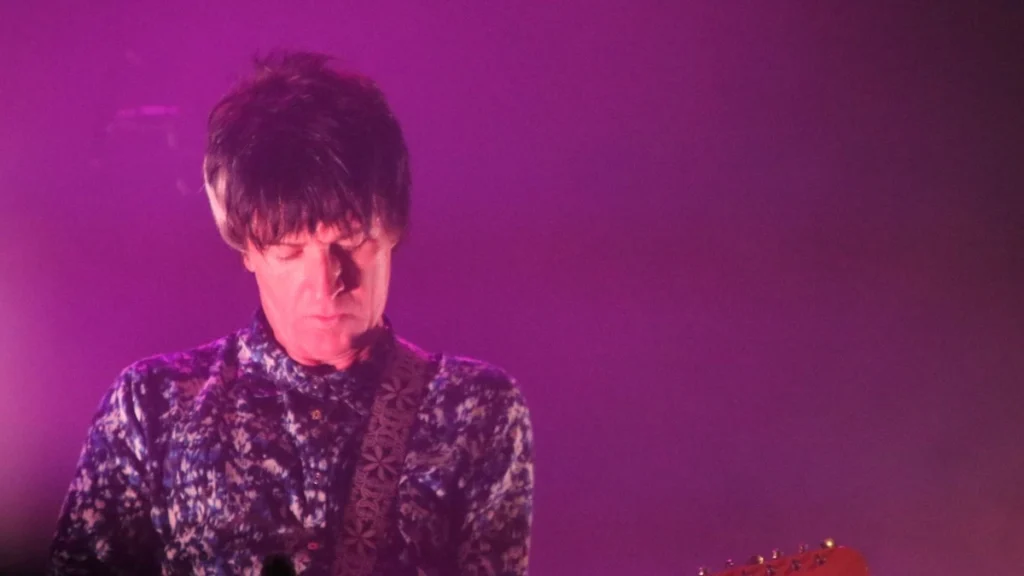
Johnny Marr Road-Tested The Age of Everything Before Recording It
Before Johnny Marr recorded The Age of Everything in Manchester, he decided to find out how the songs held up in front of a crowd. The album was written in London and road-tested across North America’s East Coast before he laid it down in his home city, as DIY reported when the record was announced. That order of events, write it, play it, then record it, shaped the album that came out on 2 October through BMG.
The Age of Everything is Marr’s fifth solo studio album and his first since Fever Dreams Pts 1-4 in 2022. Here is how it was made, what is on it, and why its release lands just weeks before the biggest London headline show of his solo career.
Written in London, Tested on the Road, Recorded in Manchester
Many albums are finished in the studio and only then learned on stage. Marr reversed part of that process. Songs that were written in London went out on the road first, and only after audiences had heard them did he take them into the studio in Manchester, the city where he was born.
Reviewers have noticed the effect. The Upcoming’s review points to the road-testing of most of these songs as the reason the record balances singalong moments with well-timed guitar breakdowns. God Is in the TV notes that three of the new tracks were already in the set at his Castlefield Bowl show in Manchester in July, that “How Come” was given its live debut in Southampton the previous summer, and that “All in a Life” was first played live in Leeds.
The approach also explains how familiar some of the album already feels to his audience. “It’s Time”, one of the singles released ahead of the album, had already become a firm live favourite before the album was released, according to the same review. By the time the record arrived, fans who had followed the tour had heard a good part of it already.
Why Marr Calls It His Most Cathartic Record
Marr has described The Age of Everything as the most cathartic songwriting of his career, according to Classic Pop. He has explained that the title arrived early in the writing and became an idea he could not shake, because it seemed to sum up the way many people feel right now.
He has been careful to say the title is not a complaint. In his account, there is a sense of overwhelm in the culture brought about by technology, but the same situation, seen in a different light, also carries a sense of possibility. That double meaning runs through the record: songs about information overload and unsettled relationships sit beside songs that look for something hopeful in the noise.
The opener and lead single, “Spin”, makes the theme plain from the first verse, with Marr singing about having too much coming into his mind. Its video was conceptualised by Marr himself and filmed in Manchester, which ties the song back to the city where the album was recorded.
The Ten Songs, From Spin to All in a Life
The album runs to ten tracks: “Spin”, “Beyond the Rain”, “It’s Time”, “How Come”, “Ophelia”, “That Feeling”, “In and Out of Love”, “Just Once More”, “Fire With Fire” and “All in a Life”.
The early part of the record moves fast. God Is in the TV describes “Spin” as driven by a propulsive rhythm section and a thick, bass-heavy groove, and “It’s Time” as built on rapid drumming with Marr’s guitar lines cutting through. The Upcoming hears rapid-fire guitars on “It’s Time” that recall The Smiths, and a subtle disco rhythm under “Ophelia”.
The middle of the album changes pace. “How Come” is a slower, reflective song that God Is in the TV says shows a more wistful side of Marr. “In and Out of Love” is his own favourite on the record and, by his account, the first song he has written about heartbreak. The Upcoming calls it a sweeping waltz unlike anything else in his solo catalogue.
“Fire With Fire” grew partly out of an unsettling experience Marr has described: hearing someone you have known for years suddenly express a view that makes you wonder how well you really knew them. While writing the album, he returned to his earlier solo records, and that song carries some of the momentum of Playland, according to God Is in the TV.
The closer, “All in a Life”, belongs to a tradition in his solo work. As God Is in the TV points out, each of his albums has had a darker, more brooding song, from “Say Demesne” on The Messenger to “Candidate” on Playland, “Walk Into the Sea” on Call the Comet and “Rubicon” on Fever Dreams Pts 1-4. On this record, that song is the one that ends it.
The Band Behind the Record
Marr wrote the songs, but the album is very much a band record. God Is in the TV singles out Iwan Gronow’s bass on “Spin” and Jack Mitchell’s drumming on “It’s Time”, and calls Marr and his band a powerhouse, with several of these songs already proven on stage.
James Doviak is the other important name. His keyboards, guitars and production have helped Marr widen the sound of his solo work, and God Is in the TV hears that instinct most clearly on “That Feeling”, where effects layered over Marr’s vocal add another texture. Instrumentally, that track echoes parts of Marr’s debut solo album, The Messenger.
Both reviews also single out Marr’s singing. The Upcoming argues that his voice has grown since 2013 into a strong instrument in its own right, and God Is in the TV hears a new confidence that lets him be more vulnerable in his songwriting.
A Busy Few Years Between Albums
The four years since Fever Dreams Pts 1-4 were hardly quiet. In 2023 Marr released the career-spanning collection Spirit Power, a reissue of the Healers’ Boomslang and his guitar photobook, Marr’s Guitars. The 2025 live album Look Out Live! followed, as DIY notes.
The guitar book kept him especially busy, culminating in an auction at Christie’s in London where more than 100 of his guitars, amps, posters and other pieces were exhibited and sold, and The Upcoming puts the total at £3.6 million. An illustrated anniversary edition of his 2016 autobiography, Set the Boy Free, is also on the way.
All the while he kept touring, which is where the new songs were tested. In that sense the busy period and the new album are the same story: the road work that filled the gap between records is part of how this one was made.
From The Smiths to a Fifth Solo Album
For newer listeners, the background matters. Marr was born in Manchester in 1963 and formed The Smiths with Morrissey in 1982. Between 1984 and 1987 the band released four studio albums, and Marr’s guitar became the musical counterpoint to Morrissey’s lyrics, as Messed!Up sets out in its overview of his career.
After The Smiths split in 1987, he chose variety over repetition. He joined The The, formed Electronic with New Order’s Bernard Sumner, and worked with The Pretenders, Pet Shop Boys and Talking Heads, before later stints with Modest Mouse and The Cribs. The Upcoming adds his work with Gorillaz and Hans Zimmer to that list.
He did not step out under his own name until The Messenger in 2013. Playland followed in 2014, Call the Comet in 2018 and the double album Fever Dreams Pts 1-4 in 2022. The Age of Everything is the fifth. God Is in the TV reads it as further proof that there is far more to Marr than being the guitarist from The Smiths, and The Upcoming calls it potentially his best solo album to date.
Wembley Arena and What Comes Next
The album arrives at the peak of a big year on stage. Marr played a sold-out homecoming show at Manchester’s Castlefield Bowl on 9 July, and he headlines London’s Wembley Arena on 24 October, with Baxter Dury as special guest. DIY describes the two shows as the biggest solo headline gigs of his career.
The record is out now on CD, black vinyl and limited edition red vinyl, with an exclusive three-colour splatter vinyl and bundles through his official store, according to Classic Pop.
“Testing songs in front of audiences before recording them is an old-fashioned way to make an album, and it suits a songwriter whose solo shows keep moving into bigger rooms,” said the NewMusic.News curator team.
For another look at how a British songwriter made a new record, read how Michael Kiwanuka built FUDGE in a shack outside Southampton. The Age of Everything by Johnny Marr is out now on BMG.