
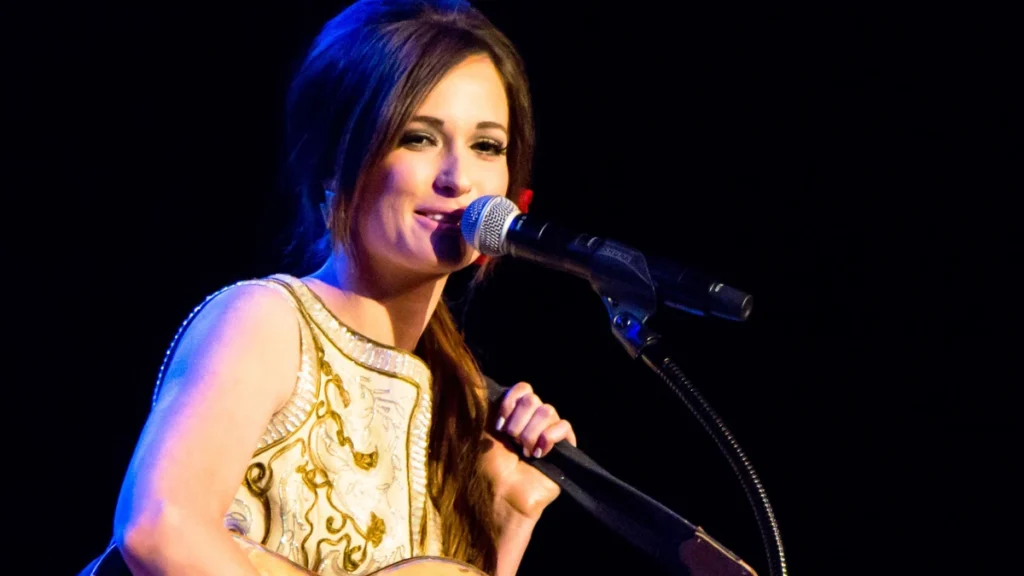
Kacey Musgraves turned the opening night of an arena tour into her own birthday party. The Middle of Nowhere Tour began at the United Center in Chicago on 21 August 2026, the day she was born, and runs for thirty-six dates ending at the OVO Arena Wembley on 26 February.
Between those two points sit two nights at Madison Square Garden, the Bridgestone Arena in Nashville, the Moody Center in Austin, Crypto.com Arena in Los Angeles and Climate Pledge Arena in Seattle, plus an Australian run at the Longhaul Festival in January and British dates in Glasgow and Manchester.
Eight Opening Acts
The support is unusually broad: Midland, Flatland Cavalry, Carter Faith, Charles Wesley Godwin, Estevie, William Beckmann, Gabriella Rose and The Brudi Brothers, rotating across the run.
Eight openers on a thirty-six date tour means the bill changes region by region, which is a deliberate way of using an arena headline slot. A single support act across a whole tour is cheaper and simpler; rotating eight of them turns the tour into a platform, and several of those names are considerably earlier in their careers than a Crypto.com Arena stage would normally allow.
The Album Takes in Zydeco
Middle of Nowhere, her seventh, arrived on 1 May 2026 through Lost Highway Records, a label relaunched the previous year. The stated range is country, pop, bluegrass, Zydeco and Norteño, which is wider than any of her previous records attempted.
The guest list follows the same logic. Willie Nelson and Miranda Lambert are country institutions from either side of her own generation. Billy Strings is the most technically formidable bluegrass player currently working. Gregory Alan Isakov comes from the quiet, folk end of Americana. Nobody on that list was chosen for streaming reach.
Zydeco and Norteño are the genuinely unusual inclusions. Both are regional American traditions with deep audiences and almost no presence on country radio, and reaching for them on an album that will be played in arenas is a choice that could easily have gone wrong.
The label matters as well. Lost Highway was the imprint that housed a particular strand of serious American roots music in the 2000s before being folded away, and relaunching it in 2025 was a statement about what kind of records it intended to release. Putting a seventh album by an artist of Musgraves’s commercial standing on a revived catalogue label, rather than on a major country division, tells you which audience the record was aimed at.
It also explains the album’s second single sharing the album’s title, a move that reads as confidence in the whole rather than in any individual track. An artist chasing radio picks the most obviously playable song; naming the single after the record signals that the album is the unit.
A Single About Being Bored
Dry Spell led the campaign on 11 March, produced by Musgraves with Daniel Tashian, Ian Fitchuk and Luke Laird. It is a comic song about romantic frustration built on a run of agricultural double meanings, with a chorus that gets to nobody’s tool up in my shed and nobody’s boots under my bed.
She trailed it by posting a question about whether it is possible to die of horniness, asking for a friend, which sets the register accurately. Consequence called the result boldly hilarious and self-aware; American Songwriter said it was full of the witty wordplay that made her famous; Pitchfork called it a playful confession of boredom; Billboard settled for humorous and twangy.
It reached fifty-five on the Hot 100, fifteen on Hot Country Songs and thirty-four on Country Airplay, and charted in Canada, the United Kingdom, New Zealand, Japan and across Europe. The video, co-directed with Hannah Lux Davis, sets her in a grocery store surrounded by visual innuendo.
Why the Radio Number Matters
The gap between fifteen on Hot Country Songs and thirty-four on Country Airplay is the whole story of her career in one comparison. The first chart counts streaming and sales; the second counts what programmers choose to play.
Musgraves has never been a country radio artist in the way her sales suggest she should be, and a comic single about not having sex was never going to change that. What she has instead is an audience that buys tickets, which is why the tour is in arenas regardless of the airplay position.
How the Route Is Built
The North American leg is paced unusually carefully for an arena run. Chicago on 21 August is followed by Toronto on the 24th, Boston at the end of the month and two nights at Madison Square Garden across 31 August and 1 September, then Philadelphia and Baltimore.
A gap follows before Minneapolis and Kansas City on 22 and 23 September, then Nashville and Atlanta at the end of that month, Austin and Dallas in the second week of October, Phoenix and Los Angeles the following week, and Oakland and Seattle to close on 26 and 27 October.
That is roughly two shows a week rather than the four or five a hard-touring act would attempt, with clear rest blocks built in. Spacing an arena tour that generously costs money in crew and venue holds, and it is the sort of schedule an artist sets when the priority is finishing the run in the same condition it started.
The overseas dates are separated by months rather than tacked on. Australia comes in late January, three Longhaul Festival appearances at the Melbourne, Sydney and Brisbane showgrounds on consecutive days, and the British leg follows a month later: Glasgow on 22 February, Manchester on the 24th and London on the 26th.
Three Shows Came Off the Calendar
On 26 July three dates were cancelled without explanation: Chicago on 20 August, Boston on 29 August and the Barclays Center in New York on 2 September. The Chicago cancellation is the interesting one, because it removed the night before the opener rather than a date buried in the run.
Dropping a Barclays Center show while keeping two nights at Madison Square Garden also suggests a routing adjustment rather than a demand problem, particularly since additional dates were added on 8 May because of demand after the tour was announced in April.
Where This Sits
Before August, the only thing on her calendar was three nights at Gruene Hall in New Braunfels, Texas, in early May. Gruene Hall is the oldest continuously operating dance hall in Texas and holds a few hundred people.
Playing three nights there and then opening an arena tour four months later is the same instinct behind Sierra Ferrell playing the State Fair of West Virginia between festival dates: an artist at arena scale deliberately keeping one foot in rooms that cannot possibly pay. Both will be at Bridgestone Arena in Nashville this autumn, from opposite ends of the bill.
What the two have in common beyond the venues is a refusal to let country radio define the ceiling. Neither is a mainstream airplay artist, both fill large rooms, and both did it by building an audience through records and live performance rather than through format. That is now a viable route to an arena, which it was not fifteen years ago, and the thirty-six dates on this tour are the clearest available proof of it.
About The Author

More From NewMusic.News
-
The Long Way to ATE: Kick 5000 and a Club-Tempo Story for Lyric-First Listeners
-
3’s Charmed ☆ on Nostalgic Pop and the Making of Match Me First
-
The Long Way to You_Know.: Missingno. and the Collaboration That Never Clicked
-
Mike McCarthy on Trance Roots and the Making of Right By You
-
Inside BACK & FORTH: How Alex Shade Built a Self-Released Turn From Rap to R&B