
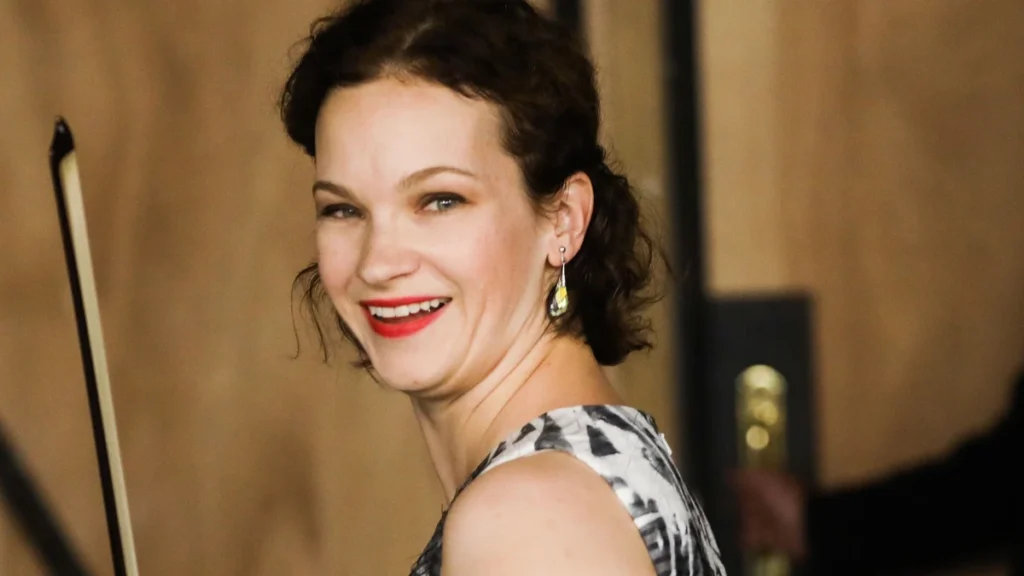
The sentence Hilary Hahn used, posting to her own audience in February, was not the one a publicist would have written. She is, she said, now the proud owner of an artificial disc. Her career has a future again, her neck has healthier alignment than before, and she is pain free.
That is the end of roughly two concert seasons of cancellations. It is also a reminder of something the violin repertoire never mentions, which is that the instrument is held between a jaw and a collarbone, and everything else depends on what is happening in the neck.
What the Two Years Looked Like
She withdrew from concerts from July 2024 with pinched nerves. In her own account the first herniation of a cervical disc, about eighteen months before the surgery, was debilitating: muscle atrophy alongside ongoing nerve stress. She recovered from that one without an operation and went back to work.
The return came in late February 2025 with the New York Philharmonic and the conductor Herbert Blomstedt, playing the Brahms Violin Concerto across four performances at David Geffen Hall, with Schubert’s sixth symphony completing the programme. She described it as a homecoming and called the orchestra family.
She was also explicit at the time that the schedule would be managed rather than resumed, saying she was taking a measured approach with adequate rest between concerts, and that this meant cancelling dates that had already been announced. Then, over the summer of 2025, the same disc herniated again and compressed nearly all of her remaining nerve space.
The Surgeon Who Played the Violin
At that point conservative treatment was no longer an option. The disc was replaced with an artificial one, and Hahn noted, in a detail that is either a coincidence or an extremely good piece of referral, that her surgeon used to play the violin.
It matters more than it sounds. A cervical fusion and a disc replacement produce different outcomes for range of motion, and a violinist needs a specific and unusual amount of lateral rotation and flexion to hold the instrument at all. A surgeon who has done it understands what the requirement actually is rather than treating the patient as a generic neck.
The Scarves
She has told audiences to expect scarves for a while, because she has a surgical scar on her neck she wants to protect both offstage and on. She added that it might be a style she keeps.
Announcing that in advance is a practical solution to a problem that only exists in performance. A soloist stands lit from the front for two hours in front of two thousand people; anything visible becomes a subject. Naming it first turns it into a wardrobe decision rather than a rumour.
What She Is Rebuilding
Her stated task now is getting strength and micro-coordination back while the nerves settle. The second word is the one violinists will recognise. Gross strength returns predictably; the fine differential control of individual fingers under a bow arm is a separate faculty, and it is the one that separates a professional from an amateur.
She has been careful not to overstate the position, noting that surgery brings longer-term consequences and that nobody can know the future, while describing the prognosis as really good. Given how much of the past two years she spent not knowing whether the career would continue, that is a measured way to put it.
The Programme She Built for the Comeback
The 2025 return is worth looking at in detail, because the choices were not those of someone easing back in. The Brahms concerto is one of the longest and most physically demanding works in the violin repertoire, roughly forty minutes of sustained playing with a first movement that gives the soloist almost nowhere to rest. Nobody chooses it to test a recovering neck.
Then, on the second night, she added a late-night set with Philharmonic musicians and the New York City Ballet principal Tiler Peck: Max Richter’s Mercy, Jessie Montgomery’s Musings, two pieces by Carlos Simon, the Ysaÿe Ballade, a Bach courante and movements from George Walker’s cello sonata. Playing a full concerto and then a chamber programme of mostly living composers, in the same week you return from a seven-month absence, describes a particular relationship with the work.
Curtis at Ten, and an Ysaÿe Lineage
Hahn was born in Lexington, Virginia in 1979 and admitted to the Curtis Institute in 1990, at ten. She studied there with Jascha Brodsky, who had studied with Eugène Ysaÿe, and later with Jaime Laredo, graduating in 1999.
That teaching line is not decorative. Ysaÿe wrote the six solo sonatas that are among the hardest things in the repertoire, and Hahn has recorded them; when she programmed a late-night set during her 2025 return she included the third of them, the Ballade, alongside Bach, Max Richter, Jessie Montgomery and Carlos Simon.
The Grammys came in 2001 for the Brahms and Stravinsky concertos, in 2008 for Schoenberg and Sibelius, and in 2013 for In 27 Pieces. Sixteen albums have appeared since 1996 across Sony Classical, Deutsche Grammophon and Decca.
The Commissioning Is the Career
In 27 Pieces: The Hilary Hahn Encores is the clearest statement of what she actually does. She commissioned twenty-six living composers to write short encores, among them Jennifer Higdon, Nico Muhly, Du Yun, David Del Tredici and Max Richter, then ran an open contest for the twenty-seventh, won by Jeff Myers. She toured the results between 2011 and 2013 before releasing the album.
The list of other commissions is long: a concerto from Edgar Meyer in 1999, Jennifer Higdon’s violin concerto, which won the Pulitzer Prize in 2010, six partitas from Antón García Abril premiered across 2016 and 2017, and a sonata from Lera Auerbach in 2019.
Very few soloists at this level spend that much of their working life on music nobody has heard. It is the same instinct as Víkingur Ólafsson building a studio under his own house, which is a decision to make the conditions rather than accept them. In Hahn’s case the conditions being made are the repertoire itself.
An 1864 Copy
She plays an 1864 Jean-Baptiste Vuillaume modelled on Paganini’s Guarneri, the instrument known as Il Cannone, and also owns an 1865 Vuillaume based on the Alard Stradivarius. Neither is a priceless original, which is a quietly characteristic choice from a player whose reputation rests on control rather than on tone as an inheritance.
Vuillaume was a nineteenth-century Parisian maker whose copies were good enough that soloists have used them by preference rather than by necessity for a century and a half. Choosing one over a period Italian instrument also removes a practical anxiety: a working violinist who tours constantly is carrying the thing through airports, and an instrument that is merely excellent rather than irreplaceable is a different daily proposition. She has lived in Cambridge, Massachusetts since 2016, having previously been based in New York.
The best line from the whole episode came a year before the surgery, at the first return, when she wrote that she intended to keep making music for as long as possible, and hoped to manage it until she was ninety-seven, like Maestro Blomstedt. She then added, in brackets, no pressure. On the current evidence the joke has become a plan.
About The Author

More From NewMusic.News
-
The Long Way to ATE: Kick 5000 and a Club-Tempo Story for Lyric-First Listeners
-
3’s Charmed ☆ on Nostalgic Pop and the Making of Match Me First
-
The Long Way to You_Know.: Missingno. and the Collaboration That Never Clicked
-
Mike McCarthy on Trance Roots and the Making of Right By You
-
Inside BACK & FORTH: How Alex Shade Built a Self-Released Turn From Rap to R&B