
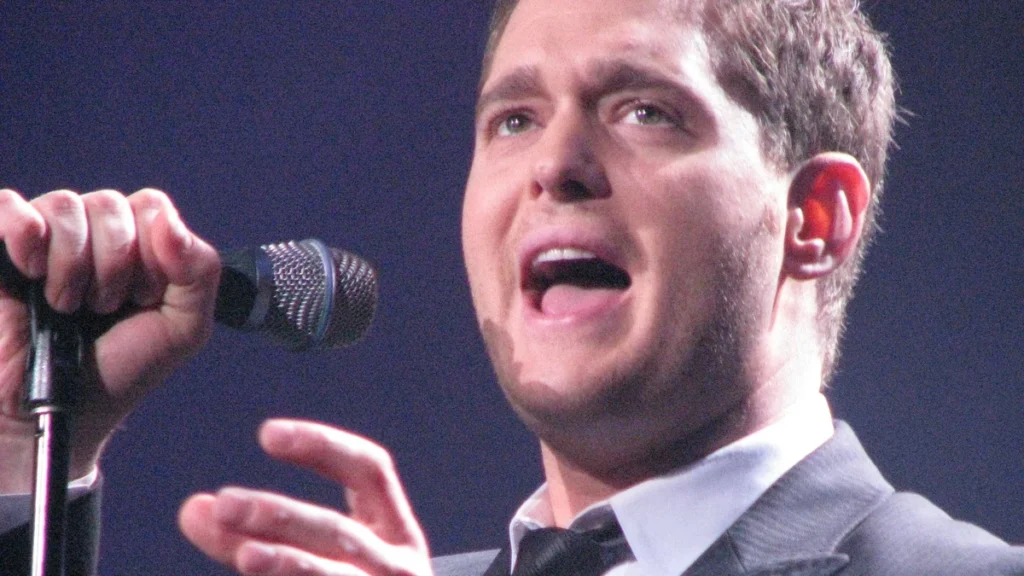
In the first week of January 2012, Michael Bublé’s Christmas fell from number one on the Billboard 200 to number twenty-four. That remains the sixth-largest single-week drop from the top of that chart, and the explanation requires no analysis at all.
It is also the most instructive fact about the record. An album that can occupy the top of the American chart for five weeks and then become almost unsellable overnight is operating on a completely different commercial logic from everything around it, and fourteen years later it is still doing so.
Twenty Countries at Number One
Released in late October 2011 through 143 Records and Reprise, produced by David Foster, Bob Rock and Humberto Gatica, it went to number one in twenty countries: the United States, the United Kingdom, Canada, Australia, Germany, Italy, Ireland, the Netherlands, Austria, Denmark, Hungary, Iceland, Norway, Poland, Portugal, Sweden, Switzerland, Croatia and New Zealand among them.
In the United States it was the second best-selling album of 2011 on 2,452,000 copies, behind only Adele’s 21. Worldwide sales have passed sixteen million.
The certifications describe an unusually even global spread rather than one dominant market: six times platinum in the United States, eleven times platinum in the United Kingdom, diamond in Canada, double diamond in Australia, fourteen times platinum in New Zealand and eight times platinum in Italy. It is the best-selling holiday album Britain has ever had.
Six Separate Decembers at Number One in Australia
The recurrence is the part with no real precedent. It topped the ARIA albums chart in December 2011, 2012, 2013, 2014, 2016 and 2019, making it the first album to reach number one there on six separate occasions.
In Britain it became the first seasonal album to place inside the top ten in three consecutive years. It has re-entered charts every year from release through to 2024, and it finished the 2010s at number two on Australia’s decade-end chart, five in the United Kingdom and twenty-four in the United States. On the all-time American holiday albums chart it sits at number two.
An album that sells for six weeks a year for fourteen years accumulates figures that annual releases cannot match, and it does so without any of the promotional spending a new record requires.
Sixteen Tracks, One New Song
The construction is conservative by design. It’s Beginning to Look a Lot Like Christmas opens, followed by Santa Claus Is Comin’ to Town, Jingle Bells with The Puppini Sisters, White Christmas as a duet with Shania Twain, and versions of All I Want for Christmas Is You, A Holly Jolly Christmas, Santa Baby, Have Yourself a Merry Little Christmas, Christmas (Baby Please Come Home), Silent Night, Blue Christmas, I’ll Be Home for Christmas and Ave Maria.
Thalía joins for Mis Deseos and Feliz Navidad. A hidden track carries a spoken greeting. Only one song, Cold December Night, is new.
Fifteen standards and one original is a precise ratio. A holiday album succeeds by being familiar, and the single new song exists so the record has something of its own rather than to carry the release. Later editions added Winter Wonderland, Frosty the Snowman, Silver Bells with Naturally 7, and eventually a seven-track bonus disc for the tenth anniversary in 2021.
The one genuinely contentious decision was rewriting Santa Baby’s pronouns for a male singer, which produced Santa buddy, Santa pally and an instruction to wait up that has been widely mocked ever since.
Why This One and Not Another
Dozens of singers with comparable voices have made Christmas albums, and almost all of them sell for one season and disappear. The reasons this one persisted are mostly structural rather than musical.
The first is timing. It arrived in 2011, at the point where streaming was beginning to make seasonal playlists automatic, so an album already positioned as the default benefited from a distribution mechanism that had not existed for earlier Christmas records. The second is the production team: David Foster and Humberto Gatica had spent decades making exactly this kind of large, warm, orchestral pop, and the record sounds expensive in a way that survives repeated exposure.
The third is the least discussed. A Christmas album has to work as background. It is played in kitchens and shops and cars by people who are not listening to it, and anything demanding or idiosyncratic fails at that job. The relentless conservatism of the arrangements, which would be a criticism of any other record, is the specification being met.
What that produces is an unusual commercial object: an album with almost no critical standing that outsells nearly everything reviewed favourably in the same year, and then does it again annually for over a decade.
He Learned It From Bing Crosby
Bublé was born in Burnaby, British Columbia in 1975, and his interest in this music started at about five, when his family played Bing Crosby’s Christmas album. That is a direct line: the record that shaped him is the one his own record was eventually measured against.
His grandfather, Demetrio Santagà, traded plumbing work for stage time at local nightclubs so his sixteen-year-old grandson could sing. The break came in 2000 at Caroline Mulroney’s wedding, where he performed Mack the Knife and met David Foster, who signed him to 143 Records and later produced the Christmas album.
The Television Half
The album is inseparable from the specials that followed it. NBC broadcast A Michael Bublé Christmas in 2011, a third annual special in 2013 featuring Mariah Carey, Mary J. Blige and Queen Latifah, then Christmas in New York in 2014, Christmas in Hollywood in 2015 and Christmas in the City in 2021.
An annual television slot is what turns a seasonal album into an institution. Each broadcast reintroduces the record to an audience that was not shopping for it, which is precisely the mechanism behind those chart re-entries.
What He Does the Rest of the Year
Nine studio albums have sold more than seventy-five million records between them, and he has won five Grammys, all of them for Best Traditional Pop Vocal Album. His own touring is built around a thirty-six-piece orchestra on tiered staging, and the sixth tour ran to a hundred and fifty-one shows across four years.
He returns to the United Kingdom and Ireland between late June and early July 2026, playing outdoor venues, castles and estates, with a first Maltese date at Ta’ Qali National Park in July. Those are his only British and Irish shows of the year.
Playing castles in July and dominating December is a career shape almost nobody else has. It is a version of the arrangement Pentatonix have built by booking twenty-eight arenas for six weeks of Christmas, with one difference: their touring is the business, while Bublé’s Christmas record does the work whether he tours it or not.
He has also spent the past two years coaching on The Voice, winning with Sofronio Vasquez in his first season and Adam David in his second, which is the modern equivalent of the annual television special: a way of being visible to a large general audience without releasing anything.
All of which points at the same conclusion. The most valuable thing Michael Bublé owns is not a touring operation or a current single but a sixteen-track album of mostly other people’s songs, recorded in 2011, that a substantial part of the world has agreed to treat as furniture for one month a year.
About The Author

More From NewMusic.News
-
Deluminate, Pandemic Isolation and the Making of A Different Light
-
The Long Way to A Live Family Rayunion 2025: Ray’s Music Exchange at Thirty
-
Inside DIRTY LUV: How Lloyd Haines Built a Late-Night R&B Record on Trust
-
Razed by Rebels Built Broken Paradigm Around One Question: What Does Standing by Your Convictions Cost?
-
Phil Lentz Presents…: The Long Way From a College Song to a First Album