
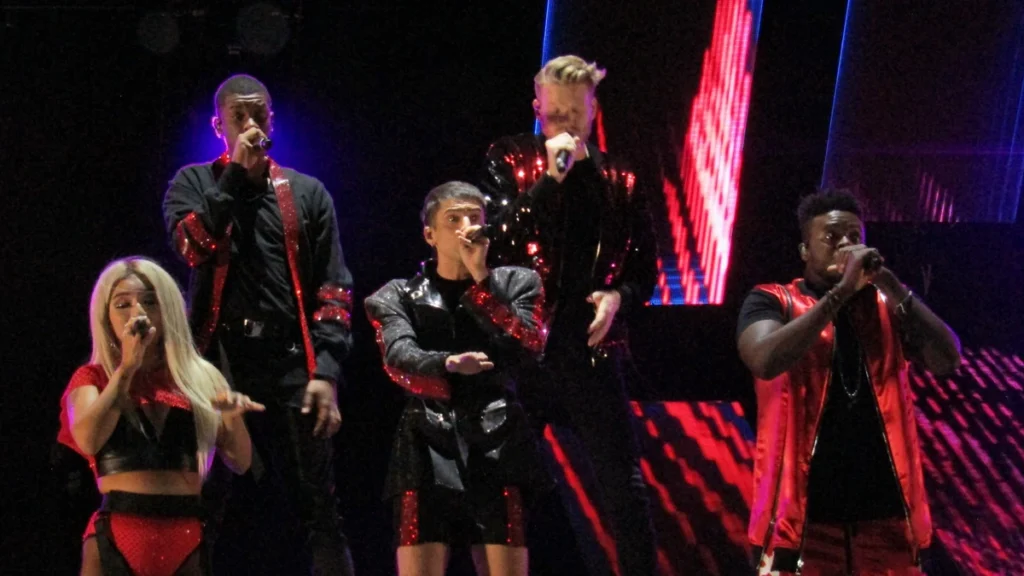
The first date is 5 November at the Tacoma Dome. The last is 22 December at the Kia Forum in Los Angeles. Between them Pentatonix play twenty-six other arenas, which works out to roughly one show every other night for seven weeks, all of it Christmas music. Tickets went on general sale on 14 August.
Six days before the tour opens, on 30 October, a deluxe edition of Christmas in the City arrives, adding ten songs to the sixteen on the original. That album came out on 24 October 2025 through Republic Records and is the group’s eighth Christmas record. The sequencing of album, then deluxe, then tour is the machinery of a seasonal business that Pentatonix have been building since 2012.
The Route
November runs west to east and back again: Tacoma, then Vancouver’s Rogers Arena, Bozeman, Casper, Lincoln, Milwaukee, Grand Rapids, Louisville, Buffalo, Cleveland, Pittsburgh, Hamilton, Charlottesville and Albany. December opens in Baltimore and works south through Columbia, Greenville, Raleigh, Nashville and Atlanta before turning west via North Little Rock, Bossier City, Austin, Fort Worth, Lubbock, Glendale and San Diego.
Two things stand out in that list. The first is how many mid-sized markets it includes: Casper, Wyoming and Bozeman, Montana are not standard arena-tour stops, and playing them in mid-November suggests an audience that is geographically spread rather than concentrated in major metros. The second is the pairing of Vancouver and Hamilton as the Canadian dates, both listed as firsts.
The density is the other notable feature. Twenty-eight arena shows inside forty-eight days means very few days off, and the run includes stretches of three shows in four nights. For a group whose entire instrumentation is human voices, that schedule is a physical proposition rather than a logistical one. There is no guitar to hide behind on a night when a voice is tired, and no backing band to carry a song, which is why a cappella acts historically toured less than their record sales would suggest they could.
What the Deluxe Adds
The original Christmas in the City runs sixteen tracks and forty-six minutes, opening with a twenty-one-second piece called Snow and closing on a Christmas Classics Medley. In between it moves between originals like Bah Humbug, Christmas Movie and Moody Rudy and standards including Holly Jolly Christmas, Silver Bells and Caroling, Caroling.
The deluxe brings ten more, made up of new material, covers and live recordings from the touring cycle. The lead single, released on 6 August, is a mashup of Get Happy and Happy Days Are Here Again, a pairing with a long history in American entertainment. Kirstin Maldonado has framed it as a tribute to the Christmas music of Hollywood’s golden age and the jazz era, which describes the whole record’s ambitions fairly.
A Big Band Without a Band
Scott Hoying has said the group wanted a big band orchestral sound with no rules, aiming for something “fun and bold and theatrical and camp” built around the idea of Christmas in New York. That is a demanding brief for five voices, one of whom is providing the percussion.
The a cappella constraint is what makes the record interesting rather than what limits it. Reproducing a brass section and a rhythm section vocally forces arrangement decisions that a real orchestra would make invisible, and the reviews picked up on it. The Associated Press’s Maria Sherman included it among the best holiday releases of 2025 and pointed to the group’s vocal athletics; another critic praised the multi-part arrangements, rhythmic precision and stylistic range.
Not Everyone Was Convinced
The reception was not uniform. Eric Saeger at Hippo gave it a B minus, finding the original songs largely unsuccessful while rating the traditional carol covers highly. That split is worth noting because it identifies the actual creative problem with a long-running holiday franchise: the standards are what the audience wants, and writing new Christmas songs that survive alongside them is close to impossible. The canon is effectively closed: most of what gets played every December was written between the 1930s and the 1960s, and the handful of later additions can be counted on two hands.
That is the trap every artist making an eighth holiday record walks into. Fill it with standards and you are competing against definitive recordings; fill it with originals and you are asking an audience to learn new songs during the one month a year they most want familiarity. Christmas in the City splits the difference roughly down the middle, and the reviews split along exactly that line.
Commercially the album performed as a catalogue release rather than an event, reaching twenty-eight on Billboard’s Top Album Sales chart and six on Top Holiday Albums. The bigger chart story came from a track rather than the record: the group’s version of I’ve Got My Love to Keep Me Warm, built around a Frank Sinatra vocal, reached number one on the Adult Contemporary chart last December.
How They Got Here
Scott Hoying, Mitch Grassi and Kirstin Maldonado were schoolmates in Arlington, Texas. Hoying recruited the other two for an audition on NBC’s The Sing-Off, adding Kevin Olusola, found through a video of him beatboxing while playing cello, and a bass vocalist. The five met the day before the audition and won the third season in 2011, taking a cash prize and a recording contract.
Matt Sallee took over bass duties in 2017. Along the way the group won three Grammy Awards: two for arrangement, in 2015 and 2016, and one in 2017 for a version of Jolene recorded with Dolly Parton. They received a star on the Hollywood Walk of Fame in February 2023 and signed to Republic Records in early 2025.
The label move matters more than it looks. Republic is a pop major, and arriving there after more than a decade elsewhere, immediately before an eighth Christmas album and a twenty-eight-date arena run, indicates a group being handled as a year-round commercial asset rather than a seasonal one. Two non-holiday singles this year, Heaven on Earth in February and Sacrifice in July, point the same way.
The Christmas Catalogue Is the Business
Eight Christmas albums in thirteen years, plus compilations, is a genuine body of seasonal work. That’s Christmas to Me in 2014 remains the commercial peak: number two on the Billboard 200, double platinum, the fourth best-selling album in the United States that year at 1.14 million copies, and the highest-charting holiday album by a group since 1962. A Pentatonix Christmas in 2016 eventually reached number one.
Building a career around a season that lasts eight weeks is a strange structure, and it works because the catalogue compounds. Every year the older records return to the charts, and every new one adds to the pool. The tour is the part that cannot be automated, which is presumably why it runs to twenty-eight arenas.
The Donation at Checkout
One detail sits outside the commercial logic. The tour partners with the Save The Music Foundation, a music education nonprofit, with an optional donation offered during ticket purchase. It is a small thing and easy to dismiss as brand alignment, though the fit is closer than most: a group formed by school friends, discovered on a television competition, funding school music programmes.
It also puts them in company with acts making deliberately awkward commercial choices this year, in the way Sturgill Simpson capped his own resale market at face value across a comparable arena run. Pentatonix are working the most commercial season in music and have added a line at the checkout that asks for money to go somewhere else.
About The Author

More From NewMusic.News
-
The Long Way to Bebopping Along: Phil Lentz Trades the Newsroom for Bebop Piano
-
The Long Way to In My Head: Bite To Break and a Cymbal Sale
-
The Long Way to Late Night Drive, Where Gio 22/6 Brings Rado Ricky and Ty Lab Together
-
TOP NINJA and Hell Rell Take the Long Way to Birds Eye From Terrace Avenue
-
Inside Effervescence: How Logan Threshold Built a One-Man Synth Rock Debut