
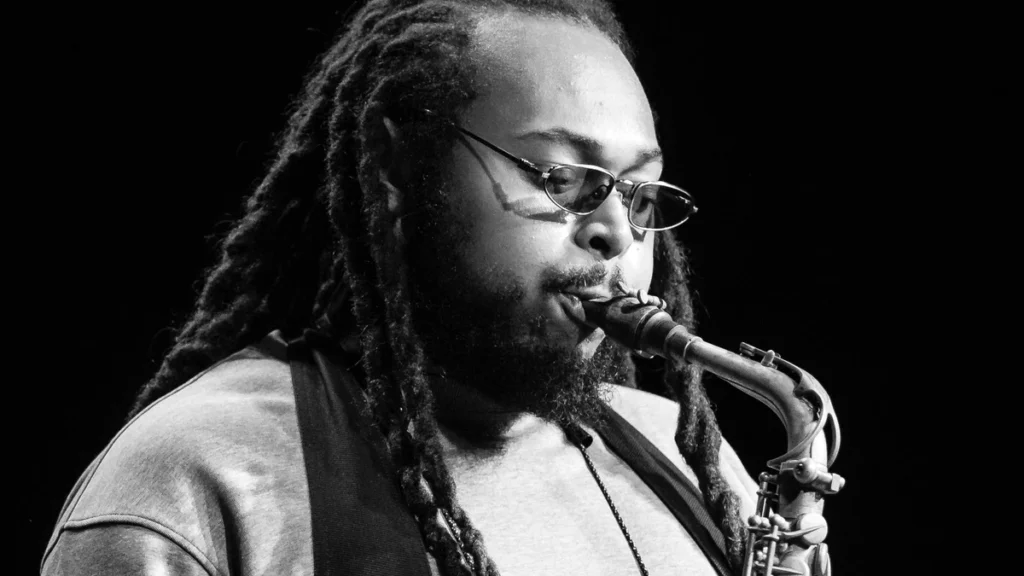
On the evening of 15 May 2025, four musicians carried their instruments down the stairs into a basement room on Seventh Avenue South that holds about 130 people. They played there that night and again the next. Between the two evenings they recorded thirteen pieces of music, and rather than choose among them, Blue Note put out all thirteen across three separate volumes.
That decision is the story here. A live album is normally an act of compression: you play a run of nights, you take the best version of each tune, and you assemble a single record that sounds like one great evening. Immanuel Wilkins Quartet: Live at the Village Vanguard refuses that. Vol. 1 arrived on 20 March on vinyl, CD and digital, Vol. 2 on 17 April and Vol. 3 on 15 May, the last two digital only. Almost nothing was left out.
Two Nights, Thirteen Tracks
The maths explains part of it. These performances stretch. One piece on the first volume runs eighteen minutes, and it is not an outlier so much as a statement of how the group works. Four tracks fill Vol. 1, five fill Vol. 2 and four fill Vol. 3. Compress that into a single seventy-minute record and you would be cutting roughly two thirds of what happened in the room.
The sequencing across the volumes is deliberate rather than chronological tidying. Vol. 1 opens with Warriors, moves through Composition II and the Alice Coltrane cover Charanam, and closes on Eternal. Vol. 2 gathers The Big Country, Waiting Pt. 1, Citrine, Grace and Mercy and Go ‘Head Get Down. Vol. 3 holds Ring Shout, Composition IX, Dolla$ and Put 100 on the Blue Chain. Each set has its own arc.
The titles carry their own logic across the three records. Ring Shout, which opens Vol. 3, names a ritual form that predates jazz entirely, a circle dance from the Black American church built on shuffling feet and call-and-response. Grace and Mercy and Go ‘Head Get Down point the same way. Set against those are Composition II and Composition IX, deliberately plain labels for the most formally constructed pieces here. The pairing of devotional language with numbered exercises is not accidental, and it maps closely onto how the music actually behaves.
The Room Is Part of the Instrument
The Village Vanguard has been recorded so many times that its sound is itself a reference point, a slightly boxy warmth with the audience close enough to hear. Sonny Rollins, John Coltrane and Bill Evans all made records there that people still study. Playing a first live album in that room is a decision about lineage as much as acoustics.
Tina M. Campt, who wrote the liner notes, framed the project as an attempt to summon the room’s own recorded history and make it audible again. That is a fair description of what these performances do. The quartet is not imitating anyone who played there before, but the room keeps supplying the context, and the group plays into it rather than around it.
There is a practical dimension too. The Vanguard is small and its stage is shallow, so a quartet stands close enough to hear each other without monitoring. Groups that play there often describe it as the easiest room in New York to listen in, which matters enormously for music built on reacting rather than executing. Much of what sounds telepathic on these recordings is really just four people who can hear every detail of what the others are doing.
What Wilkins Means by Practice
Wilkins has described these sessions as practice, and he defines the word in a specific way: “working things out without a certain set of key variables; a refusal of the conditions expected of your production.” That is a working method, not modesty. It explains why passages are allowed to run past the point where a studio take would be cut, and why the group is comfortable letting an idea fail in public.
It also explains the three-volume structure better than the running times do. If the sessions are practice, then editing them into a highlights record would misrepresent what happened. Releasing everything keeps the searching in, including the parts that do not resolve.
The Alice Coltrane Cover at the Centre
Charanam is the only piece on Vol. 1 that Wilkins did not write. It comes from Alice Coltrane’s Turiya Sings, and its roots are in kirtan, the devotional practice built on call-and-response chanting. That structure survives the translation to a jazz quartet: the music moves in circles, with rhythmic repetitions gathering around Kweku Sumbry’s beat and Micah Thomas’s wide chords.
Over that, Glide Magazine noted Wilkins using a fluttering technique more commonly heard from trumpet players than saxophonists, alongside the spiralling solo lines that have become his signature. Choosing Alice Coltrane rather than a standard says something too. It places the record in a devotional tradition rather than a repertory one.
Where the Length Becomes the Argument
Not everything lands, and the reviews have been honest about it. Eternal builds on an eleven-note phrase that recurs for thirteen of its eighteen minutes, descending in volume over a two-chord bed. Glide found it ponderous, and suggested that what works as hypnosis in a room does not necessarily survive the trip to a recording.
That is a real limitation of documenting practice rather than editing it. But the same approach produces Composition II, modelled on Bach’s Well-Tempered Clavier and played with deliberate restraint: Ryoma Takenaga’s bass handled gently, Wilkins in a clear and unhurried tone, Thomas accompanying rather than filling. The record asks for attention and rewards it unevenly, which is what a real night in a club is like.
The Quartet Doing the Work
Micah Thomas has his own trio and three solo piano albums, and his playing here moves between wide harmonic support and near-silence depending on what the piece needs. Sumbry’s drumming is the engine on the faster material, kinetic without crowding. Takenaga anchors the quieter passages, which on this record is the harder job.
Wilkins came to the instrument through a community church in Upper Darby, Pennsylvania, then the Clef Club of Jazz and Performing Arts in Philadelphia, then Juilliard, where he studied with Bruce Williams, Steve Wilson and Joe Temperley. He is not yet thirty. This is his sixth album for Blue Note, after Omega in 2020, The 7th Hand in 2022 and Blues Blood, which earned him a Grammy nomination for Best Alternative Jazz Album.
He has also spent a substantial part of his twenties as a sideman, and the list is a good map of where contemporary jazz has been concentrated: four albums with the vibraphonist Joel Ross, two with the drummer Johnathan Blake, sessions with Kenny Barron, James Francies and Orrin Evans. That volume of collaborative work is audible in how he leads. He does not play like a soloist with a rhythm section behind him, which is the default shape for a saxophone-led quartet, and the long pieces here only function because the other three are given room to determine where things go.
Why the Label Backed the Long Version
Don Was, who runs Blue Note, has said that like Coltrane, people will be listening to Immanuel Wilkins sixty years from now. Labels say things about their artists, but the release strategy is the more reliable signal: issuing three volumes of long-form live improvisation, two of them digital only, is not a commercial play. It is an archival one.
It also fits where instrumental music has been heading. The most interesting records in this space keep refusing the shapes that streaming rewards, in the same way Nala Sinephro built a film score that declines to behave like one. Wilkins had two nights in a small basement room and thirteen pieces of music. Rather than decide which four mattered most, he let all of them stand.
About The Author

More From NewMusic.News
-
The Long Way to Bebopping Along: Phil Lentz Trades the Newsroom for Bebop Piano
-
The Long Way to In My Head: Bite To Break and a Cymbal Sale
-
The Long Way to Late Night Drive, Where Gio 22/6 Brings Rado Ricky and Ty Lab Together
-
TOP NINJA and Hell Rell Take the Long Way to Birds Eye From Terrace Avenue
-
Inside Effervescence: How Logan Threshold Built a One-Man Synth Rock Debut