
Almost every instinct in modern record-making pushes the vocal forward. Streaming rewards an identifiable hook early, playlists reward clarity, and a singer buried in the mix is normally a sign that something went wrong in mastering.
Michael Gordon, who records as Mk.gee, did the opposite deliberately, and it produced one of the most decorated debuts of its year.
Twelve Tracks, Thirty-Three Minutes, Nobody Else
Two Star & the Dream Police was released on 9 February 2024 through R&R. Twelve tracks, thirty-three minutes and eighteen seconds — an average of two minutes forty-six per song, with “New Low” at 2:06 and “DNM” at 1:58.
The release schedule showed the same refusal to run the normal sequence. Five singles preceded the album, and the first two — “Candy” and “How Many Miles” — arrived together as a double A-side on 11 August 2023, attached to no announced album at all. A second double, “Are You Looking Up” and “You Got It”, followed on 20 October. Only with “Dream Police” on 19 January 2024 did the record acquire a title and a date. Half a year of music went out before Gordon conceded there was an album behind it.
The more unusual number is zero. The album carries no guest features at all, which in contemporary alternative R&B is close to a statement. Debuts in this lane are normally where an artist spends their relationships.
Gordon had those relationships to spend. He played guitar on Dijon’s Absolutely, worked on Omar Apollo’s Apolonio, has a writing credit with The Kid Laroi, and was sampled on “Fair Trade” from Drake’s Certified Lover Boy. He used none of it. Dijon Duenas appears, but as co-producer on two tracks rather than as a voice.
The Vocal Is Under the Groove on Purpose
The signature is a mix decision. The Line of Best Fit, scoring the record 8 out of 10, describes vocals “layered under the minimalist groove” and intentionally mixed low, with “I Want” noted as “one of the few moments his vocals come through clearly”.
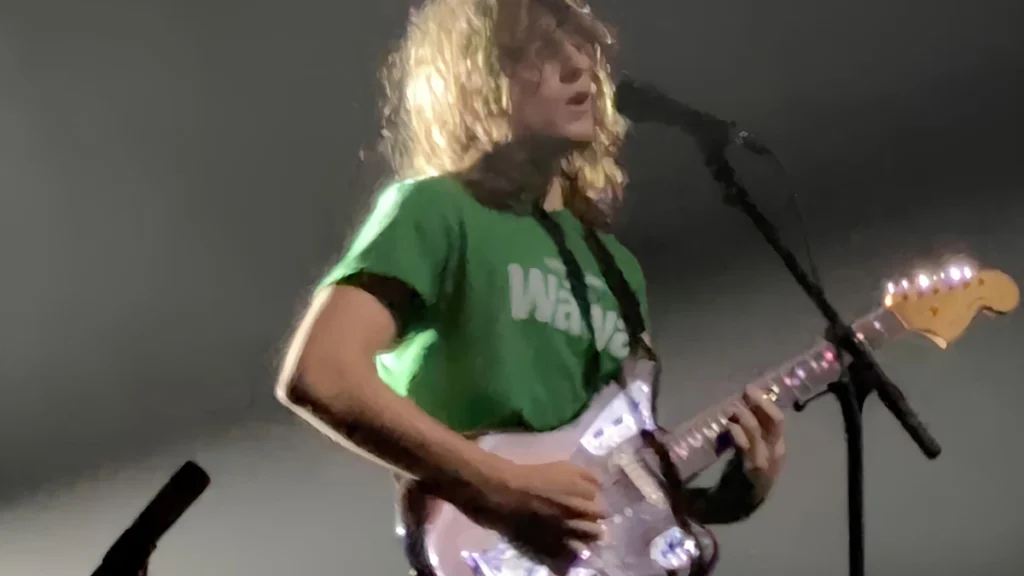
Burying the lead is only viable if something else is carrying the melodic argument, and here it is the guitar. The review characterises his tone as “warm but sharp” and used “as lyrically as his words” — which is the whole design in one phrase. The guitar is not accompanying the vocal; the two are sharing the job, and sometimes the guitar wins.
The rest of the palette is described as “dripping in reverb and sonically barebones”, with pounding toms, distant horns and twinkling synths, and a drum sound the reviewer places somewhere between Prince’s M1 and Meg White’s Ludwig snare. Reverb plus sparseness is a difficult combination: reverb usually fills a mix, and using it while keeping the arrangement bare means the space itself becomes an instrument.
The track listing itself points at the process. One song is called “Alesis”, after the audio-hardware maker whose drum machines and mixers furnished a generation of home studios. Naming a track for a piece of gear rather than a person or a feeling is a small tell about where the writing starts on this record.
He treats it as more than an in-joke. In February 2024 Gordon played the Jil Sander Fall/Winter show in Milan alongside Benji B, and the three songs he performed were “Dream Police”, “How Many Miles” and “Alesis” — a non-single named after a drum-machine manufacturer, given equal billing with the lead singles in front of a fashion-house audience.
Why Mixing It Himself Mattered
A buried vocal is exactly the decision an outside mixer talks an artist out of, and it is worth noting who held the fader. Gordon mixed the album himself.
That is the mechanism behind the whole aesthetic. A mix engineer’s professional instinct — and often their explicit brief — is intelligibility, so a deliberately obscured lead would be corrected somewhere between the first pass and the label playback. Keeping the mix in-house is what let a choice this counterintuitive survive to release.
Mastering was split, unusually, between two engineers: Heba Kadry took “How Many Miles” and “Candy”, Simon Lancelot the other ten. Splitting a short record between masters risks inconsistency, and doing it anyway suggests those two tracks needed something the rest did not.
It is also a deliberate break from his own past. The Line of Best Fit frames the album as a sonic departure from the lo-fi aesthetic of his earlier A Museum of Contradiction — so the reverb-soaked spareness here is a constructed decision, not a limitation carried over from making records cheaply.
Short Songs Are a Structural Choice, Not a Shortcut
Nine of the twelve tracks run under three minutes. That reads as brevity for the streaming era, but the record is not built like playlist bait — the songs are loosely structured and drift rather than resolving into choruses.
Short and unresolved is a harder combination than short and catchy. Without a hook to return to, a two-minute song has to justify itself on texture and feel alone, and it has to stop before the listener starts waiting for a payoff that is not coming. Ending early is how the record avoids reading as unfinished.
Only “Breakthespell” passes four minutes, at 4:27. It is the one place the album lets an idea run.
The writing is almost entirely his as well. Only two tracks carry co-writes — John Keuch and Sam Wilkes on “You Got It”, Keuch again on the closing “Dream Police” — so the same person is responsible for the song, the guitar part, the arrangement and the mix on ten of the twelve. That concentration is what makes a decision as unusual as the buried vocal internally consistent rather than eccentric: there is no seam where someone else would have argued for clarity.
The Critics Reached for the Same Word
Reception was strong and, more tellingly, consistent in what it identified. The album took a Metacritic score of 83. Pitchfork scored it 7.8, called it a “magnificent debut album” and noted that “nothing in contemporary music sounds quite like it”. The Guardian gave five stars, Rolling Stone four, Clash and The Line of Best Fit both 8 out of 10 — the latter praising “an artistry so well studied and expertly executed”.
Clash also described “an immersive quality” and a “nocturnal wash of acoustics”, which is a fair account of what a buried vocal and a wet, sparse mix do to a listener: you lean in, and leaning in is the point.
Year-end recognition went further than the review scores suggest. It was named album of the year by Clash, by Dazed, and by Jon Caramanica at The New York Times, and Pitchfork later included it among the best albums of the first half of the 2020s.
What the Charts Did and Did Not Say
Commercially it stayed in specialist territory: number eight on the UK independent albums chart, twelve in Scotland, ninety-one on the French rock and metal chart. There is no mainstream chart placing to report.
The audience arrived by other routes. “Are You Looking Up” placed twelfth in Dazed’s twenty best tracks of 2023 and “You Got It” twenty-sixth in The Fader’s hundred best songs of that year, both before the album existed. Gordon made his live television debut on Jimmy Kimmel Live! in April 2024, and that June “Are You Looking Up” surfaced in the ninth episode of the third season of The Bear. Then he toured it properly — North America from April to May 2024, followed by a world tour through North America, Europe and Australia running from September to December.
None of that is chart activity, and all of it is distribution.
That gap between critical position and chart position is the honest outcome of the decisions above. A record with no features, no clear vocal hook and no song built to be excerpted has almost nothing for the mechanisms that produce chart placings to grab hold of.
What it has instead is a sound that critics repeatedly described as unlike anything else, which is the rarer currency and the one that survives a year-end list. For a writer curious about the opposite approach, our piece on how features became a career strategy covers what Gordon declined to do.
Two Star & the Dream Police is out on R&R.
About The Author

More From NewMusic.News
-
The Long Way to ATE: Kick 5000 and a Club-Tempo Story for Lyric-First Listeners
-
3’s Charmed ☆ on Nostalgic Pop and the Making of Match Me First
-
The Long Way to You_Know.: Missingno. and the Collaboration That Never Clicked
-
Mike McCarthy on Trance Roots and the Making of Right By You
-
Inside BACK & FORTH: How Alex Shade Built a Self-Released Turn From Rap to R&B