
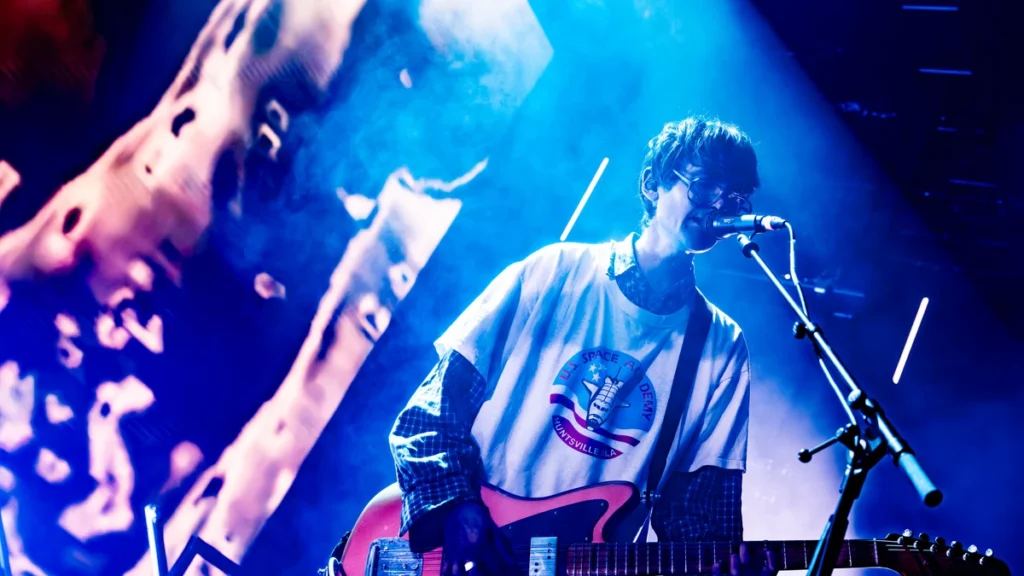
DIIV performing at Here at Outernet in London in September 2025
When DIIV went into the studio with A. G. Cook, the producer insisted on starting from the drums. “I became a bit obsessed with their live sound,” Cook said, “and insisted on recording live drums before most of the songs were even finished.”
The result is ZIRP!, the fifth DIIV album, out on Friday 30 October through Fantasy Recordings. It follows 2024’s Frog in Boiling Water, and it pairs a Brooklyn band known for layered guitar music with a producer whose name is usually attached to the most digital corners of pop. How that pairing worked, according to Cook’s own account, is the story of the record.
The Producer Who Asked for Drums First
Cook is best known as the founder of the PC Music label and for his work with Charli XCX, music built from synthetic, heavily processed sound. On ZIRP! he went the other way. “We spent a lot of time recording intricate guitar parts with specific guitar pedals,” he told DIY, “and as little time as possible doing anything on a computer, at least by my standards.”
That last clause is the interesting one. Cook is not claiming to have made an analogue record. He is saying that, for someone whose working method usually lives inside a laptop, this was an unusually physical project: live drums captured first, guitars shaped by pedals rather than plug-ins, and the songs built up around performances instead of the other way round.
Recording drums before the songs are finished reverses the usual order, in which the arrangement is settled and the drums are tracked to fit it. Doing it the other way puts the band’s feel at the foundation. Whatever the songs became, they had to grow on top of how DIIV actually sound when they play together in a room.
That puts a spotlight on the rhythm section. The band is Zachary Cole Smith on vocals and guitar, Andrew Bailey on guitar, Colin Caulfield on bass and vocals, and Ben Newman on drums, according to Hot Press, which also notes that the group formed in Brooklyn in 2011, first went by the name Dive, and counts My Bloody Valentine and Slowdive among its influences. Cook’s method made Newman’s drum takes the foundation of the whole record.
How the Sessions Turned Into a Concept
The concept came out of the process rather than ahead of it. “After a few rounds of that, ZIRP! emerged as a concept, and a sort of utopian, dystopian mantra,” Cook said. “For me it became a vehicle to push the band into new territory.”
Both halves of that quote matter. The first describes a record whose theme was found in the studio, not written into a pitch document. The second describes the producer’s job as he saw it: not to make DIIV sound like an A. G. Cook record, but to push them somewhere they had not been. Exclaim! picked out the same quotes when the album was announced on 6 August, alongside the lead single, “The Fountain”.
Whatever the finished record sounds like, the method Cook describes is the opposite of a studio gloss: live takes, pedals, minimal editing. Any polish has to come from the songs themselves, not from a production layer added afterwards.
What ZIRP Actually Means
The title is an acronym. ZIRP refers to zero interest rate policies, which the band connects to “a world of failed startups” that turned people into atomised “users”, according to DIY. It is an unusual subject for a guitar record, and a very specific one: the years of cheap money that funded apps, platforms and growth-at-all-costs companies, many of which did not survive.
The campaign has leaned into the joke. DIY described “The Fountain” as “investment-ready”, and Exclaim! reported that fans were handed business cards with QR codes linking to diiv.net/zirp, promising “a new genre for the 21st century”. It is startup language turned back on itself, the pitch-deck tone of a decade of tech hype applied to a rock album.
That framing gives Cook’s “utopian, dystopian mantra” its meaning. Cheap money promised a better future and delivered a lot of wreckage, and a record named after it is set up to hold both of those feelings at once.
Kid, a Video Made by a Son
The second single, “Kid”, arrived on 3 September and sits second on the album. Its video was directed by Jaxon Whittington, but it was filmed by frontman Zachary Cole Smith’s son Roy and his friend Julian, Consequence reported.
Handing the camera to Smith’s son fits the song’s title and the album’s method. Like the drums recorded before the songs were finished, it trades control for something less polished and more alive. For a band working with a producer famous for precision, the choice says a lot about what everyone involved wanted this record to feel like.
What the First Review Heard
The earliest published review suggests the experiment worked. Writing on 27 October, Indie Berlin called ZIRP! “one of the most surprising indie releases of the week” and “a bold, restless and surprisingly fun album from a band that refuses to stay in one place”.
The review hears the band keeping its “noisy guitars and emotional intensity” while adding “electronic textures, pop structures and a sharper, more playful energy”, with “warped synths, processed vocals and moments close to glitch pop and hyperpop”. It credits Cook with helping the group “rebuild their material from the ground up” while preserving “the energy of their live performances”, which matches his own account of the sessions almost exactly.
Specific songs stand out. “The Fountain” is “explosive, melodic and restless”, with guitars that “still matter” in a song that feels “more direct and immediate” than much of the band’s earlier work. On “Trillions”, Cook uses Auto-Tune to create “distance between the voice and the listener”, and on “Kid” soft drums and wavering synths give way to a sharp guitar line. “Evangelizer” is described as one of the album’s most reflective moments, questioning passivity and inaction while Smith admits his own limitations.
The ZIRP! Tracklist
The album has 11 tracks, according to DIY and Consequence:
- The Fountain
- Kid
- When The Glow Came For Us
- Dare Me
- The Crash
- Trillions
- Us Against You
- Evangelizer
- Underground
- My Star
- Idiot In The Sky
Read as titles, the sequence tracks the concept closely, with “The Crash” and “Trillions” sitting in the middle like a market chart before the closer, “Idiot In The Sky”.
Where to Hear DIIV Play It
DIIV have been on the road through the run-up to release, with a set at São Paulo’s Balaclava Fest on 27 September, a show at The Meadows in Brooklyn on 29 September, North American dates with Interpol in October and an appearance at San Francisco’s Psyched! Fest on 21 October. In November they play Pitchfork Music Festival in Paris on 2 November and Pitchfork Music Festival in London on 7 November.
The festival sets land just after release, and they suit Cook’s approach: if the drums came first in the studio, the songs should hold up in a room, because the room is where they started. For more on how a band captures a live sound on record, see our piece on Pete Keating, seven players and the making of Louder at London Bridge Studio.
About The Author

More From NewMusic.News
-
The Long Way to Eileen The Weary Crow: Beyond The Veil Follow Bloodborne’s Hunter of Hunters
-
Stockhausen’s Wishes, Passed Through Ellen Corver, Shape Pedro G. A. Aguinagalderomalde’s Klavierstück IX
-
Inside Time Is Wasting Away: How Rise Up Revival Built Their Longest Song Around One Question
-
TOP NINJA, One Slice of Bread and the Making of Momma
-
Jean-Marc Wanner Sets Alain Varlet’s Words to Three Distorted Guitars on En Coulisses