
Peter Gabriel Released His New Album One Full Moon at a Time
For most of this year, Peter Gabriel’s new songs arrived on a lunar timetable. Each month a track appeared on the full moon, introduced in a YouTube video that opened with the words “Hi lunatics”, and by the time the album was finished, listeners had already heard ten of its 13 songs. Today the whole thing is out: oi, released on 27 November on Real World, the companion to his 2023 album i/o and, at 82 minutes, the longest record Peter Gabriel has ever made.
It is an unusual way to build an album, and an unusual album to build that way. The songs were written and produced by Gabriel at Real World Studios and his home studio, mixed twice in stereo and once more for Dolby Atmos, and paired one by one with work by 13 visual artists. Together, i/o and oi form a single 25-track project, released in moon-timed instalments across two albums.
Why Peter Gabriel Let the Moon Set the Schedule
The moon calendar was not new. Gabriel used the same approach for i/o, which went on to reach number one in the UK album chart, and he returned to it for oi. According to Consequence, he released songs monthly through 2026 with the full and new moons, sharing ten of the 13 tracks before the album’s release.
The practical effect is that oi reached its audience in slices. Fans heard one song, lived with it for a month, then heard the next, which is closer to the way a serialised novel used to be read than the way albums are usually released. MOJO’s Tom Doyle noted the ritual in his review, describing the monthly track released “on the occasion of the full moon”, each with a video that greeted viewers with “Hi lunatics”.
Gabriel has been candid that the process was long. “This record has been more of a marathon than a sprint,” he said in the album announcement, adding that “it’s the longest album I have ever put out”. Elsewhere in the same notes he offered a shorter version of the same idea: “Sometimes things take time.”
Two Stereo Mixes, Then a Third in Atmos
The most distinctive decision on oi is that every song exists in more than one finished form. As on i/o, each track has a Bright-Side mix by Mark ‘Spike’ Stent and a Dark-Side mix by Tchad Blake, with one exception: the Dark-Side version of Who Are We Talking To? was mixed by Mike Elizondo, according to the release details from Universal Music Canada.
On top of those sits a third version, a digital-only Dolby Atmos In-Side mix by Hans-Martin Buff, who won a Grammy for his immersive mix of i/o. The physical formats follow the same split. The 4CD set carries both stereo mixes, while the vinyl comes as two separate double albums, one for the Bright-Side mixes and one for the Dark-Side mixes, each in a gatefold sleeve with a 32-page booklet.
MOJO’s verdict on the two stereo mixes was characteristically dry: they “do exactly what it says on the tin”. The point, though, is less about which is better than about giving the listener a choice of light and shade for the same song, a decision usually made once, behind closed doors, by an artist and an engineer.
The Band That Built oi
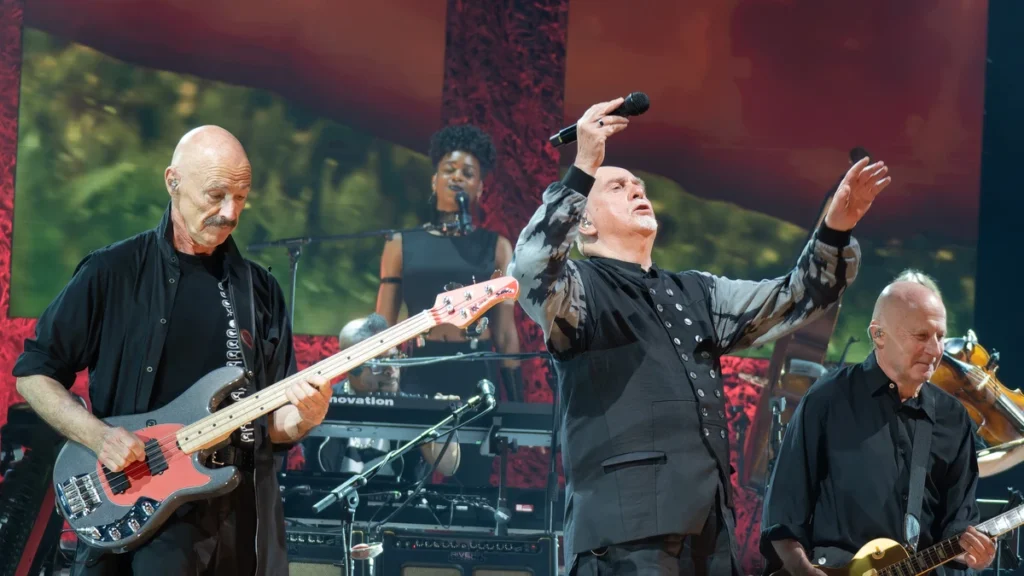
The core players will be familiar to anyone who has followed Gabriel’s records. David Rhodes plays guitar, Tony Levin plays bass and Manu Katché plays drums, joined by touring musicians Richard Evans, Josh Shpak and Don E. The guest list stretches across genres and decades: Brian Eno, guitarists Leo Nocentelli and Tony Berg, drummer Abe Rounds, pianist Tom Cawley, trumpeter Paolo Fresu, cellist Linnea Olsson, multi-instrumentalist Evan Smith and Gabriel’s daughter Melanie Gabriel on vocals.
The bigger ensembles add the scale. The New Blood Orchestra, led by John Metcalfe, the Soweto Gospel Choir and the Swedish male choir Orphei Drängar all appear, according to the release details. Mike Elizondo, who mixed one of the Dark-Side versions, also co-produced A Hard Lesson.
The album was recorded primarily at Real World Studios and at Gabriel’s home studio. Three years separate i/o and oi, the shortest gap between his studio albums since the early 1980s, according to The Prog Report.
What oi Is About
The themes carry on from i/o: our relationship with nature, the passing of time, the growing influence of technology and the question of where a person fits in the world. Gabriel put it simply. “Trying to get a handle on where you fit in life, that’s what I write about a lot,” he said in the album notes. On nature he was more direct still: “We are something else, a part of nature, a part of everything.”
Technology is the newer pressure. Speaking about the album, Gabriel said, as reported by SPIN, that “we are sliding into a period of transition like no other”, pointing to artificial intelligence, quantum computing and brain-computer interfaces as the forces behind it. He has also described the two albums as a pair of directions: “i/o: the inside has a new way out and oi: the outside has a new way in.”
The visual side reflects the same outward turn. Each song is paired with artwork by an international artist, among them Judy Chicago, Shirin Neshat, Tomás Saraceno, Francis Alÿs, Tatsuo Miyajima, Janaina Mello Landini, Berndnaut Smilde, Tishan Hsu and Michal Rovner, and the cover photograph is by Nadav Kander. The pairing turns each of the 13 songs into a small exhibition as well as a track.
How to Hear Every Version of oi
Because the mixes are the point, the formats matter more than usual. According to the release details, the 4CD package is the only physical edition that carries both stereo mixes together. The vinyl is split: a double LP of the Bright-Side mixes and a separate double LP of the Dark-Side mixes, each on black vinyl at 33rpm in a gatefold sleeve with an obi strip, a 32-page booklet and a download card. Coloured vinyl versions are sold as retail exclusives. The Dolby Atmos In-Side mix is available only digitally, so listeners who want all three versions will need more than one format.
The Songs Critics Are Singling Out
The tracklist runs: Been Undone, Put the Bucket Down, What Lies Ahead, Till Your Mind Is Shining, Won’t Stand Down, Who Are We Talking To?, Yes, It Will Go, One by One, A Hard Lesson, Face the Wall, I Belong to the Sky, Looking for the Happy and Sacrament.
In his four-star MOJO review, Doyle pointed to the “tumbling rhythms” of the opener, Been Undone, and to the “funky, Zen-like state” of Till Your Mind Is Shining. He singled out Face the Wall as “gently pulsing, melodically rich”, with Gabriel “affectingly ruminating on mortality”.
Across the whole record, Doyle found it “immaculately produced as ever” and wrote that “Gabriel is in fine voice”. For an album that runs past 80 minutes, his most useful line may be the simplest: “it grips the attention throughout”.
What the Moon Schedule Means for Listeners Now
For anyone who followed the monthly releases, oi arrives as a reunion rather than a first listen, with three new songs and the full running order finally in place. For anyone who did not, it is the rare modern album built to be heard slowly, with two stereo versions of every song to compare and an Atmos mix for headphones and home systems.
Patient, long-form records are not only the preserve of veterans. We looked at one recent example in how Radie Peat made her solo debut the way Mike Oldfield made Tubular Bells. Peter Gabriel has turned that patience into a release strategy. Whether listeners take oi a moon at a time or all 82 minutes at once, the record rewards the time it asks for.