
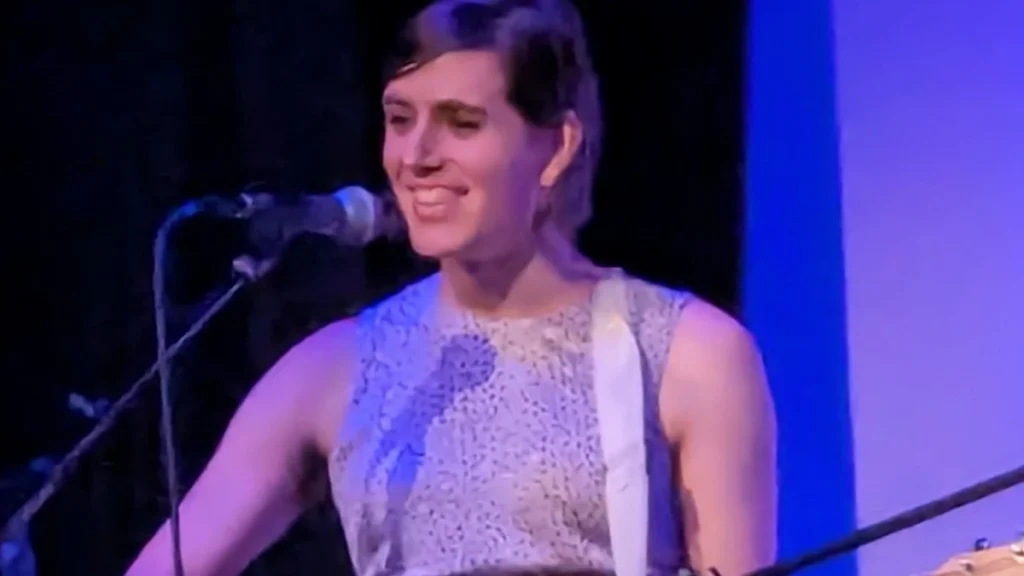
The first sound on Goodbye Small Head is a string section, and the second is a synth humming somewhere underneath it. Then a breakbeat arrives, skittering and slightly wrong-footed, and a voice starts asking to be let out of a moving car. Ezra Furman has a phrase for the combination: an orchestral emo prog-rock record sprinkled with samples. It is an unwieldy description, and it is accurate.
The album came out on Bella Union on 16 May 2025, produced by Brian Deck and recorded in Chicago, where Furman is from. Twelve songs run forty-two minutes. It reached number three on the UK Independent Albums chart, and in January she takes it across Europe and Britain for fourteen nights, opening at Arena Wien in Vienna on the 19th.
Where the Songs Came From
Furman has been open about the circumstances. The material arrived in a rush after a period of illness in early 2023, and she has described the writing as happening inside the experience rather than after it: “This poetry, my poetry, arrived in the midst of the storm. It was written as I teetered toward the edge.”
She is precise about what that does and does not mean for the songs. “They’re not about someone going off the rails,” she has said, “they are inside that person’s heart.” That distinction matters to how the record works. It is not a set of case notes written in retrospect, and it does not resolve, because it was not made from a position where resolution was available.
The Sound of Losing Control
The production carries the argument. Sweeping strings sit against low synths and chopped-up voice samples, and the rhythm section keeps declining to settle. Furman has said the twelve songs delineate a loss of control through means both conventional and not, listing weakness, heartbreak, mysticism, drugs, and living in society with your eyes open.
Set against that lyrical content, the arrangements are unexpectedly lush. Mojo called it her calmest record, flecked with ballads and strings, which is a fair reading of the surface and slightly misses what is underneath. The calm is the frame, not the subject. Putting an unravelling into an orchestral setting is a compositional decision that makes the unravelling more legible, not less.
Four Songs That Show the Method
Jump Out opens on buoyant strings and that low hum, with Furman wailing at a driver who has no intention of stopping. Grand Mal is the most developed of the openers in her catalogue, lush and swaying, and, as The Line of Best Fit observed, oddly lullabying for a song about a seizure.
You Mustn’t Show Weakness sets brooding breakbeats under a mantra Furman directs at herself, an instruction not to fold. A World of Love and Care is the album’s most affecting stretch, built on questions about what a society actually guarantees anyone. The record closes on I Need the Angel, the one song here Furman did not write, an electric reading of an Alex Walton composition delivered with heartland rock riffage.
The rest of the running order keeps widening the palette rather than settling it. Sudden Storm and Power of the Moon sit early, the latter the longest thing on the first half at four and a half minutes. Submission, Veil Song and Slow Burn run consecutively through the middle, and You Hurt Me, I Hate You is the bluntest title on a record otherwise inclined toward metaphor. Strange Girl follows it. The bossa nova influence that reviewers kept noting surfaces in the rhythmic feel of these central tracks rather than in any single arrangement, which is why the album can move between genres without ever sounding like a compilation of styles.
What the Reviews Landed On
The reception was strong and unusually consistent about why. DIY gave it four and a half out of five and called the lyrics some of her finest, unafraid of the darkest corners. Hot Press scored it eight out of ten and identified the theme precisely: the songs are explicitly about the act, and the art, of losing control.
The Line of Best Fit’s Dom Lepore gave it seven out of ten and framed it as a novel and necessary display of fervour in a hypervigilant era. MusicOMH went four out of five, describing Furman as one of the most exciting songwriters working. Nobody found it an easy listen, and nobody suggested it should have been.
The commercial pattern matched that critical one. Number three on the UK Independent Albums chart is a genuine result for a record on a label the size of Bella Union, and it sits alongside 23 on UK Album Downloads and 38 in Scotland. Those are the numbers of an artist with a committed audience rather than a broad one, which is the position Furman has occupied for most of a career now spanning more than a decade and a half, first with bands and latterly under her own name.
Fourteen Nights in Winter
The touring plan is dense. January runs Vienna, then Graz’s Dom Im Berg, Linz’s Posthof and Munich’s Strom on consecutive nights, followed by Prague, Berlin’s Columbia Theater, Hamburg’s Molotow, Amsterdam’s Paradiso Tolhuistuin, Antwerp’s Trix Club and Le Cabaret Sauvage in Paris. February brings Glasgow’s Art School, New Century Hall in Manchester, Bristol’s Electric, and the O2 Forum Kentish Town in London on the 4th.
Those are club and mid-size rooms rather than arenas, which suits material this intimate, and the routing is the compact European circuit an independent-label artist plays when the record has done well without crossing over. North American dates ran through the second half of 2025, so the UK and European leg is the album’s long tail rather than its launch.
Winter routing of that density also tells you something about how the show is built. Ten European dates inside eleven nights leaves no room for elaborate staging or a large touring party, which points to a set carried by the songs and a small band rather than by production. For a record this dependent on strings and samples, reproducing it live is the interesting problem, and the venues suggest the answer is rearrangement rather than replication.
Why It Reads as Queer Music
Furman is a trans woman and has written about faith, gender and belonging across her catalogue, but the reason this record belongs in that conversation is structural rather than topical. Very little of it is about identity in a declarative way. It is about being unable to trust your own footing, and about the gap between how you are managing and how you are required to appear.
That is a queer record in the sense that matters: it treats the pressure to present as composed as the actual subject, rather than as background. You Mustn’t Show Weakness is the clearest statement of it, an instruction delivered to oneself in a voice that plainly does not believe it.
An Artist Who Kept the Framing
What comes through across the album, the interviews and the reviews is how firmly Furman has held onto her own account of the record. She named the genre, defined the subject and drew the line between writing from inside an experience and reporting on it afterwards. Critics have largely adopted her terms, which does not always happen.
It puts her among a set of artists currently insisting on authorship over the frame as well as the music, in the way Leon Thomas spent two decades producing for other people before making the record with his own name on it. Furman’s version is quieter and harder to sell, and the fourteen January dates suggest an audience that turned up for exactly that.
About The Author

More From NewMusic.News
-
The Long Way to Bebopping Along: Phil Lentz Trades the Newsroom for Bebop Piano
-
The Long Way to In My Head: Bite To Break and a Cymbal Sale
-
The Long Way to Late Night Drive, Where Gio 22/6 Brings Rado Ricky and Ty Lab Together
-
TOP NINJA and Hell Rell Take the Long Way to Birds Eye From Terrace Avenue
-
Inside Effervescence: How Logan Threshold Built a One-Man Synth Rock Debut