
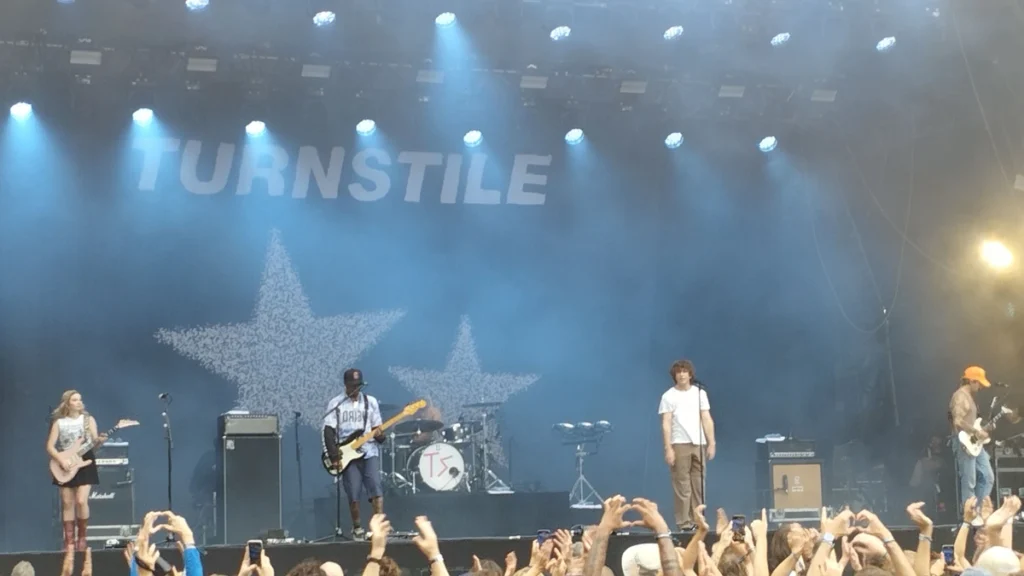
Somewhere on the guest list for Never Enough: Versions, Elton John’s name sits a few lines away from Dying Fetus, a death metal band from Maryland whose song titles are not printable in most contexts. Both are reworking material from the same album. That single fact tells you more about where Turnstile have arrived than any chart position does.
The record is out today, 28 August 2026, and it reinterprets Never Enough, the band’s fourth album, which came out on Roadrunner in June 2025 and won Best Rock Album at the 68th Grammy Awards. More than twenty artists contribute. When the project was announced a week ago, the band had not said which guest had taken which song, and that omission looks deliberate.
The Guest List Is the Statement
Read it in full and the logic emerges. There are pop figures of the largest possible scale and there is extreme metal. There is electronic music from several unrelated corners: Four Tet, Floating Points, A. G. Cook, Kettama, Dan Deacon. There are songwriters working in confessional registers, Julien Baker and Mustafa and Faye Webster, alongside Blood Orange, Oklou, Porches, Alex G, Chanel Beads and Nourished by Time.
Then there are the Baltimore inclusions, which are the ones that explain the rest. Rod Lee is a Baltimore club producer. Brandon Woody is a Baltimore trumpeter. Angel Du$t is a band Turnstile members play in. A remix album assembled purely for reach would not bother with any of them, and their presence turns the project from a marketing exercise into something closer to a map of where the band actually come from.
What They Are Reworking
Never Enough runs fourteen tracks and forty-five minutes, produced by the band’s singer Brendan Yates, with Will Yip engineering and contributing additional production, and A. G. Cook adding production to Dull. It arrived after three singles: the title track in April 2025, then Seein’ Stars paired with Birds later that month, and Look Out for Me in May.
The album is already an unusual object for a hardcore band. Look Out for Me runs nearly seven minutes; Ceiling lasts seventy-three seconds. Kerrang! called it cinematic in scope and execution and made it their album of the year. The Guardian, giving it four out of five, described a profusion of ideas deftly handled. Metacritic settled at 83 from nineteen reviews. Pitchfork was cooler at 7.8, hearing 1980s nostalgia in it.
The structure is what makes it reworkable. A record built from uniform three-minute songs offers a remixer one obvious job: change the drums, extend the intro, deliver a version. Never Enough does not offer that. Its lengths run from Ceiling at seventy-three seconds to Look Out for Me at six minutes forty-four, and the album keeps interrupting itself with short instrumental passages that function as breathing room rather than transitions. Handing that to twenty-three artists produces twenty-three different problems rather than one repeated exercise, which is presumably the point.
Five reviewers gave it full marks, including Kerrang!, NME and The Arts Desk, while Rolling Stone stopped at three and a half out of five and AllMusic gave four and a half. That spread of enthusiasm without consensus is characteristic of records that cross over from a scene: the outlets closest to the genre were the most emphatic, and the general-interest press admired it at a slight distance.
A Hardcore Band at Number Nine
Commercially the record did something the genre rarely does. It entered the Billboard 200 at nine, the highest placing of the band’s career, on 38,000 album-equivalent units of which 27,500 were pure sales. It went to number one on both the US Top Hard Rock chart and the UK Rock and Metal chart, eleven in the UK overall, five in Australia and seven in Germany.
Then the year-end lists arrived and the spread was telling: first at Kerrang!, fourth at Exclaim!, eighth at NME, tenth at Billboard, fifteenth at The Guardian, eighteenth at Consequence, thirty-first at Rolling Stone. Publications with no shared readership all found room for the same hardcore record, which is the precondition for a guest list this wide.
Two Grammys, and Which Ones
At the 68th Grammy Awards the band won Best Rock Album, and Birds won Best Metal Performance. They were also nominated for Best Rock Performance for the title track and Best Alternative Music Performance for Seein’ Stars.
Those four nominations sit in three different genre families, which is the institutional version of the same point the guest list makes. Birds runs two minutes and twenty-six seconds and was judged metal; Seein’ Stars, from the same session and the same album, was judged alternative. The band did not change between tracks. The categories simply could not agree on what they were listening to.
Ninety-Four Shows and Counting
The touring has been relentless. The Never Enough Tour opened in Nashville on 15 September 2025 and ran to 94 shows across nine legs, through North America, Europe, Australia and New Zealand, Latin America and Asia, originally closing in Australia in January. Venues climbed accordingly, from clubs to Forest Hills Stadium in Queens, Alexandra Palace in London and the Palau Sant Jordi in Barcelona.
More than thirty-five support acts appeared across it, and the choices repeat the pattern: hardcore institutions like Hatebreed, Terror and Agnostic Front on some nights, Blood Orange, Yves Tumor, Clipse and Vince Staples on others. The 2026 festival run took in Coachella across both weekends, Lollapalooza in Chicago, Austin City Limits across two weekends in October, Fuji Rock, Outside Lands and Osheaga.
Ninety-four shows across five continents in roughly sixteen months is a workload closer to a legacy act’s than a hardcore band’s, and it explains why the reissue arrives when it does. The album has been played nightly for a year; the songs have already been reshaped once by the road before any guest touched them. A remix collection released at the end of that cycle is documenting a record that has stopped being fixed rather than one that was ever finished.
Pt. 2, and the Nonprofits
Never Enough Tour Pt. 2 opens on 9 September in Milwaukee, a sixteen-date headline run with curated bills rather than a single support act. The lineups again refuse to pick a lane, mixing Clipse and Vince Staples with Hatebreed, Pennywise, Ceremony, Cold World and Texas Is the Reason.
The detail worth noting is that the band are partnering with local nonprofit organisations at every date, with an on-the-ground presence at each stop. That is a hardcore-scene convention scaled up to amphitheatre level, and it is the clearest sign that the band’s growth has not come with a change of operating principles.
Why the Anonymity Matters
Withholding which artist took which track is the most interesting decision in the whole project. A remix album normally sells itself on exactly that information: you go to the track by the person you already like. Removing the index forces a listener through the record in order, which is how the band sequenced the original, with its seventy-three-second interludes and its seven-minute centrepiece.
It also protects the thing that made Never Enough work. This is a band who won a metal Grammy and an alternative nomination for two songs recorded in the same room, in the same way Leon Thomas took Best R&B Album for a record he produced himself after years of being credited on other people’s. Turnstile have spent an album cycle refusing to be sorted. Handing twenty-three artists the same fourteen songs, and declining to label the results, is the most consistent thing they could have done next.
About The Author

More From NewMusic.News
-
The Long Way to Bebopping Along: Phil Lentz Trades the Newsroom for Bebop Piano
-
The Long Way to In My Head: Bite To Break and a Cymbal Sale
-
The Long Way to Late Night Drive, Where Gio 22/6 Brings Rado Ricky and Ty Lab Together
-
TOP NINJA and Hell Rell Take the Long Way to Birds Eye From Terrace Avenue
-
Inside Effervescence: How Logan Threshold Built a One-Man Synth Rock Debut