Lang Lang Recorded Game Soundtracks for Piano Book 2
Somewhere across the two discs of Piano Book 2, between Bach and Satie, Lang Lang plays Rush E. That is a piece by Andrew Wrangell written to be effectively unplayable, a joke about virtuosity that circulated as an internet video before anybody attempted it seriously, and it is now on a Deutsche Grammophon release.
The album came out on 17 October 2025 and contains thirty-two pieces. The rest of the list is almost as unusual: Nobuo Uematsu’s music from Final Fantasy X, Yu-Peng Chen’s writing for Genshin Impact and Black Myth: Wukong, themes from Naruto, Amélie, La La Land and Cinema Paradiso, and a jazz standard associated with Thelonious Monk.
Where the Repertoire Came From
The selection method is the point. Lang Lang has said the pieces were chosen from messages sent by listeners, from school music syllabuses, from what he has learned teaching, and from works that matter to him personally. He calls the thirty-two miniature masterpieces.
School syllabuses are the giveaway. This is a record aimed squarely at people who are learning the instrument, which is why the limited CD edition carries an NFC chip linking to downloadable sheet music and tutorials, and why Faber Music is publishing a companion book with the scores, photographs and his commentary.
Very few artists at his level design an album around whether the audience can play it themselves. It reframes the release as a teaching object rather than a recital, and it explains the presence of pieces that no concert programme would touch.
Classical, Contemporary and a Game Composer
The traditional half of the album covers Bach, Mozart, Chopin, Liszt, Rachmaninoff, Satie and Debussy. The first single, released on 5 September 2025, was Liszt’s second Consolation, which is about as gentle an entry point to Liszt as exists.
The contemporary half runs through Ludovico Einaudi’s Fly, Joe Hisaishi’s Spring, and Tony Ann’s Icarus, the last in a new four-hands arrangement made for the album and premiered with the composer at the Beijing launch.
Yu-Peng Chen is the most interesting inclusion. He composes for Chinese games with enormous international audiences, and his music is heard by far more people than most living concert composers manage, almost entirely by players who would never describe themselves as classical listeners.
A Cartoon Started All of This
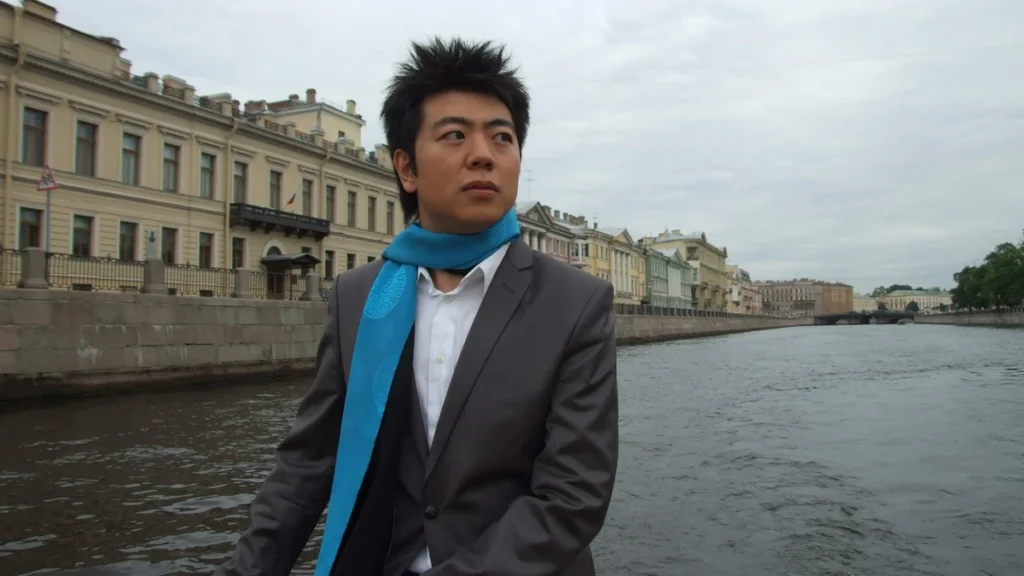
Lang Lang was born in Shenyang in 1982 to a Manchu family; his father, Lang Guoren, plays the erhu. He began lessons at three, having been set off by the Tom and Jerry episode The Cat Concerto, which is built around Liszt’s second Hungarian Rhapsody.
The Beijing launch event for Piano Book 2 featured an appearance by Tom and Jerry. That is a piece of promotional staging with an unusually direct justification: the cartoon is the reason there is a career to promote.
The rest of the training was conventional and difficult. At nine he was thrown out of his tutor’s studio for a supposed lack of talent. He continued with another teacher, studied under Zhao Ping-Guo at the Central Conservatory in Beijing, won the Xinghai National Piano Competition in 1993, and moved to the United States in 1997 to study with Gary Graffman at Curtis.
What Rush E Actually Is
It is worth being precise about the strangest thing on the album, because the joke only works if you know the setup. Rush E began as a demonstration of what music notation software will happily print but no pair of hands can execute: a cascade of notes at a density beyond human reach, produced to be watched as a scrolling video rather than performed.
It became a fixture of piano internet culture, and a genre of response videos grew around pianists attempting to play as much of it as physically possible. Recording it for a major classical label collapses that whole ecosystem into a single track, and it does so without any explanatory apparatus: it simply appears between pieces by composers who have been dead for a century.
There is a serious point buried in it. The virtuoso tradition Liszt invented was always partly about spectacle and the appearance of impossibility, and Rush E is that instinct running without a human performer at the centre. A pianist of Lang Lang’s standing playing it is a comment on his own tradition as much as on the internet.
The First One Did 1.2 Billion Streams
Piano Book, in 2019, has passed 1.2 billion streams and is among the most successful classical albums released this century. Lang Lang has more than four and a quarter million monthly listeners on Spotify, which is an order of magnitude beyond almost any other classical soloist.
Those numbers explain why Deutsche Grammophon would release a follow-up containing game music. An artist delivering that kind of audience earns the right to define what goes on the record, and the label’s calculation is presumably that the people who streamed the first one are not primarily concert-goers.
Two Labels and Back Again
He recorded for Telarc and Deutsche Grammophon early on, signed to Sony in 2010 for a reported three million dollars, and returned to Deutsche Grammophon under Universal in 2017. His Beethoven first and fourth concertos with the Orchestre de Paris went to number one on the traditional classical Billboard chart.
The institutional recognition has followed: Time named him among the hundred most influential people in 2009, Gramophone put him in its Hall of Fame in 2012, UNICEF made him a goodwill ambassador in 2004, and the United Nations named him a Messenger of Peace in 2013.
The Argument About Accessibility
Lang Lang has spent two decades being described as evangelical about widening the audience for classical music, and just as long being criticised for it. The Lang Lang International Music Foundation, launched in New York in October 2008, is the formal version of that project.
Piano Book 2 is the least ambiguous statement of the position he has made. Putting Final Fantasy and Chopin on the same release argues that the distinction between them is a matter of where a piece came from rather than what it is worth, and pairing it with sheet music makes the argument practical instead of rhetorical.
It is a different route to the same destination as Víkingur Ólafsson recording Bach in a studio under his house. Both are pianists with very large streaming audiences reorganising how the music reaches people: one by removing the recording studio’s formality, the other by removing the repertoire’s.
The counter-argument is the obvious one, that an album containing a viral internet piece is chasing attention rather than serving music. The response is in the track list. Rush E sits among Bach, Debussy and Rachmaninoff, played by somebody who could programme anything he wanted, and nothing about its inclusion prevents a listener from finding the Liszt.
The formats reinforce it. Two CDs, two LPs including a marbled vinyl edition, a score edition, signed art cards, and the NFC chip with the tutorials: this is a release designed to be bought in a physical form and then used. That is an odd strategy in 2025 and a coherent one for a record whose audience is expected to sit at an instrument afterwards.