
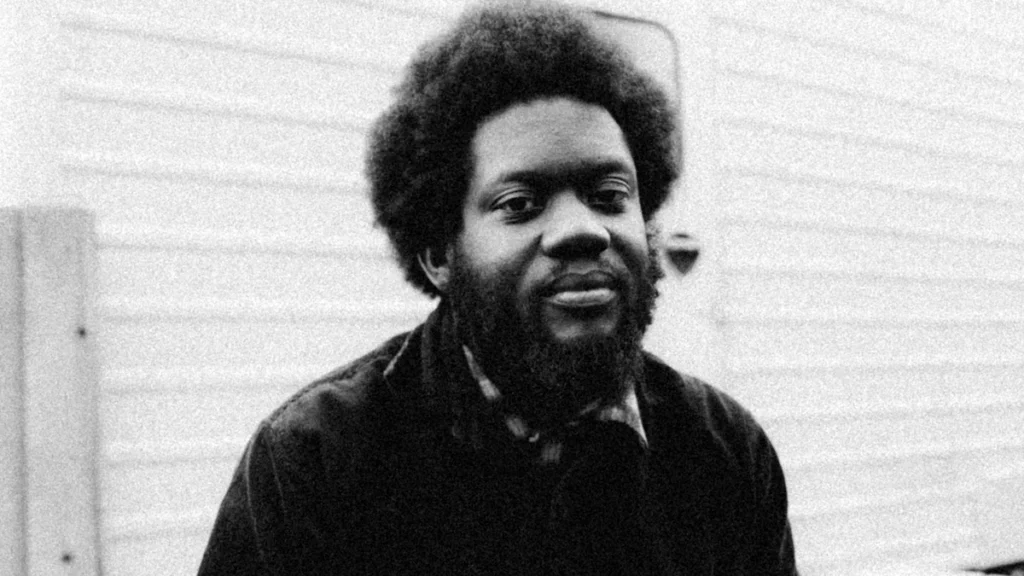
Michael Kiwanuka. Photo: Jodie Canwell
The first voice on FUDGE does not belong to Michael Kiwanuka. It belongs to the jazz pianist Chick Corea, heard on a recording at the start of “Summer Clothes”, explaining that music is about “creating the kind of things that you think are beautiful”. Kiwanuka placed those words at the front of the album, and they explain the whole project. FUDGE is the record he built when he decided to trust his own taste: produced by Kiwanuka himself, recorded in a modest studio near his Southampton home, and made without Inflo and Danger Mouse, the producers whose rich, psychedelic sound had become his calling card.
He finished it. Then, in July 2025, a haemorrhagic stroke stopped everything. A tour was cancelled, the album was shelved, and for more than a year Michael Kiwanuka was out of public view. FUDGE finally arrived on 23 October through Polydor, released with his blessing while his rehabilitation continues. This is how it was made, what happened next, and why its songs now carry a weight nobody planned for.
A Record Built Away From His Usual Team
FUDGE began life in the middle of something else. According to Far Out, Kiwanuka started it halfway through making his previous album, 2024’s Small Changes, as a way to keep his creative flow going away from his trusted collaborators and to take production into his own hands. The Line of Best Fit describes the two records as conceived effectively in tandem, but FUDGE was largely built in a modest Southampton studio, and it is the first time since 2012’s Home Again that Kiwanuka has worked without Inflo and Danger Mouse.
He was not entirely alone. NME’s review notes that he recorded with trusted collaborators such as the multi-instrumentalist Joe Connell, and that the producer Dom Monks, whose credits include Laura Marling and Big Thief, and the long-standing strings collaborator Rosie Danvers, who has worked with Adele and Coldplay, made valuable contributions later. The decisions, though, were his. NME reads the album’s bright, bubblegum visual identity as a sign of what he was chasing: playfulness and experimentation.
It also came quickly by his standards. Far Out points out that FUDGE was ready to go less than a year after Small Changes was released, the smallest gap between records in his career. Its reviewer hears much of the writing as an amicable breakup record between Kiwanuka and his old methods, an artist deciding, gently, to do things another way.
What Happened in July 2025
The reason for the silence became public with the album’s announcement. In an interview with the Guardian, quoted in NME’s review, Kiwanuka explained that he wanted people to understand why he had not been around, and that he was sharing his own pain because struggle is something every person can relate to.
The facts are stark. In July 2025, at 38, he suffered a haemorrhagic stroke caused by undiagnosed high blood pressure. NME reports that he underwent emergency surgery and months of intensive care, followed by many more months of rehabilitation at a medical centre in Hampshire, where he remained when the album was released. A report on Yahoo News UK, drawing on the same interview, says he spent five months in hospital before moving to the rehabilitation centre, and that he has not been able to return home since.
The recovery has been physical and vocal. He described daily rehab sessions and a lot of stretching, and explained that the brain injury had affected some of the pathways to parts of his body. A breathing tube had weakened his vocal cords, leaving him speaking at a very low volume for a time, and he has had to build their strength back up. Through it all he kept singing, working through songs by Bob Dylan and the Beach Boys, and in hospital he kept a notepad and wrote lyrics down every day. He has said he still has as much drive to make good music as he has ever had.
The Message He Wants People to Hear
Kiwanuka has been clear about one thing above all. He did not know his blood pressure was high, and he has said that if he had known, he would have been checked and put on medication, and in his view he would not have had the stroke. He wants his story to encourage Black people to get their blood pressure tested, because, as the Yahoo News UK report notes, Black men are believed to be more susceptible.
It is an unusual thing to find at the centre of an album campaign, and it may be the most useful part of this story to pass on. His point is simple: he had no idea he was unwell until the crisis came, and he believes that knowing would have changed the outcome.
Inside the 12 Tracks of FUDGE
FUDGE runs to 12 songs and just over an hour. As listed on his official Bandcamp page, they are Summer Clothes, California, Just Another Moment, Drowning In Your Heart, Love In My Heart, Across The Sky, Stars, You Sent Me Flying, Move In My Direction, Steve’s Paradise, Sing and Swings and Roundabouts.
The Line of Best Fit hears “Summer Clothes” unfold into female-led harmonies that recall the sweep of 2016’s “Cold Little Heart”, without that song’s dramatic drums. “California” brings the rhythm section back, with a telephone-filtered vocal the review compares to Damon Albarn’s work as 2-D, until Kiwanuka’s voice audibly catches on the word “wonderful”. The seven-minute “Love In My Heart” reaches towards the handmade psychedelic soul of Shuggie Otis’s Inspiration Information, and Far Out names it the standout track.
Elsewhere, “Across The Sky” pares back to an acoustic reckoning with mortality and artistic posterity, and “Stars”, an older composition, cuts through the album’s candyfloss palette with angular, fuzz-smeared guitar. The album’s Bandcamp page notes that half of the tracks run to five minutes or more and calls FUDGE a tribute to taking your time. On “Steve’s Paradise”, Kiwanuka’s voice does not arrive until roughly halfway through, leaving the space to organ, sliding guitar and backing harmonies.
Songs That Sound Different Now
Everything on FUDGE was written and recorded before the stroke, but it is impossible to hear it the same way now, and the reviews have said so. NME points to the spacious chorus of the penultimate track, “Sing”: “We’re nowhere if we never sing / Sing / Sing.” Knowing how hard Kiwanuka has had to work to get his voice back, the line lands with a weight it was never meant to carry.
Far Out finds the same thing in two other lyrics: “I’m scared of putting it all on the shelf” on “Sing”, and “I remember when I played I used to feel, now I don’t feel a thing” on “Stars”. Written about creative change and parting ways with old collaborators, they now read, in that review’s words, as if he were addressing his own circumstances in a prophetically heartbreaking way.
Kiwanuka himself has framed the music as something the stroke could not reach. He told the Guardian that while a stroke can take a lot of things away, it cannot take those songs, and that the person he was still exists in them. For the NewMusic.News desk, that is the right way to meet the record: “FUDGE is the sound of an artist trusting his own taste, and it deserves to be heard on those terms.”
What the Critics Make of FUDGE
NME calls the album a powerful portrait of a man on the precipice of tragedy, both an unexpected gift and a deeply poignant glimpse of his creative state before a life-altering moment. Its verdict ends with an instruction: “Drink it in, let it warm your soul, and be reminded how lucky we are to have an artist like Kiwanuka.”
The Line of Best Fit is more measured at 7/10. Rhys Morgan finds the album often beautiful and sometimes thrillingly strange, but argues that at just over an hour it “sometimes confuses the luxury of time with the impulse to use all of it”. He still closes generously: “He has earned the right to wander.”
Far Out concludes that Kiwanuka has made a record of sprawling, elegant songs that invoke loss, confusion and hard goodbyes. Together, the reviews describe an album that was meant to be a playful side road and became something heavier through no choice of its maker. For another record shaped by an unusual decision in the studio, read why DIIV let A. G. Cook record the drums before the songs were done. For FUDGE, start with “Love In My Heart” and stay for “Sing”.
About The Author

More From NewMusic.News
-
ANTHEM by CMONEY Ended Seven Months Without a Single, in 97 Seconds of Self-Produced Rap
-
Inside All in Vain: How Aces Low Built a Nu Metal Breakup Song Over Discord
-
Of Your Touch by Zhenyok Chem Brat, Revisited as Lay Your Heart Down Follows Two Years Later
-
Saturn Spiders on Romantic Rock, Lou Reed and the Making of Sweet Surrender
-
Phil Lentz Presents… Vol. II Arrived in Election Month, From a Star-Ledger Newsman Turned Jazz Pianist