
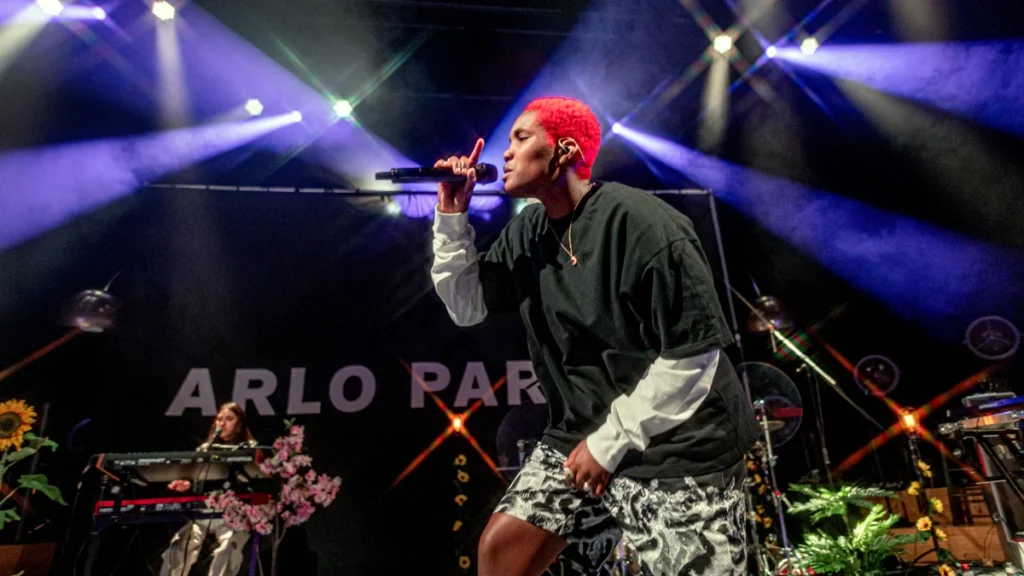
Ambiguous Desire Rebuilds Arlo Parks Around a New York Dancefloor
There is a particular kind of record an artist makes when the thing they were known for stops fitting. Arlo Parks built a career on proximity: songs that sounded like they were being said to one person, close enough to hear the breath. Ambiguous Desire, released on 3 April 2026 through Transgressive Records, is what happened when she stopped writing for a bedroom and started writing for a room with a soundsystem in it.
Twelve tracks, forty minutes and one second, and a set of credits that looks nothing like her first two albums. It is not a reinvention in the marketing sense, where an artist puts on a costume and calls it a chapter. It is more specific and more interesting than that: a songwriter working out what happens to her actual technique when the tempo doubles and the room gets louder.
What Changed Between My Soft Machine and This Record
My Soft Machine arrived in 2023 and stayed close to the template that made Collapsed in Sunbeams work. The vocal sat forward, the arrangements deferred to it, and the emotional register was confessional in the literal sense: someone telling you a thing they had not told many people.
Ambiguous Desire keeps the writing and moves everything underneath it. The first two singles set the terms early. Ticketmaster’s tour announcement noted that “Heaven” and “2SIDED” both lean into house music and UK garage, sounds Parks reached for after immersing herself in club culture. That is a real structural change, not a texture. House and garage put the vocal in a different relationship to the track: it stops being the thing everything else supports and becomes one element inside a groove that would keep going without it.
You can hear the consequence across the record. Phrases get shorter. Lines repeat where they would previously have developed. The writing has to survive being looped, which is a different discipline from writing something that only has to land once.
The Break-Up That Sent Her to the Club
The turn was personal before it was musical, and Parks has been unusually direct about the sequence. “I danced more than ever as I made this record, I made more friends than ever too, found myself in the weird underbelly of New York juke nights,” she said in the tour announcement.
That detail matters more than it looks. Dance records made by non-dance artists often fail because the writer treats the club as an aesthetic rather than a place they have actually stood in at three in the morning. Parks describes going repeatedly, socially, over a period long enough for it to change what she found interesting. The record reads as reportage from somewhere she had been, rather than a genre exercise assembled from references.
She has framed the album’s organising idea in the same plain terms: “This record has desire at its center. Desire is a life force, it’s a wanting, a yearning, a momentum.” Momentum is the operative word. It is a description of a feeling and a description of a rhythm section, and on this album those are the same claim.
Eight Producers, and Why That Is Not a Warning Sign
The credits list eight producers: Parks herself, alongside Paul Epworth, Rob Bisel, Andrew Sarlo, Buddy Ross, Romil Hemnani, Baird and Dylan Neustadter. On paper that is the shape of a record made by committee, the kind of album where a label throws names at a problem until something sticks.
It does not play that way, and the reason is in the rest of the credits. David Wrench mixed the album, and a single mixer across twelve tracks is what stops a multi-producer record from sounding like a compilation. Wrench is the continuity: whatever came in from whichever room, it leaves through one set of decisions about space and low end.
Epworth also appears as a musician rather than only a producer, credited with guitar, synthesiser, drums and bass, which suggests sessions where things were played rather than assembled. Simon Martinez plays guitar, Ryan Raines drums, and Brad Oberhofer piano. That is a band’s worth of human performance sitting underneath music that could easily have been programmed end to end.
How the Singles Mapped the Turn
The rollout was unusually long and unusually deliberate. “2Sided” came first on 13 January 2026, followed by “Heaven” on 2 February, “Get Go” on 10 March and “Beams” on 31 March, three days before the album. “Senses”, the Sampha collaboration, followed on 22 May, and a “Floette” remix with John Glacier arrived on 4 August.
Read in order, that sequence is an argument. The two most club-facing tracks went first, which is the opposite of the cautious approach, where an artist leads with the song closest to what audiences already expect. Parks led with the change. By the time the album arrived, anyone who had been paying attention had already decided how they felt about the new tempo.
The Sampha feature landing seven weeks after release is the other tell. A guest of that profile is normally spent on launch week. Holding it back suggests confidence that the record could open on its own terms.
What the Reviews Actually Split On
Critical response was warm without being unanimous, which is usually what an interesting record produces. Metacritic settled at 77 from a spread that ran from Hot Press at 9/10 and DIY at four and a half stars down to Paste at B-. Pitchfork landed at 7.1, Clash and Exclaim! both at 8/10, and The Independent and Rolling Stone UK at four stars.
The commercial picture was similarly split by category rather than by quality. The album reached number 13 on the UK albums chart, which is respectable rather than dominant, and number one on the UK independent albums chart, which is the number that actually describes its position. It also charted in Scotland at four, Germany at 43 and Switzerland at 50.
A number 13 peak alongside an independent number one is the signature of a record with a committed audience rather than a passive one, and that is the audience a tour of this length is built for.
The Desire Tour Puts the Record in the Room It Came From
The North American leg opens on 29 August at The Howard Theatre in Washington, D.C., then runs through Philadelphia, Boston, Montreal, Toronto, Detroit, Dallas, Austin, San Diego, Los Angeles, San Francisco, Seattle, Vancouver, Portland, Salt Lake City, Denver and Chicago, closing at Knockdown Center in Queens on 1 October. The UK and Ireland follow, with O2 Academy Brixton on 20 October, and Europe carries it to Stockholm on 2 December.
The venues are the point. These are mid-size rooms with proper soundsystems rather than seated theatres, and a record built on low end and repetition needs the former. Parks’ own framing of the tour was characteristically unfussy: “Let’s laugh, cry and move our bodies.”
What will be worth watching is the older material. A catalogue written for close listening has to survive a set built around a four-to-the-floor spine, and the usual solution is rearrangement rather than omission. It is the same problem, viewed from the other end, as the one this album set itself: how a voice trained for intimacy holds its shape at volume. Readers curious about how that voice gets constructed in the first place may find our piece on how a pop vocal actually gets built a useful companion.
Ambiguous Desire is out now on Transgressive Records. The Desire Tour runs from 29 August to 2 December.