
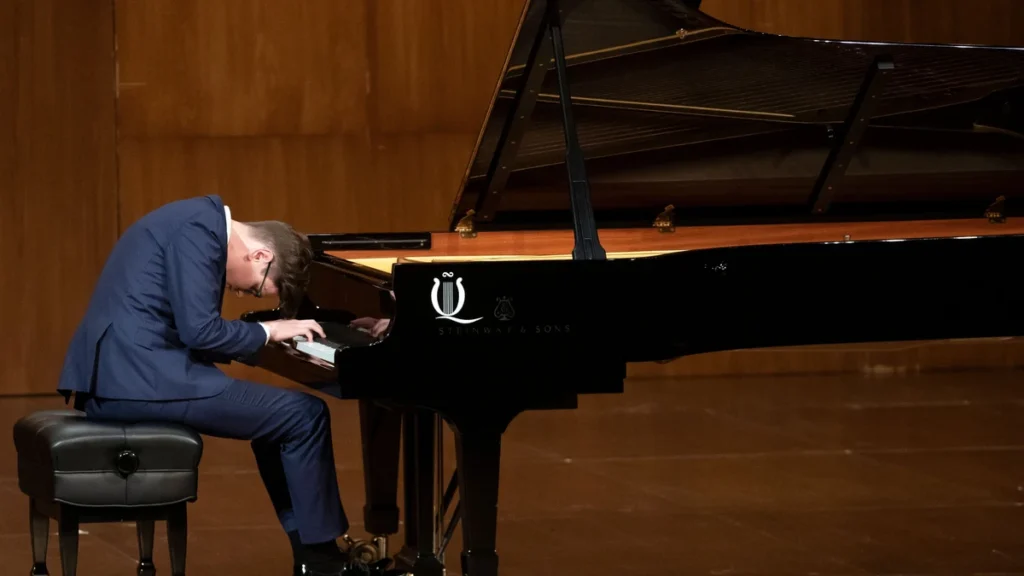
Víkingur Ólafsson Made His Bach Album in a Home Studio
There is a room under his house in Iceland with teak walls and enough equipment to run a session without an engineer in the building. He calls it The Nutshell. His description of what it is for is the least grand sentence a Grammy-winning pianist has offered in some time: he can wander downstairs late at night in his pyjamas, press a couple of buttons, and start recording.
Continuum II, which Deutsche Grammophon releases on 13 November 2026, is the first album Víkingur Ólafsson has made entirely in there. Everything about the record follows from that fact.
Bach as a Diary
The project has an unusually plain premise. For more than thirty years he has played a little Bach every day, and he has described it as the one constant in his life regardless of what else is happening. Continuum, whose first volume appeared in October 2024, is that habit turned into a release schedule rather than a concept devised for one.
He has called this instalment his first album domesticum, built around intimate works associated with the home. The word choice is exact rather than decorative: these are pieces written for domestic instruments and domestic occasions, now recorded in a domestic building.
What Is Actually on It
The repertoire declines almost every opportunity for display. Six chorales, including Wie schön leuchtet der Morgenstern, Welt, ade!, and Es ist genug. Six short preludes Bach wrote as practice pieces for his pupils. The Largo from the Keyboard Concerto No. 5 in F minor. The Larghetto from the Keyboard Concerto No. 1 in D major, itself Bach’s reworking of Vivaldi, which was released as the second single in August.
There is one ensemble piece: the Adagio from the Violin Sonata No. 5 in F minor, arranged for piano, string quartet and double bass, with the Siggi String Quartet and the bassist Xun Yang. Everything else is a man alone in a room with an instrument, which is what the studio was built for.
Choosing student exercises for an album is a real decision. The short preludes exist because a teacher needed material for children, and they are usually heard played by beginners rather than by soloists who have sold out Wigmore Hall. Recording them at this level is an argument that the domestic Bach is not lesser Bach.
Two Versions of the Same Air
The first single, released in July, was his own arrangement of Air on the G String, dedicated to György Kurtág for his hundredth birthday. He recorded it twice: once on a grand piano and once on an upright.
That is the clearest demonstration of what the home studio changes. Booking two instruments and a hall to record alternate takes of one three-minute piece is an expensive proposition that a label would question. Doing it in your own basement costs an afternoon, and the second version exists because there was no reason it should not.
What Continuum Means
The title points at something specific. Ólafsson has noted that the project is named for the unbroken thread linking all music, and that the composer’s own surname is the German word for a stream. A series of albums assembled from daily practice is that idea made literal: the recording is a section cut out of something that was running before the tape started and carries on after it stops.
It also solves a problem that catalogue Bach usually has. A pianist recording the Well-Tempered Clavier or the partitas is producing a definitive statement on a fixed text, and the format invites comparison with every previous recording. An open-ended journal makes no such claim. Each volume is only what the playing was like during that stretch, which is a far more forgiving frame and, on this evidence, a more honest one.
Why He Built It
He has connected the studio to turning forty and wanting the freedom to record with complete spontaneity. Classical recording normally runs on the opposite principle: a hall booked months out, a producer, an engineer, a tuner, a schedule measured in sessions, and a piano that has to be right on the day.
Under that system a performance has to be ready when the diary says so. Removing the booking removes the deadline, and a musician who plays Bach every morning can simply record on the days when it goes well. For a project explicitly framed as a journal, that is the only sane way to work.
He Ran His Own Label First
None of this is out of character. Ólafsson was born in Reykjavík in 1984 to a mother, Svana Víkingsdóttir, who was a piano teacher and gave him his first lessons. He studied in Iceland, then took a bachelor’s and a master’s at Juilliard.
Before Deutsche Grammophon signed him in 2016, he released three albums on his own label, Dirrindí: a debut of Brahms and Beethoven in 2009, a Chopin and Bach programme in 2011, and a Winterreise with the bass Kristinn Sigmundsson in 2012 that won Classical Album of the Year at the Icelandic Music Awards. He also founded the Reykjavík Midsummer Music festival in 2012 and has premiered six piano concertos by Icelandic composers.
Building infrastructure rather than waiting to be given it is the through-line. It puts him alongside Igor Levit naming a new label after a concert he gave in Berlin: two pianists of the same generation who have concluded that owning the means of release is part of the artistic work rather than a business afterthought.
A Billion Streams of Mostly Bach
The commercial position is unusual for a classical soloist. He has passed a billion streams worldwide, about half of them Bach, and the Goldberg Variations won him the 2025 Grammy for Best Classical Instrumental Solo. The shelf also holds BBC Music Magazine Album of the Year, two Opus Klassik awards, Gramophone Artist of the Year, the RPS Gold Medal, the Nordic Council Music Prize and Iceland’s Order of the Falcon.
The Deutsche Grammophon run since 2017 has been deliberately varied: Philip Glass, then Bach, then Debussy paired with Rameau, then Mozart and his contemporaries, then From Afar, then the Goldbergs, then Opus 109. A pianist who programmes that way is not repeating a formula, which makes the decision to settle into a multi-volume Bach project a change of method rather than a safe retreat.
The Rest of the Year
The diary around the release is heavy. He created and curates the PULSE festival at Lucerne, where he played the Goldberg Variations in July with the artist Olafur Eliasson. A recital at the Edinburgh International Festival followed in August, then a European tour with the Royal Concertgebouw Orchestra playing Beethoven’s fifth piano concerto, and three recitals at Wigmore Hall in September.
October brings the world premiere of Mark Simpson’s piano concerto with the London Philharmonic, then a recital tour of South Korea, China and Taiwan. He closes the year on 4 December playing Brahms’s first concerto with the Berliner Philharmoniker in Baden-Baden.
Against that schedule, the argument for the room under the house becomes obvious. A musician on the road for most of a year has very few days at home, and the only way to record on those days is to have somewhere to do it that requires no notice from anybody.