
Deutsche Grammophon

Lang Lang Recorded Game Soundtracks for Piano Book 2

Somewhere across the two discs of Piano Book 2, between Bach and Satie, Lang Lang plays Rush E. That is a piece by Andrew Wrangell written to be effectively unplayable, a joke about virtuosity that circulated as an internet video before anybody attempted it seriously, and it is now on a Deutsche Grammophon release.

The album came out on 17 October 2025 and contains thirty-two pieces. The rest of the list is almost as unusual: Nobuo Uematsu’s music from Final Fantasy X, Yu-Peng Chen’s writing for Genshin Impact and Black Myth: Wukong, themes from Naruto, Amélie, La La Land and Cinema Paradiso, and a jazz standard associated with Thelonious Monk.

Where the Repertoire Came From

The selection method is the point. Lang Lang has said the pieces were chosen from messages sent by listeners, from school music syllabuses, from what he has learned teaching, and from works that matter to him personally. He calls the thirty-two miniature masterpieces.

School syllabuses are the giveaway. This is a record aimed squarely at people who are learning the instrument, which is why the limited CD edition carries an NFC chip linking to downloadable sheet music and tutorials, and why Faber Music is publishing a companion book with the scores, photographs and his commentary.

Very few artists at his level design an album around whether the audience can play it themselves. It reframes the release as a teaching object rather than a recital, and it explains the presence of pieces that no concert programme would touch.

Classical, Contemporary and a Game Composer

The traditional half of the album covers Bach, Mozart, Chopin, Liszt, Rachmaninoff, Satie and Debussy. The first single, released on 5 September 2025, was Liszt’s second Consolation, which is about as gentle an entry point to Liszt as exists.

The contemporary half runs through Ludovico Einaudi’s Fly, Joe Hisaishi’s Spring, and Tony Ann’s Icarus, the last in a new four-hands arrangement made for the album and premiered with the composer at the Beijing launch.

Yu-Peng Chen is the most interesting inclusion. He composes for Chinese games with enormous international audiences, and his music is heard by far more people than most living concert composers manage, almost entirely by players who would never describe themselves as classical listeners.

A Cartoon Started All of This

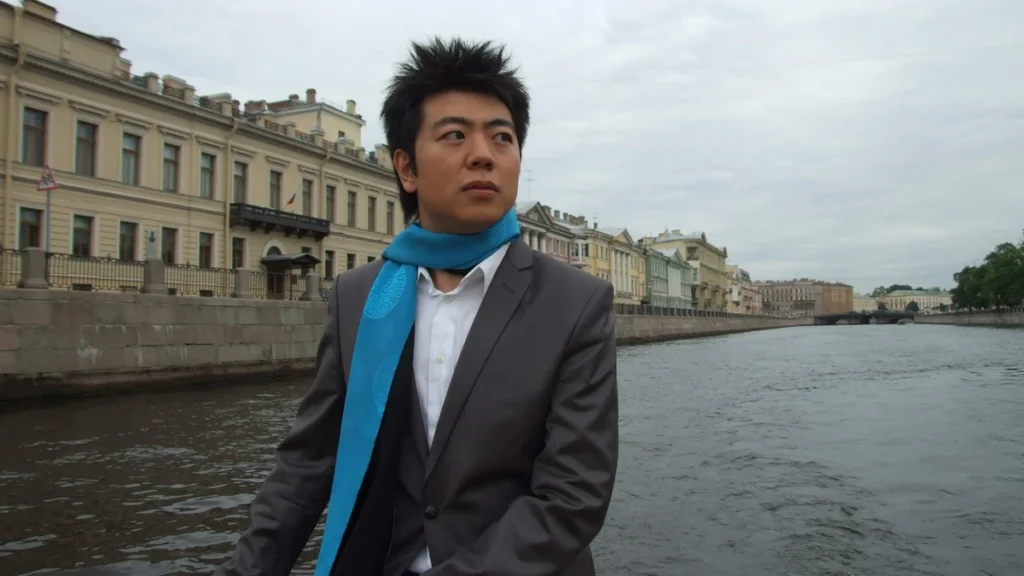
Lang Lang was born in Shenyang in 1982 to a Manchu family; his father, Lang Guoren, plays the erhu. He began lessons at three, having been set off by the Tom and Jerry episode The Cat Concerto, which is built around Liszt’s second Hungarian Rhapsody.

The Beijing launch event for Piano Book 2 featured an appearance by Tom and Jerry. That is a piece of promotional staging with an unusually direct justification: the cartoon is the reason there is a career to promote.

The rest of the training was conventional and difficult. At nine he was thrown out of his tutor’s studio for a supposed lack of talent. He continued with another teacher, studied under Zhao Ping-Guo at the Central Conservatory in Beijing, won the Xinghai National Piano Competition in 1993, and moved to the United States in 1997 to study with Gary Graffman at Curtis.

What Rush E Actually Is

It is worth being precise about the strangest thing on the album, because the joke only works if you know the setup. Rush E began as a demonstration of what music notation software will happily print but no pair of hands can execute: a cascade of notes at a density beyond human reach, produced to be watched as a scrolling video rather than performed.

It became a fixture of piano internet culture, and a genre of response videos grew around pianists attempting to play as much of it as physically possible. Recording it for a major classical label collapses that whole ecosystem into a single track, and it does so without any explanatory apparatus: it simply appears between pieces by composers who have been dead for a century.

There is a serious point buried in it. The virtuoso tradition Liszt invented was always partly about spectacle and the appearance of impossibility, and Rush E is that instinct running without a human performer at the centre. A pianist of Lang Lang’s standing playing it is a comment on his own tradition as much as on the internet.

The First One Did 1.2 Billion Streams

Piano Book, in 2019, has passed 1.2 billion streams and is among the most successful classical albums released this century. Lang Lang has more than four and a quarter million monthly listeners on Spotify, which is an order of magnitude beyond almost any other classical soloist.

Those numbers explain why Deutsche Grammophon would release a follow-up containing game music. An artist delivering that kind of audience earns the right to define what goes on the record, and the label’s calculation is presumably that the people who streamed the first one are not primarily concert-goers.

Two Labels and Back Again

He recorded for Telarc and Deutsche Grammophon early on, signed to Sony in 2010 for a reported three million dollars, and returned to Deutsche Grammophon under Universal in 2017. His Beethoven first and fourth concertos with the Orchestre de Paris went to number one on the traditional classical Billboard chart.

The institutional recognition has followed: Time named him among the hundred most influential people in 2009, Gramophone put him in its Hall of Fame in 2012, UNICEF made him a goodwill ambassador in 2004, and the United Nations named him a Messenger of Peace in 2013.

The Argument About Accessibility

Lang Lang has spent two decades being described as evangelical about widening the audience for classical music, and just as long being criticised for it. The Lang Lang International Music Foundation, launched in New York in October 2008, is the formal version of that project.

Piano Book 2 is the least ambiguous statement of the position he has made. Putting Final Fantasy and Chopin on the same release argues that the distinction between them is a matter of where a piece came from rather than what it is worth, and pairing it with sheet music makes the argument practical instead of rhetorical.

It is a different route to the same destination as Víkingur Ólafsson recording Bach in a studio under his house. Both are pianists with very large streaming audiences reorganising how the music reaches people: one by removing the recording studio’s formality, the other by removing the repertoire’s.

The counter-argument is the obvious one, that an album containing a viral internet piece is chasing attention rather than serving music. The response is in the track list. Rush E sits among Bach, Debussy and Rachmaninoff, played by somebody who could programme anything he wanted, and nothing about its inclusion prevents a listener from finding the Liszt.

The formats reinforce it. Two CDs, two LPs including a marbled vinyl edition, a score edition, signed art cards, and the NFC chip with the tutorials: this is a release designed to be bought in a physical form and then used. That is an odd strategy in 2025 and a coherent one for a record whose audience is expected to sit at an instrument afterwards.
Víkingur Ólafsson Made His Bach Album in a Home Studio

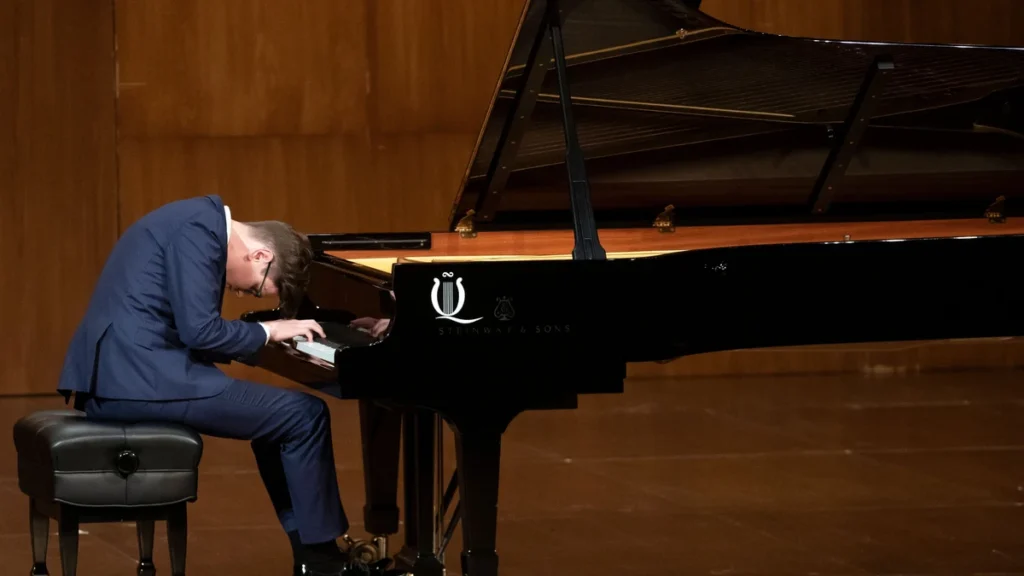
There is a room under his house in Iceland with teak walls and enough equipment to run a session without an engineer in the building. He calls it The Nutshell. His description of what it is for is the least grand sentence a Grammy-winning pianist has offered in some time: he can wander downstairs late at night in his pyjamas, press a couple of buttons, and start recording.

Continuum II, which Deutsche Grammophon releases on 13 November 2026, is the first album Víkingur Ólafsson has made entirely in there. Everything about the record follows from that fact.

Bach as a Diary

The project has an unusually plain premise. For more than thirty years he has played a little Bach every day, and he has described it as the one constant in his life regardless of what else is happening. Continuum, whose first volume appeared in October 2024, is that habit turned into a release schedule rather than a concept devised for one.

He has called this instalment his first album domesticum, built around intimate works associated with the home. The word choice is exact rather than decorative: these are pieces written for domestic instruments and domestic occasions, now recorded in a domestic building.

What Is Actually on It

The repertoire declines almost every opportunity for display. Six chorales, including Wie schön leuchtet der Morgenstern, Welt, ade!, and Es ist genug. Six short preludes Bach wrote as practice pieces for his pupils. The Largo from the Keyboard Concerto No. 5 in F minor. The Larghetto from the Keyboard Concerto No. 1 in D major, itself Bach’s reworking of Vivaldi, which was released as the second single in August.

There is one ensemble piece: the Adagio from the Violin Sonata No. 5 in F minor, arranged for piano, string quartet and double bass, with the Siggi String Quartet and the bassist Xun Yang. Everything else is a man alone in a room with an instrument, which is what the studio was built for.

Choosing student exercises for an album is a real decision. The short preludes exist because a teacher needed material for children, and they are usually heard played by beginners rather than by soloists who have sold out Wigmore Hall. Recording them at this level is an argument that the domestic Bach is not lesser Bach.

Two Versions of the Same Air

The first single, released in July, was his own arrangement of Air on the G String, dedicated to György Kurtág for his hundredth birthday. He recorded it twice: once on a grand piano and once on an upright.

That is the clearest demonstration of what the home studio changes. Booking two instruments and a hall to record alternate takes of one three-minute piece is an expensive proposition that a label would question. Doing it in your own basement costs an afternoon, and the second version exists because there was no reason it should not.

What Continuum Means

The title points at something specific. Ólafsson has noted that the project is named for the unbroken thread linking all music, and that the composer’s own surname is the German word for a stream. A series of albums assembled from daily practice is that idea made literal: the recording is a section cut out of something that was running before the tape started and carries on after it stops.

It also solves a problem that catalogue Bach usually has. A pianist recording the Well-Tempered Clavier or the partitas is producing a definitive statement on a fixed text, and the format invites comparison with every previous recording. An open-ended journal makes no such claim. Each volume is only what the playing was like during that stretch, which is a far more forgiving frame and, on this evidence, a more honest one.

Why He Built It

He has connected the studio to turning forty and wanting the freedom to record with complete spontaneity. Classical recording normally runs on the opposite principle: a hall booked months out, a producer, an engineer, a tuner, a schedule measured in sessions, and a piano that has to be right on the day.

Under that system a performance has to be ready when the diary says so. Removing the booking removes the deadline, and a musician who plays Bach every morning can simply record on the days when it goes well. For a project explicitly framed as a journal, that is the only sane way to work.

He Ran His Own Label First

None of this is out of character. Ólafsson was born in Reykjavík in 1984 to a mother, Svana Víkingsdóttir, who was a piano teacher and gave him his first lessons. He studied in Iceland, then took a bachelor’s and a master’s at Juilliard.

Before Deutsche Grammophon signed him in 2016, he released three albums on his own label, Dirrindí: a debut of Brahms and Beethoven in 2009, a Chopin and Bach programme in 2011, and a Winterreise with the bass Kristinn Sigmundsson in 2012 that won Classical Album of the Year at the Icelandic Music Awards. He also founded the Reykjavík Midsummer Music festival in 2012 and has premiered six piano concertos by Icelandic composers.

Building infrastructure rather than waiting to be given it is the through-line. It puts him alongside Igor Levit naming a new label after a concert he gave in Berlin: two pianists of the same generation who have concluded that owning the means of release is part of the artistic work rather than a business afterthought.

A Billion Streams of Mostly Bach

The commercial position is unusual for a classical soloist. He has passed a billion streams worldwide, about half of them Bach, and the Goldberg Variations won him the 2025 Grammy for Best Classical Instrumental Solo. The shelf also holds BBC Music Magazine Album of the Year, two Opus Klassik awards, Gramophone Artist of the Year, the RPS Gold Medal, the Nordic Council Music Prize and Iceland’s Order of the Falcon.

The Deutsche Grammophon run since 2017 has been deliberately varied: Philip Glass, then Bach, then Debussy paired with Rameau, then Mozart and his contemporaries, then From Afar, then the Goldbergs, then Opus 109. A pianist who programmes that way is not repeating a formula, which makes the decision to settle into a multi-volume Bach project a change of method rather than a safe retreat.

The Rest of the Year

The diary around the release is heavy. He created and curates the PULSE festival at Lucerne, where he played the Goldberg Variations in July with the artist Olafur Eliasson. A recital at the Edinburgh International Festival followed in August, then a European tour with the Royal Concertgebouw Orchestra playing Beethoven’s fifth piano concerto, and three recitals at Wigmore Hall in September.

October brings the world premiere of Mark Simpson’s piano concerto with the London Philharmonic, then a recital tour of South Korea, China and Taiwan. He closes the year on 4 December playing Brahms’s first concerto with the Berliner Philharmoniker in Baden-Baden.

Against that schedule, the argument for the room under the house becomes obvious. A musician on the road for most of a year has very few days at home, and the only way to record on those days is to have somewhere to do it that requires no notice from anybody.