
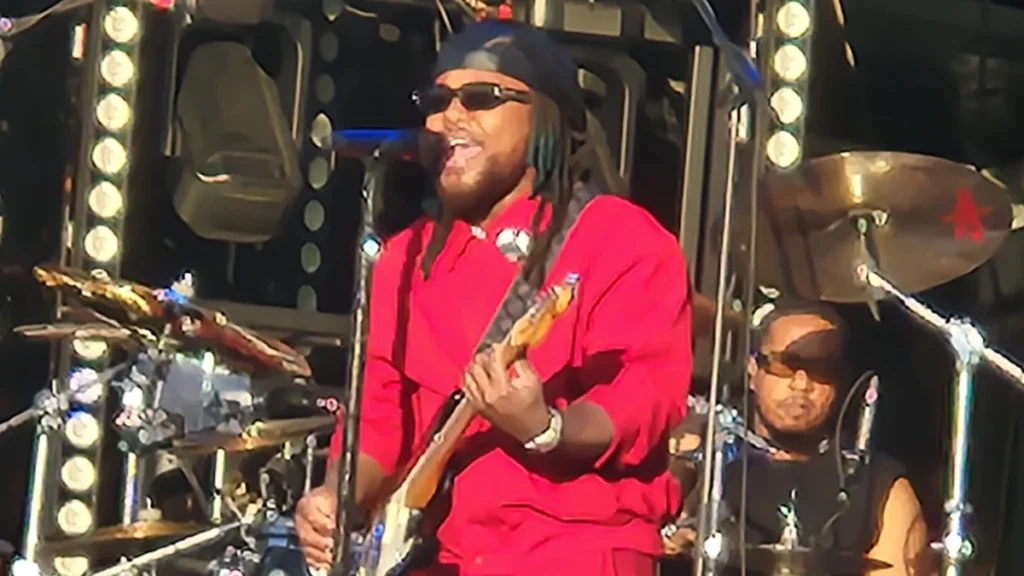
Leon Thomas Won Best R&B Album With a Record He Produced Himself
There is a moment in most producers’ careers where they stop giving the good idea away. Leon Thomas reached it late. He had spent two decades in the industry, much of it writing and producing for other people, and in 2024 he won a Grammy for production work on a single that carried somebody else’s name. Two years later he won Best R&B Album for Mutt, a record he made largely for himself.
The 68th Grammy Awards also nominated Mutt for Album of the Year, which is a different order of recognition. Best R&B Album is a genre prize; Album of the Year is a claim about the whole field. For a record released in September 2024 on EZMNY and Motown, arriving without a marketing campaign of the size those nominations usually imply, that is an unusual trajectory.
The Long Approach
Thomas was born in Brooklyn in 1993 and has been working since 2003. He started as a child actor on Broadway, appeared in The Lion King, then moved into television. The music came alongside, and for years it came mostly on other people’s records. He signed to EZMNY in 2022 and released his own debut, Electric Dusk, the following year, with Victoria Monet, Benny the Butcher and Ty Dolla $ign among its guests.
The acting was not a footnote either. He appeared on Nickelodeon’s Victorious and later on HBO’s Insecure, and his label history runs through Columbia and Rostrum before EZMNY and Motown. He is also a member of the group The Rascals. A career that scattered is usually a sign of someone searching for the right format; the interesting thing about Mutt is how settled it sounds by comparison, as though the searching finished somewhere before the recording started.
That is a twenty-year run-up to a breakthrough, and it shows in the record. Mutt does not sound like a first attempt at anything. The arrangements sit low and unhurried, the vocal is mixed close, and the writing assumes a listener who will stay for a whole album rather than a playlist placement. Those are choices made by someone who has watched a lot of records get built.
What the Album Actually Sounds Like
The palette is neo-soul with harder edges. Across fourteen tracks the record moves between the hushed and the abrasive, with hip-hop drum programming underneath and psychedelic textures at the corners. The Recording Academy’s own write-up reached for D’Angelo, Musiq Soulchild and Maxwell as reference points, which locates the vocal lineage accurately without quite capturing how much rock guitar is in it.
The guest list is used sparingly for a modern R&B album: Masego on Lucid Dreams, Wale on Feelings on Silent, Ty Dolla $ign on Far Fetched, Baby Rose on I Used To. Nine of the fourteen tracks have no feature at all. AllMusic gave it four stars out of five. The production credits run long, including James Fauntleroy, Conductor Williams, Aaron Paris and Khristopher Riddick-Tynes, with Thomas himself among them throughout.
The Title Track Did the Work
Mutt arrived as a single on 8 August 2024, seven weeks before the album, and it became the thing that carried the record. It reached number one on Billboard’s Hot R&B Songs chart, number one on Adult R&B Airplay and on the UK R&B singles chart, and climbed to 13 on the Hot 100. It is certified platinum in the United States.
The record also closes with a remix of the title track featuring Freddie Gibbs, which is a deliberate move: putting a rapper on the last version of the song that broke the album lets the project end by pointing outward rather than resolving inward. The album’s own chart performance was more modest: 35 on the Billboard 200, 8 on Top R&B/Hip-Hop Albums, 30 on the UK R&B albums chart, with a gold certification. That gap between a platinum single and a gold album is the ordinary shape of contemporary success, and it makes the Album of the Year nomination more striking rather than less. The voters were not following the sales.
A Deluxe That Changed the Argument
On 30 May 2025 he released Mutt Deluxe: Heel, adding nine tracks. Deluxe editions are usually a streaming-era manoeuvre, a way of restarting a release cycle with offcuts. This one behaved differently, bringing in Kehlani, Big Sean, Halle and Chris Brown and pushing further into rock textures than the original had.
It also extended the record’s life through the awards window, which matters. Two more singles came off the project long after release, Rather Be Alone in April 2025 and Yes It Is that September, a full year after the album. Sustaining a campaign across eighteen months is how a record that opened at 35 ends up nominated for Album of the Year.
The Producer Who Kept the Song
The 2024 production Grammy is the detail that reframes everything else. Winning as a producer establishes that the industry already trusted his ear; the people making the biggest R&B records were hiring him. What it did not establish was whether he could carry a record as the voice on it.
Plenty of successful producers never manage that transition, and the failure mode is predictable: an album that sounds expensively made and emotionally vacant, because the person assembling it is more comfortable solving problems than exposing anything. Mutt avoids that by being unusually direct about wanting things, being unsure, and behaving badly. The title is not flattering, and it is not meant to be.
The Tour That Sold Out
The Mutts Don’t Heel world tour sold out across the United States, and the live setting suits the material. This is a record built on musicians rather than sequencing, so the songs survive being played by a band without the arrangements thinning out. He has also worked the television circuit hard, from late-night appearances to a Tiny Desk session that became one of the most-watched entries in that series.
The rollout around it was relentless in a way that album campaigns rarely are two years after release: a Billboard Hip-Hop and R&B Power Players cover, MTV PUSH Artist of the Month in March 2025, a late-night debut, and performances of the deluxe material on network television. Recognition arrived in a run: Billboard’s Breakthrough Artist of the Year, Best New Artist at the 2025 BET Awards, then the Grammys. Best New Artist is a strange category to win at thirty-one after twenty-two years of work, and it says more about when an industry decides to notice someone than about when they started.
What It Signals for the Genre
Best R&B Album going to a self-produced record made cheaply, on a small imprint inside a major, is a useful marker. It sits alongside a broader pattern of artists taking ownership of the apparatus around their music rather than only the music, in the same way Igor Levit has just launched his own label from inside a major classical company.
What makes Thomas’s version interesting is that he had the production credentials first and the platform second, which is the reverse of the usual order. Most artists reach for control after success. He had the skills the whole time and spent twenty years applying them to other people’s records before making the one with his name on it.