Leon Bridges Finished Half of Happiness Anytime in Four Days
Leon Bridges
The first song arrived before the instrumental was finished. In April 2025, Josh Lloyd-Watson and Lydia Kitto of the British group Jungle played Leon Bridges a skeletal track built around a Wurlitzer chord progression and a relaxed drum pattern, and he started singing as soon as it began. “Straight away he sang the first bit to ‘Your Love Is Electric,'” Lloyd-Watson recalls in notes released with the album. “And I’m like, ‘Whoo, let’s go. This is it.'”
Four days later, the three of them had six songs, half of the finished record. Happiness Anytime, the fifth studio album from Leon Bridges, is out today on Columbia Records: twelve tracks that the Fort Worth singer describes as being about “cultivating pockets of happiness”.
A Writing Session With One Rule
The collaboration grew out of chance meetings. Bridges and the Jungle pair kept crossing paths at festivals and shows, including one in Copenhagen, before deciding to try a low-pressure writing session in Los Angeles. “I always just loved their dance-y vibe, and I felt they were ideal collaborators,” Bridges told an interviewer in a conversation published by Yahoo last week.
The sessions ran on a simple rule. “We aren’t leaving until we have a full track at the end of the day,” Lloyd-Watson says in the album notes reported by BroadwayWorld. “We didn’t want to have, ‘We’ll come back to this tomorrow.’ We wanted fully finished tracks.” He puts the thinking behind it plainly: “First thought is the best thought. That’s where the emotion is.”
Bridges remembers the process as a release. “It was the most freeing experience of creating music,” he said. “We built everything on drum loops and we’d just pass the guitar around until we landed on something cool.” He is quick to credit his co-producer’s voice as well: “Lydia, man, her vocals, in my opinion, really carry a lot of these songs.”
Pino Palladino, Fela Kuti and a Party in Los Angeles
The record was completed across three fast sessions. When the trio reconvened in August 2025, they were drawing on Fela Kuti’s Afrobeat, Brazilian music, soul, disco and South American rhythms. “We’d been listening to a lot of South American music and Sergio Mendes,” Lloyd-Watson says. “We infused it with these Latin rhythms and African rhythms,” he says, aiming for “music that had groove and soul and feeling.”
They also brought in a player with a long reach: the bassist Pino Palladino, whose credits include D’Angelo and Adele, joined them at Chaplin Recording Studios in Los Angeles to complete the album. The label’s notes describe echoes of Fela Kuti, the wanderlust of Paul Simon’s The Rhythm of the Saints and the warmth of Jorge Ben, while insisting the record never feels referential.
For Bridges, the Fela thread started almost by accident. He told the interviewer he knew only a few of the Nigerian musician’s songs until he heard one at a GQ party at the Chateau Marmont, and it sparked more ideas. “What I do a lot is, when I hear instrumental stuff, I’ll start freestyling over it,” he said. That track, he explained, inspired songs like “Illusion” and the deeper, introspective side of the album.
Getting Back Out Front to Dance
The other goal was movement. Early in his career, Bridges was out in front dancing, something that had waned in recent years. “Leon said he wants to have music that he can dance to,” Kitto recalls. “He wants to have moments where he can put the guitar down and just dance and perform at the front.”
Dancing goes back a long way for him. He told the interviewer he fell for it at 11 or 12, practising his moonwalk after taping a Michael Jackson anniversary broadcast, and later danced with a company called Velocity while at Tarrant County College. “I’m always dancing, man,” he said. “I don’t really deem myself an amazing dancer. But I feel like I have my own style and expression.”
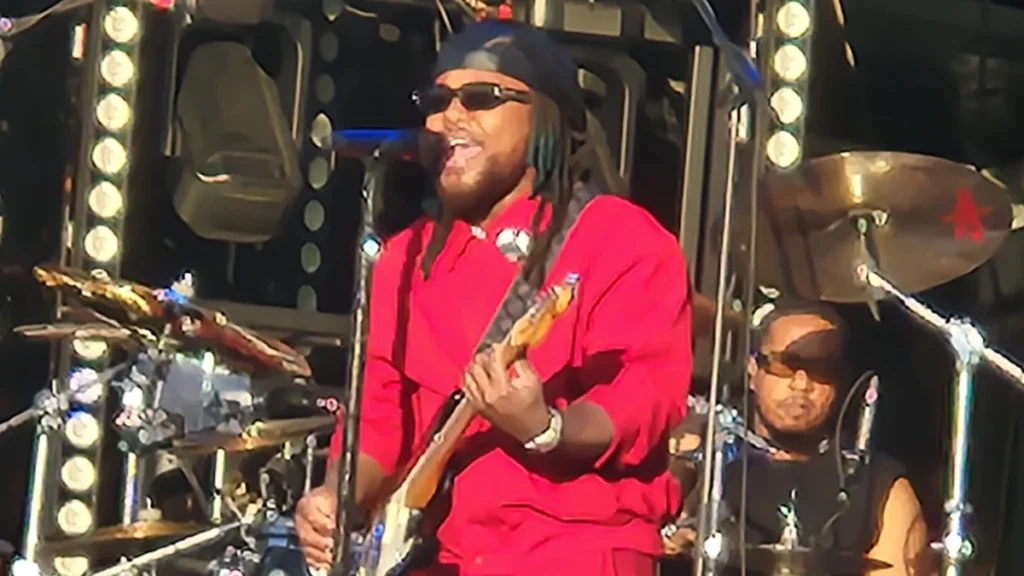
That has reshaped the live show. Bridges has been introducing the songs through Leon Bridges Presents Happiness Anytime, a reimagined stage production with a vinyl DJ, a horn section and three backing vocalists, inspired in part by the communal spirit of classic Jamaican dancehall culture. DIY reported that he previewed it in pop-up performances in Paris, Cannes, Los Angeles, at Montreux Jazz Festival and at London’s Jazz Cafe. Earlier this month he performed a medley of “Talk It Over”, “Light The Way” and “Illusion” on The Tonight Show Starring Jimmy Fallon, and “Watch You Dance” premiered on Apple Music 1 alongside an interview with Zane Lowe.
Why Happiness, and Why Now
Bridges is clear that the title is not a slogan about ignoring the world. “For me, happiness is not a feeling that you chase,” he said when the album was announced in July. “I want this album to be something that lingers with people and lingers in people’s bones. There’s this feeling that we have to fix the problems of the world; you feel inadequate or it can be debilitating. My role is to be light.”
He returned to the point in the Yahoo conversation. “It’s not [ignoring] issues of the world. Black people are no strangers to suffering and pain. But we’ve created the most beautiful art that’s come from our suffering,” he said. “If there’s chaos around, you can’t freak out or lose your cool. You gotta stand firm-rooted. That’s kind of what the album is for me.”
Some of the songs look back as well as forward. “Tears of Joy” is a thank-you, a song in which Bridges looks back at the years since his 2015 debut and imagines “10 more years of glory”. Lloyd-Watson hears it as a song about legacy: “What being on the road means. What you sacrifice to give this artistry to the world.” Kitto has the simplest explanation of the title: “It’s music you can put on no matter how you’re feeling, and it makes you feel happy and it makes you want to get up and dance.”
A Release in Three Parts
The album did not arrive all at once. Bridges released it in three instalments of four songs each, starting in July with “Light The Way”, “Tears of Joy”, “Illusion” and “Your Love Is Electric”, according to DIY, so eight of the twelve tracks were already out before today. The full tracklist runs: “Light The Way”, “Tears of Joy”, “Illusion”, “Your Love Is Electric”, “Talk It Over”, “Happiness Anytime”, “All Day, All Night” featuring Lydia Kitto, “Fly Baby”, “Watch You Dance”, “The Way It Goes”, “Take My Hand” and “Please Don’t Say Goodbye”.
Happiness Anytime follows Leon, his 2024 album, which Rated R&B notes debuted at No. 5 on Billboard’s Top R&B Albums chart. The label’s notes position the new record as a return to the warmth of his 2015 debut Coming Home, combined with the adventurous groove of his two collaborative albums with Khruangbin. Across his career, Bridges has earned six Grammy nominations and one win.
What Comes After the Record
Bridges, who is 37, is already thinking beyond his own songs. He told the interviewer his next goal is to help aspiring artists who lack resources. “I actually had this thought to put together a crew of house musicians, almost like a Muscle Shoals vibe,” he said. “Whoever wants to make cool stuff, let’s do it.”
Where a record gets made often shapes how it sounds, and it has been a theme on NewMusic.News this month, from Happiness Anytime’s quick sessions in Los Angeles to the way Olivia Dean found a house where no music had been made.
For Leon Bridges, home remains fixed. “Fort Worth is forever gonna be home,” he said. Happiness Anytime is the sound of him leaving it for a few days, passing a guitar around a room in Los Angeles, and coming back with a record built to move.