
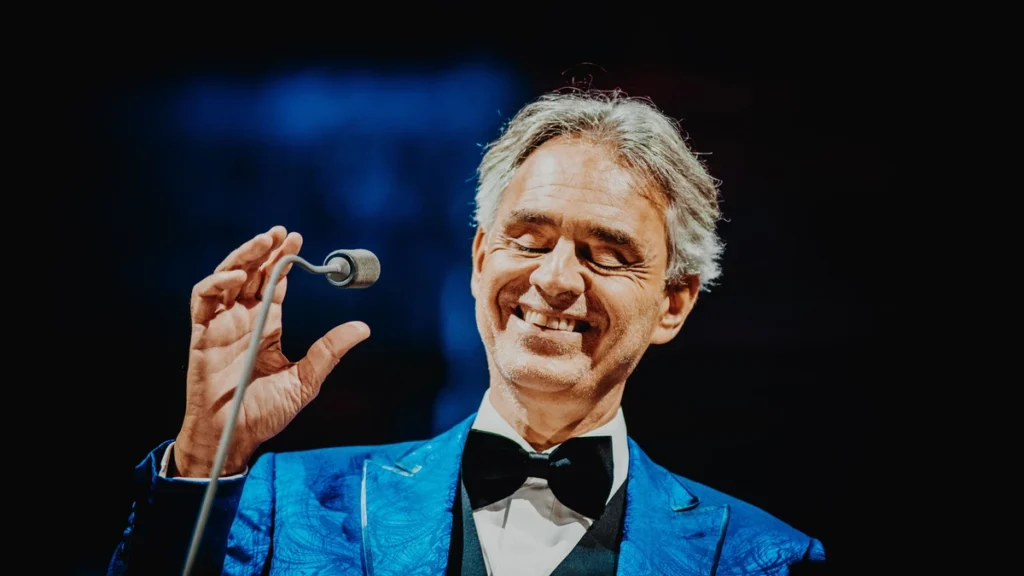
Andrea Bocelli Made a Christmas Album With His Children
Virginia Bocelli was ten years old when she took a solo on her father’s Christmas album. The track is When Christmas Comes To Town, from The Polar Express, and it sits on a Decca release alongside her brother Matteo, then twenty-four, who sings I’ll Be Home For Christmas alone.
A Family Christmas came out on 22 October 2022, produced by Stephan Moccio, and was the first record Andrea Bocelli had made with his children. Thirteen tracks move between English and Italian and between solos, duets and trios, and it went on to be the best-selling Christmas album of that year.
What Is Actually on It
The repertoire is standard by design: Do You Hear What I Hear?, Feliz Navidad, Have Yourself A Merry Little Christmas, Joy To The World, Happy Xmas (War Is Over), and, less predictably, Over The Rainbow.
The inclusion of a song from The Wizard of Oz on a Christmas record is the kind of decision that only makes sense in a family context, where the selection is governed by what three people can sing together rather than by what belongs in a carol service. The same logic explains giving the ten-year-old a solo from a children’s film.
Moccio is a considered choice of producer. He is best known for co-writing Wrecking Ball and Earned It, which is a long way from Tuscan tenor repertoire, and the result is a record that sits closer to contemporary pop production than Bocelli’s classical work does.
How It Performed
It reached number one in Ireland in the week of 23 December 2022 and twenty-two on the Billboard 200, where it spent five weeks across that December and the following January. Those are not spectacular chart positions, and they still made it the year’s best-selling Christmas album, which says something about how thinly that market is spread across a very large number of releases.
A thirty-seven-minute documentary film accompanied it, shot at Castel Savoia in Italy. A Disney+ short with The Simpsons followed on 15 December 2022, and the 2023 deluxe edition expanded the album to twenty-two tracks with nine additions, including that Simpsons collaboration and one with Pentatonix.
Recording with Pentatonix, who now book twenty-eight arenas for six weeks of Christmas every year, is a fairly precise indication of which market the deluxe edition was aimed at. The two acts occupy the same December territory from opposite ends: one an a cappella group built entirely for the season, the other an opera tenor who visits it.
Putting a Child on a Major Label Album
Giving a ten-year-old a solo track on a Decca release is a decision worth examining, because the obvious version of it would be indefensible. A child’s voice on a commercial record is usually either a novelty or a liability, and the industry has a poor history in both directions.
What makes it work here is the choice of song. When Christmas Comes To Town was written to be sung by a child in an animated film; it sits in a comfortable range and asks for nothing a young singer cannot deliver honestly. Nobody is being asked to perform beyond their means, which is the difference between including a child and exploiting one.
Matteo’s position is entirely different. He was twenty-four, already recording under his own name, and a solo on his father’s album functions as a professional credit rather than a family cameo. The album therefore does two separate things at once: it introduces one child and it platforms another.
Where He Came From
Bocelli was born in Lajatico in Tuscany in 1958 with congenital glaucoma, and lost his sight completely at twelve after being hit in the eye during a football match. He began piano at six and went on to learn flute, saxophone, trumpet, trombone, guitar and drums.
He studied law at Pisa and briefly worked as a court-appointed lawyer, singing in piano bars in the evenings for money. The break came in 1994 when he won the newcomers’ section at Sanremo, followed in 1996 by Time to Say Goodbye with Sarah Brightman.
Romanza arrived in 1997 and became one of the best-selling albums ever made. He has since sold more than ninety million records, and Sacred Arias is the biggest-selling classical album by any solo artist. Sì, in 2019, went to number one in both Britain and the United States.
Thirty Years of Romanza
The current tour marks that album’s thirtieth anniversary and is unusually long. It opened in North America in February 2026 with Columbus, Hollywood in Florida, Tampa, Raleigh, Birmingham, Nashville and Chicago, the Nashville date shared with Michael W. Smith and Lauren Daigle.
European summer dates take in Piazza San Marco in Venice in June, Gdansk and the PGE Narodowy in Warsaw in August, and the Ernst-Happel-Stadion in Vienna. A second American leg in September runs from Seattle down the west coast to two nights at the Hollywood Bowl and two at Red Rocks.
Then, in December, the tour becomes a Christmas run in all but name: Boston on the tenth, Buffalo, Montreal, two nights at Madison Square Garden on the sixteenth and seventeenth, Hamilton, Pittsburgh and Philadelphia on the twenty-second.
He also sang at the opening ceremony of the Milano Cortina Winter Olympics at the San Siro on 6 February, which is the kind of booking that follows from having spent three decades as the most recognisable classical voice in the world.
The venue mix across the year is the interesting part. Piazza San Marco and Red Rocks are open-air spaces chosen for their setting; the United Center and Madison Square Garden are chosen for capacity; the Hollywood Bowl manages both. Very few artists can move between a Venetian square and an American ice-hockey arena within a single tour without one of them feeling wrong, and the reason he can is that the show travels with an orchestra rather than a band.
The December Business
Eight arena dates in the twelve days before Christmas is a deliberate structure, and it explains why a family Christmas album made sense commercially as well as personally. An artist who can fill Madison Square Garden twice in December has an annual seasonal audience whether or not he has a seasonal record, and having one converts that audience into sales.
It is the inverse of how the format usually works. Mariah Carey’s Christmas record created her December; Bocelli already had one and made the album to serve it. The children were presumably not a commercial calculation, but putting them on it is what gave the project a reason to exist beyond the calendar.
It also solves a succession problem that most classical crossover artists never address. A voice like his has a finite working life, and the audience that fills arenas in December has been following him for thirty years. Recording an album that introduces the next generation of the family, rather than simply announcing them separately, hands that audience over rather than hoping it transfers.
Whether it works is a question for the next decade. What is already clear is that a record made in a Tuscan castle with a ten-year-old singing a song from a Christmas film outsold every other holiday album released that year, which is not the outcome anybody would have predicted from the description.