
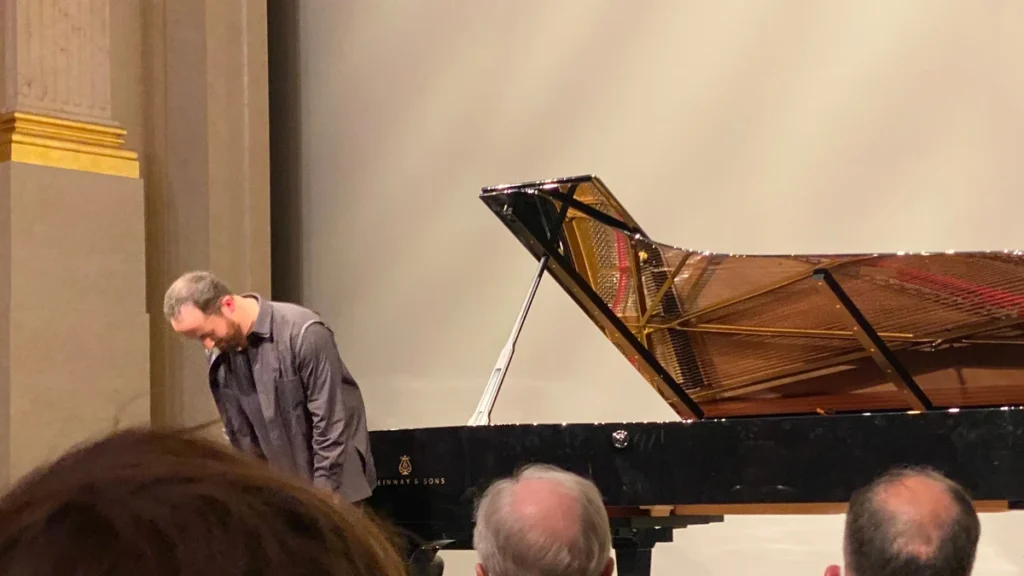
Igor Levit Named His New Label After a Concert He Gave in Berlin
Somebody had to decide how many copies to press. The answer, for Igor Levit’s recording of Erik Satie’s Vexations, is 840, and it is not an arbitrary number. Satie’s manuscript carries a note suggesting the short motif be repeated 840 times, which is why complete performances run past twelve hours. The edition size is the piece’s own instruction, turned into a manufacturing decision.
That album is one of the first three releases on No Silence, the label Levit has founded in partnership with Sony Classical. All three arrive on 23 October, trailed since 19 June by a single: Satie’s Gymnopedie No. 1. For a pianist who has recorded exclusively for Sony since 2013, starting a label inside the same company is less a departure than a change of authorship over what gets made.
Where the Name Came From
No Silence takes its name from a concert. After the attacks in Israel on 7 October 2023, Levit performed at the Berliner Ensemble in an event titled Against Silence, Against Anti-Semitism. The label carries that title forward, and Levit has been direct about the implication: “NO SILENCE is not simply a label. NO SILENCE is a stance.”
Naming a record label after a protest concert is unusual, and it sets an expectation the catalogue will have to meet. Levit has spent much of the last decade placing his playing inside public argument rather than beside it, from streamed house concerts during lockdown to programming that pairs canonical repertoire with pieces written in response to catastrophe. The label formalises a position he already occupied.
The Eroica, but for One Pianist
The second of the three releases is the most technically curious. Levit plays Liszt’s piano transcription of Beethoven’s Third Symphony, the Eroica, a piece Liszt reduced from a full orchestra to two hands without simplifying it. Transcriptions of that kind are a strange genre: the pianist has to imply an orchestra rather than imitate one, and the writing frequently asks for more notes than a player has fingers.
It is paired with Schoenberg’s Ode to Napoleon Buonaparte, performed with the conductor Antonello Manacorda, the Kammerakademie Potsdam and the actress Dorte Lyssewski. Schoenberg wrote the Ode in 1942 as a setting of Byron, and its subject is a tyrant’s fall. Programming it against Beethoven’s Eroica, a symphony whose dedication to Napoleon Beethoven famously withdrew, makes the pairing an argument rather than a coupling.
The forces involved also explain why this is not simply a solo record. Schoenberg scored the Ode for a speaker, piano and string quartet, with the text delivered in Sprechstimme, the half-spoken, half-sung delivery that sits between recitation and melody. Casting an actress rather than a singer in that role is the orthodox choice and the more demanding one, because the part has to carry Byron’s contempt while staying tied to written pitches. Placing it after forty-five minutes of solo Beethoven transcription gives the album an abrupt change of texture at exactly the point a listener might have settled.
The Label’s First Signing
The third album belongs to someone else entirely. Lukas Sternath, a winner of the ARD Music Competition and a BBC New Generation Artist, makes his debut with a programme of Liszt and Schubert. That choice says as much about the label’s intent as Levit’s own releases do: a new imprint led by an established soloist could easily have been a vehicle for his catalogue alone.
Sony’s executives have framed the partnership in the language labels use, with Per Hauber, who runs Sony Classical, describing it as the next milestone in a long relationship. The more informative signal is structural. Levit is not leaving a major to go independent; he is being given an imprint inside one, which is a different arrangement and a rarer one in classical music.
What Levit Already Built
The catalogue behind this is substantial. Levit signed to Sony at twenty-five and made his debut on the label in 2013 with Beethoven’s late sonatas. His complete Beethoven sonata recording, released in September 2019, went straight to number one in the official classical charts. Along the way he has collected four Opus Klassik awards, Gramophone’s Artist of the Year in 2020, Musical America’s Recording Artist of the Year the same year, and both the Recording of the Year and Instrumental awards from BBC Music Magazine.
He has also built institutional roles rather than only touring. Since the 2022-23 season he has been co-artistic director of the Heidelberger Fruhling festival, and a year later he initiated the Piano Fest with the Lucerne Festival. Those are administrative jobs as much as artistic ones, and they suggest someone comfortable running things, which is the temperament a label demands.
His repertoire choices have pointed this way for years as well. On DSCH, released on Sony in 2021, paired Shostakovich’s 24 Preludes and Fugues, a cycle running about two and a half hours across every major and minor key, with Ronald Stevenson’s rarely played Passacaglia on DSCH, itself built from more than three hundred variations on Shostakovich’s musical monogram. Issuing two such demanding cycles together is the kind of decision a label normally resists and an artist-run imprint exists to make. The pattern repeats across his catalogue: Life in 2018 ran from Busoni and Bach to Bill Evans, and Tristan in 2022 set Henze against Wagner and Mahler.
Satie, Twice Over
Vexations is not new territory for him. In spring 2025 Levit performed the piece for thirteen hours at London’s Southbank Centre with the performance artist Marina Abramovic, a decade after the two collaborated on Bach’s Goldberg Variations at the Park Avenue Armory in New York. A recording of a work built on endurance is a paradox: the thing that makes a live Vexations extraordinary is the duration a listener shares with the player.
The physical edition acknowledges that. The 840 copies carry an NFC chip and signed sheet music, which turns the release into an object rather than a document. Whether that translates the experience or simply commemorates it is a fair question, and it is the same one facing any recording of music designed to happen in a room, including the three volumes Immanuel Wilkins cut at the Village Vanguard.
What Vexations Actually Asks For
It helps to know how little music is involved. Vexations is a single page: a bass line, then two harmonisations of it, built from intervals that refuse to settle into a key. Played once it lasts somewhere between one and two minutes depending on the tempo taken, and taken alone it would be a curiosity rather than a landmark. The instruction to repeat it 840 times is what converts it into an ordeal, and Satie left no explanation for the number.
The piece went largely unperformed for decades, and its modern life began when John Cage organised a relay performance in New York in 1963 using a rotating team of pianists. Most complete accounts since have worked the same way, which makes a solo traversal the harder proposition and the reason Levit’s Southbank performance drew attention. Recording it raises a further question that a concert does not: a listener can stop a recording, and the composer’s instruction assumes they cannot.
The Season That Follows
The label arrives at the start of a heavy stretch. From October 2026 through June 2028, Levit returns to his complete Beethoven sonata cycle, presented as eight-recital sets in New York, London, Vienna, Berlin, Munich, Hamburg and North Rhine-Westphalia, timed towards the Beethoven anniversary in 2027. Further Beethoven recitals in the 2026-27 season take him to Amsterdam, Frankfurt, Leipzig, Lisbon, Milan, Paris, Prague, Rome, Warsaw and Zurich, alongside a North American tour.
In December he plays the Nobel Prize Concert in Stockholm with Sir Antonio Pappano and the Royal Stockholm Philharmonic. Set against that schedule, launching an imprint looks less like a side project than a consolidation: the recitals, the festivals he directs and now the recordings all run through decisions he makes himself. His own website describes him in three words, in this order: citizen, European, pianist.