
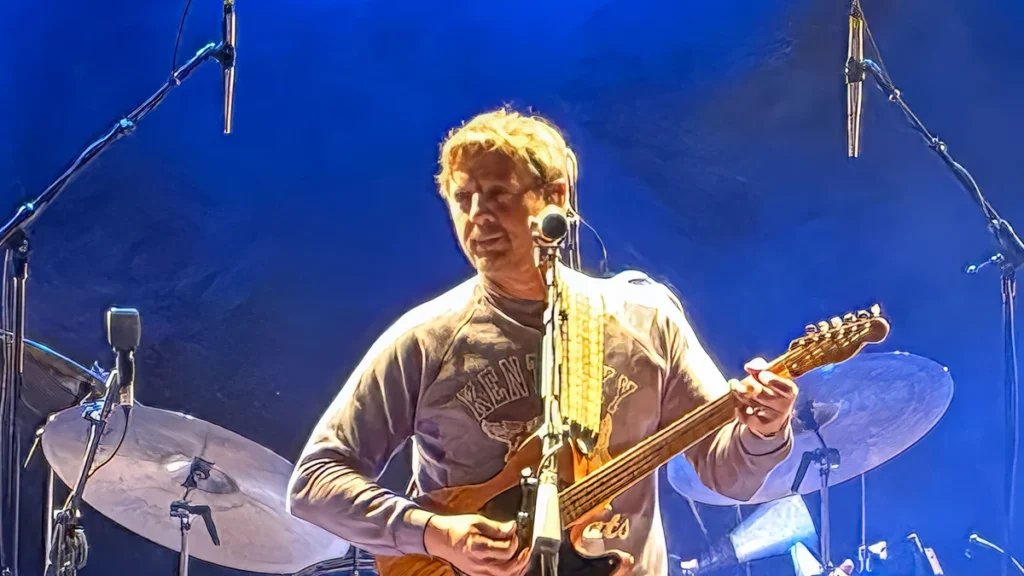
Sturgill Simpson Warmed Up for an Arena Tour in a 200-Capacity Bar
The announcement went out about two hours before the doors opened. Twenty-five dollars, cash at the door, at The Cobra in Nashville, a room that holds two hundred people. Sturgill Simpson and his band then played for close to three hours. Nine days later he opens a twenty-nine-date arena tour.
That contrast is the whole story of where Simpson currently sits. Mutiny After Midnight, released in March under the Johnny Blue Skies name, went to number three on the Billboard 200 and topped both the Americana and rock album charts. The Mutiny for the Masses tour begins on 4 September at the Moody Center in Austin and finishes on 30 October at Rupp Arena in Lexington, Kentucky, with no opening act on any night.
Three Hours, Two Hundred People
The set on 26 August was his first full show since September 2025, which explains the length. According to JamBands, it opened with A Good Look from Sound & Fury, moved into the new album’s opening track, then returned to A Good Look, which is the kind of structural joke a band plays when nobody is watching from a distance.
What followed was less a rehearsal than an unusually long night out. The covers ran from Prince’s Purple Rain to Bad Company’s Feel Like Makin’ Love, played live for the first time, to Eddie Murphy’s Party All the Time and William Bell’s You Don’t Miss Your Water. The show closed on the band’s first ever performance of Talking Heads’ Life During Wartime.
The Band Behind the Alias
The Dark Clouds are Miles Miller on drums, Laur Joamets on guitar, Kevin Black on bass and Robbie Crowell on keyboards and saxophone, each credited on the record under a nickname: Easy Luvin, Little Joe, Black Daddy, Raw B. Simpson himself is credited as Johnny Blue Skies, plays rhythm and lead guitar and produced the album.
The nicknames are not entirely a joke. Presenting the group as a named band rather than a solo artist with sidemen matches how the record was made and how it plays live: a saxophone in a country band is not a guest appearance, it is a structural choice, and the material leans on it.
It is also the third distinct project name Simpson has operated under. He spent a decade building a reputation as a country traditionalist who kept refusing the label, then made a loud rock record in Sound & Fury, then a pair of bluegrass reworkings of his own catalogue, then adopted Johnny Blue Skies for 2024’s Passage du Desir and again here. Retiring your own name at the point of greatest recognition is a strange career move, and it has been consistent enough across two albums now to read as a working method rather than a stunt.
An Album Released on Purpose Awkwardly
Mutiny After Midnight came out on 13 March 2026 through High Top Mountain and Atlantic Outpost, and it arrived as a physical-only release, no streaming at launch. Nine tracks run forty-five minutes, recorded at Easy Eye Sound in Nashville, mixed and engineered by M. Alan Parker with Howie Weinberg mastering.
Physical-only is an unusual decision in 2026, and it did not entirely hold: the album leaked to YouTube on 1 March, twelve days ahead of release. It still opened at number three. Charting that high with a release strategy that actively removes the largest distribution channel is a fairly precise measurement of how committed the audience is.
Disco, Funk and a Country Chart
The music is not what the Americana chart position implies. The record moves through funk rock, disco and country rock, and Simpson has described it as a protest against oppression and suppression, with what he called unfiltered and relentless disco-hedonism as the antidote. The opening track is a profane inversion of a political slogan, and it sets the register for everything after it.
Reviewers responded to the swerve rather than resisting it. Pitchfork’s Stephen M. Deusner heard disco and country rock working together; Paste called the album uncensored, depraved and totally batshit; Rolling Stone read it as joyous. Consequence framed it as Simpson dancing on America’s grave, which is a review headline but also a reasonable summary of the tone.
Songs Built for a Long Night
The track lengths explain why a warm-up set ran to three hours. Ain’t That a Bitch is six minutes forty-two, Venus six minutes three, Situation five forty-four, Viridescent five fourteen. Only Excited Delirium, at two minutes and two seconds, is short. This is a record designed to be stretched on stage rather than reproduced.
The Cobra setlist bore that out, running through Stay On That, Everyone Is Welcome, Excited Delirium, Venus, Ain’t That a Bitch, Viridescent, Don’t Let Go and Situation, which is very nearly the whole album, alongside older material like Welcome to Earth (Pollywog). A band that plays eight of its nine new songs at a bar gig is not testing which ones work.
The chart spread underlines how awkwardly the record sits in any single lane. Number one on the US Americana and Folk chart and number one on Top Rock and Alternative, simultaneously, for an album whose dominant mode is disco. Internationally it reached seventeen in Scotland, eleven on the UK Americana chart and seven on the Croatian international chart. Those are the numbers of a record that different territories filed under different genres because none of the available boxes fits.
Twenty-Nine Arenas, No Support
The tour routing is substantial: from Austin through New Mexico, Arizona, California, Washington, British Columbia, Oregon, Colorado, Missouri, Minnesota and Illinois in September, then Nashville on 2 October and on through Indianapolis, St. Louis, Columbus, Pittsburgh, Detroit, Boston, Philadelphia, Brooklyn, Washington, Raleigh, Charleston, Atlanta and New Orleans before Lexington.
Booking arenas with no opening act is a statement about how the evening is meant to work. It also puts the full weight of a three-hour show on one band every night, which is presumably why the warm-up happened in a room where nothing was at stake.
The choice of closing venue is not incidental either. Rupp Arena is in Lexington, and Simpson grew up in Kentucky; ending a national arena run there rather than in a larger market is the sort of routing decision made for reasons that have nothing to do with ticket sales. The same instinct runs through the September leg, which crosses into British Columbia and works through secondary markets in the mountain west before turning east.
Tickets at Face Value
The detail most likely to outlast the tour is the ticketing. Simpson routed resale through Ticketmaster’s Face Value Exchange and AXS Resale, so fans reselling tickets can only do so at the original price. That removes the secondary-market margin entirely rather than capping it.
Artists complain about scalping constantly and rarely give up the revenue that flows from tolerating it. Doing that across twenty-nine arena dates, having already released the album on physical media only, describes an operating philosophy that is consistent even where it is commercially inconvenient. The two-hundred-capacity bar show a week before the first arena fits the same pattern, and so does Zoh Amba’s decision to set aside the instrument that made their name. Neither is the move that maximises anything except the work.