
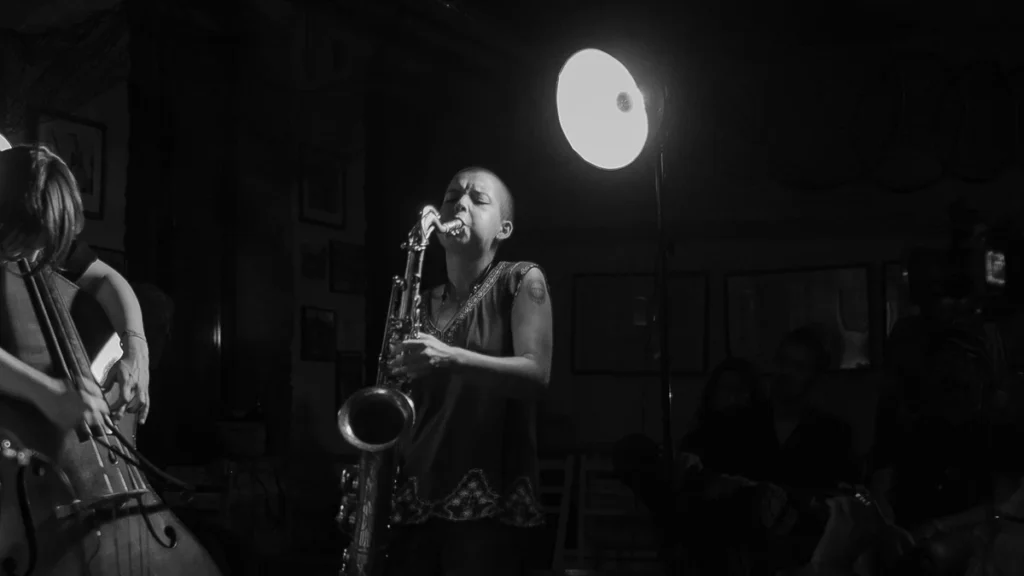
The first thing on Eyes Full is a guitar figure, plainly played, and a voice singing about a child whose medication changes how the world looks. The song is called OCD, it runs four and a half minutes, and there is no saxophone anywhere on it. For anyone who knows Zoh Amba’s work, that absence is the loudest thing about the record.
Amba spent the first years of their career as one of the most physically committed saxophonists in New York’s free jazz scene, a player critics reached for Peter Brotzmann and Albert Ayler to describe. Their first album, O, Sun, was produced by John Zorn. Eyes Full, released by Matador Records on 5 June 2026, is thirteen guitar songs with singing on them, and it was made by going home.
Kingsport, Tennessee
Home is Kingsport, in the north-east corner of Tennessee, and the return is both literal and structural. Guitar was Amba’s first instrument before the saxophone, so the record reaches back past the work they are known for to something earlier. The label frames the album as muddy, loose blues with sweet burnishes of Appalachian folk, which is accurate as far as it goes and undersells how much noise is in it.
The subject is the town rather than the self. Amba has described the songs as being about people who really need to be seen and heard, and the record keeps its attention on working-class lives in places that do not get written about. Dead End Street is a driving Southern rocker built over layers of guitar noise, and its subject is small-town American life without any of the softening that phrase usually carries.
Every Song Is About Looking
The unifying idea is stated in the title and then worked through thirteen times. Eyes Full, Child You’ll See, Smile With Your Eyes: the track list alone tells you what the record is circling. KLOF Mag identified vision as the thread running through all of it, tied to being noticed, to care, to belonging and to divinity.
That last one is not decorative. Amba practises monastic Hinduism, and the search for faith surfaces repeatedly, most directly on Another Time, the lead single, and on Weed Eating, which the same review called an extraordinary character study. A record about being seen, written by someone with a religious practice, is not really about visibility in the social-media sense. It is about being witnessed.
That framing also explains why the album resists the obvious autobiographical reading. Amba is the one who left the small town and made a name somewhere else, which is the standard shape of this kind of record: the narrator returns, observes, and reports. Eyes Full mostly declines the narrator’s vantage point. The songs sit level with their subjects, and the recurring language of sight is applied to other people at least as often as to the singer.
What It Sounds Like
The palette is wider than the folk description implies. OCD opens on minimal guitar and finds a chorus that sounds drawn from old, strange American songcraft. PG Tips sets nagging strums against screeching electric guitar. Thousand Years travels from bluesy licks into something closer to emo crunch, and Blueberry Thorn breaks down into what the review fairly called an avant-country finale.
Against those are the quiet ones. Southern Soil is a shuffling acoustic piece where the voice jumps and skips with emotion held back too long. Emahoy is sweetly acoustic and apparently casual while staying completely controlled. On the title track Amba’s voice sounds cracked and strong at once, old and ageless, which is the register the whole album is reaching for.
The Band Behind It
Amba did not do it alone. Jim White plays drums and Kevin Hyland plays lead guitar, and the trio’s instrumental approach has drawn comparisons to The Band, which is a compliment about interplay rather than about sound. The arrangements leave the guitars room to be ugly when the song wants it, and the drumming is loose in a way that a session player would have tidied away.
Thirteen tracks run just over forty minutes, and only one passes four minutes. Odd Jobs lasts two minutes and one second. That compression is unexpected from a musician whose free jazz work regularly runs to long-form improvisation, and it is the clearest sign that this is genuinely songwriting rather than an improviser borrowing the format.
The sequencing supports that reading too. The two most abrasive pieces, PG Tips and Child You’ll See, sit at eleven and twelve, deep in the second half, where a record aimed at winning over a new audience would have buried them or cut them. Placing them there and then closing on Smile With Your Eyes, a folk-rock track that folds in Southern Appalachian mountain music, gives the album a shape that returns to where it started rather than resolving outward. The circularity is deliberate: a record about seeing ends by handing the phrase back.
The Reviews Split
Reception has been genuinely divided, which is more interesting than acclaim would have been. One critic called it a wild, beautiful thing; another found it a missed opportunity. KLOF Mag landed emphatically on the positive side, calling it so complete and accomplished that it is hard to believe it is a first attempt at songwriting.
The split is easy to understand. Listeners who came for the saxophone playing that earned Amba their reputation will find none of it, and the songwriting, while strong, is working in a crowded field where Adrianne Lenker has already set the terms. Judged as a debut in an unfamiliar form, it is remarkable. Judged against the free jazz records, it is a different artist entirely, which is the point.
Why the Pivot Reads as Honest
Musicians change lanes for all sorts of reasons, and commercial ambition is usually somewhere in the mix. That reading does not fit here. A free jazz saxophonist with an avant-garde following does not increase their audience by making an album of Appalachian-tinged guitar songs about a Tennessee town, and Matador is not a label that requires it. If anything the move costs an audience: the free jazz constituency is small but devoted, and it does not automatically follow a player into songwriting.
The press around Amba’s saxophone work makes the contrast sharper. The Guardian described scalding emotional intensity and wildly uplifting music; The New York Times wrote of passion coming from somewhere deep inside alongside a soft and prayerful side. Those are notices most improvisers spend a career trying to earn. Setting that down to sing about odd jobs and weed eating in a Tennessee town is a decision that only makes sense if the songs were the point.
What the record sounds like instead is someone dealing with material they could not get at through improvisation. KLOF Mag read the return to Kingsport and the return to guitar as the same movement, an acceptance of the past that includes some difficult childhood memories. That is a hard thing to play on a saxophone and a straightforward thing to write a song about, which may be the whole explanation.
Where It Sits
Coming from the improvising world into songwriting is a well-worn path, and it usually produces respectful, slightly stiff records. This one is neither. It is unpredictable across its thirteen tracks and it commits fully to a form its maker had not previously worked in, in the same spirit as Immanuel Wilkins releasing three volumes of unedited live playing rather than one tidy album.
Both are musicians declining to give the audience the version that would be easiest to sell. Amba’s case is the more extreme, because it involves setting aside the instrument the audience came for. On the evidence of Eyes Full, the songs were always there underneath.
About The Author

More From NewMusic.News
-
The Long Way to ATE: Kick 5000 and a Club-Tempo Story for Lyric-First Listeners
-
3’s Charmed ☆ on Nostalgic Pop and the Making of Match Me First
-
The Long Way to You_Know.: Missingno. and the Collaboration That Never Clicked
-
Mike McCarthy on Trance Roots and the Making of Right By You
-
Inside BACK & FORTH: How Alex Shade Built a Self-Released Turn From Rap to R&B