
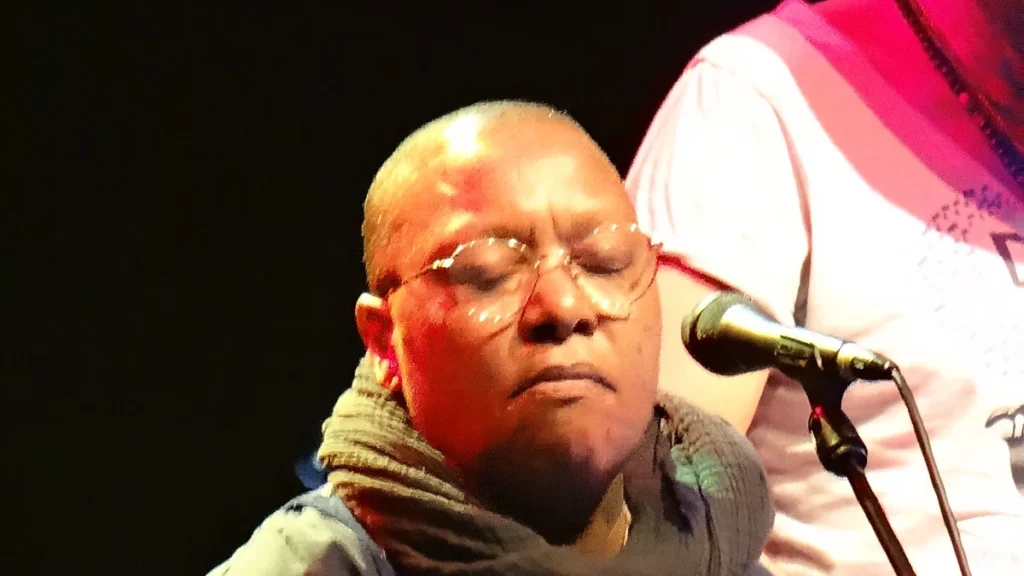
Meshell Ndegeocello Recast Fifteen Duets as Same-Gender Pairs
Islands in the Stream was written by the Bee Gees and recorded by Kenny Rogers and Dolly Parton. On Synonym it is sung by Meshell Ndegeocello and Chaka Khan. I Got You Babe belonged to Sonny and Cher; here it goes to Ndegeocello and ANOHNI. Golden Ring, a George Jones and Tammy Wynette record about a wedding ring passing between owners, is handled with Brandi Carlile.
The rule holds across all fifteen tracks. Every duet on the album is performed by two people who identify as the same gender, and the songs were chosen from a canon that almost entirely assumes otherwise. Ndegeocello’s third Blue Note album arrives on 2 October 2026, and that single constraint is the whole design.
Why the Album Is Called Synonym
She has been direct about what the title means. “This project is an expression of queer liberation as a synonym for liberation of all kinds,” she has said, and the record is built to demonstrate the point rather than argue it.
A duet is one of the few song forms with gender written into its architecture. The call and response, the harmony parts, the narrative of who is asking and who is answering were all arranged around an assumption. Removing the assumption and changing nothing else is a cleaner experiment than writing new songs would have been, because the listener already knows what these records are supposed to sound like.
Fifteen Songs From Four Decades
The source material runs from the 1960s to the early 2000s and refuses to sit in one genre. I Knew You Were Waiting (For Me), the George Michael and Aretha Franklin record, opens the album with Cynthia Erivo. Don’t You Want Me, the Human League’s, goes to Cat Power. It Ain’t Me Babe, Bob Dylan’s, is taken with Madison Cunningham, and With God On Our Side, also Dylan, closes the album with Bill Callahan and Chris Thile.
Elsewhere the list reaches into R&B and hip-hop: Don’t Stop The Music with Nick Hakim and Robert Glasper, Always on Time with Laura Lee of Khruangbin, Don’t Look Any Further with Lianne La Havas, The Closer I Get To You with Destin Conrad and Moses Sumney. Be Real Black For Me, the Roberta Flack and Donny Hathaway song, is sung with Emily King and Lizz Wright. Hunger Strike, the Temple of the Dog track, goes to WILLOW.
Nineteen guests is a large number for a record with any coherence, and the spread of idioms is deliberate. Ndegeocello has described the songs as diverse in tone and representative of various genres, and the effect is to show that the constraint is not a genre trick. It works the same way on a country weeper as on a synth-pop single.
The Producer Who Made Her First Two Records
David Gamson co-produces alongside Ndegeocello and Abe Rounds. Gamson produced Plantation Lullabies in 1993 and Peace Beyond Passion in 1996, which makes this a working relationship resumed after roughly thirty years.
That is a pointed choice given the subject. Plantation Lullabies was noted at the time for presenting a distinctly androgynous persona, and it was one of the first releases on Maverick Records. Returning to the producer of that record to make an album about who is allowed to sing to whom closes a loop that has been open most of her career.
Players Rather Than Features
The instrumental credits explain why this reads as a Blue Note album rather than a covers project. Abe Rounds and Deantoni Parks share the drums. Chris Bruce plays guitar. Jake Sherman, Jebin Bruni and Larry Goldings handle keyboards. Josh Johnson and Levon Henry play saxophone, Elena Pinderhughes plays flute, and Bela Fleck plays banjo.
Goldings, Johnson and Pinderhughes are serious jazz musicians, and Fleck’s banjo on a record containing Dolly Parton and George Jones songs is a straight-faced instrumentation decision rather than a joke. The band is fixed and rotating rather than assembled per guest, which keeps fifteen different vocal pairings sounding like one album.
Ndegeocello has framed her own role in production terms, saying she wanted to do more collective music and to show what she can do as a producer. For an artist whose reputation was built on bass playing and songwriting, that is a real repositioning.
Two Grammys in Two Years
She has thirteen Grammy nominations and three wins. The first came for Best R&B Song, for Better Than I Imagined. The other two are consecutive awards for Best Alternative Jazz Album, for The Omnichord Real Book and then No More Water: The Gospel of James Baldwin, which were her first two Blue Note releases.
Those were also the first Grammys to honour her own albums across a recording career of more than thirty years, which is a strange fact about an artist widely credited with helping to spark neo-soul. Winning the same category twice running, immediately after signing to a jazz label in her mid-fifties, describes a late-career surge rather than a legacy lap.
Go-Go Bands in Washington
She was born Michelle Lynn Johnson in Berlin in 1968 and learned to play in Washington, D.C. in the late 1980s, working with go-go bands including Prophecy, Little Benny and the Masters, and Rare Essence. The surname she adopted means free like a bird in Swahili.
Go-go is relevant to what she does now. It is a live, percussive, call-and-response idiom built on continuous grooves and audience exchange, and the habit of treating a song as something two parties do to each other rather than a fixed text runs directly into an album made of duets.
The label history since then reads like a map of an artist nobody could file: Maverick and Reprise, then Shanachie, EmArcy, Decca, Mercer Street, Naïve, and finally Blue Note in 2023. Seven labels across three decades usually indicates a commercial problem. In this case it tracks a musician who moved between R&B, rock, spoken word, covers projects and jazz faster than any single roster could follow, and the Blue Note run is the first time the catalogue and the label have been pointed the same way.
The Argument Underneath
Her other stated position on the project is disarmingly plain: whatever the differences between people, what they want underneath is much the same, and she has named healthy food and a safe place as the example. That is a modest claim to hang a fifteen-track album on, and the modesty is the point.
She has also said she is not defining anything, because the absence of definition is where she feels most free. A record that reassigns famous duets without rewriting a word is exactly that principle applied to material rather than to identity. Nothing is explained; the pairings simply happen and the songs turn out to work.
What Follows
She plays the Blue Note Jazz Club in New York on 18, 19 and 20 September 2026 in a trio configuration with Chris Dave and Eric Gales, ahead of the album’s arrival at the start of October.
A run of small-room dates before a guest-heavy studio release is the right sequencing for what this is, because the album’s argument is finally about performance rather than production. It sits alongside Immanuel Wilkins recording three albums across two nights at the Village Vanguard as evidence of what Blue Note is currently doing, which is signing musicians with a formal idea and then letting them execute it at length.