Rock

Mk.gee Made a 33-Minute Debut With No Guests and No Clear Vocals

Almost every instinct in modern record-making pushes the vocal forward. Streaming rewards an identifiable hook early, playlists reward clarity, and a singer buried in the mix is normally a sign that something went wrong in mastering.

Michael Gordon, who records as Mk.gee, did the opposite deliberately, and it produced one of the most decorated debuts of its year.

Twelve Tracks, Thirty-Three Minutes, Nobody Else

Two Star & the Dream Police was released on 9 February 2024 through R&R. Twelve tracks, thirty-three minutes and eighteen seconds — an average of two minutes forty-six per song, with “New Low” at 2:06 and “DNM” at 1:58.

The release schedule showed the same refusal to run the normal sequence. Five singles preceded the album, and the first two — “Candy” and “How Many Miles” — arrived together as a double A-side on 11 August 2023, attached to no announced album at all. A second double, “Are You Looking Up” and “You Got It”, followed on 20 October. Only with “Dream Police” on 19 January 2024 did the record acquire a title and a date. Half a year of music went out before Gordon conceded there was an album behind it.

The more unusual number is zero. The album carries no guest features at all, which in contemporary alternative R&B is close to a statement. Debuts in this lane are normally where an artist spends their relationships.

Gordon had those relationships to spend. He played guitar on Dijon’s Absolutely, worked on Omar Apollo’s Apolonio, has a writing credit with The Kid Laroi, and was sampled on “Fair Trade” from Drake’s Certified Lover Boy. He used none of it. Dijon Duenas appears, but as co-producer on two tracks rather than as a voice.

The Vocal Is Under the Groove on Purpose

The signature is a mix decision. The Line of Best Fit, scoring the record 8 out of 10, describes vocals “layered under the minimalist groove” and intentionally mixed low, with “I Want” noted as “one of the few moments his vocals come through clearly”.

Burying the lead is only viable if something else is carrying the melodic argument, and here it is the guitar. The review characterises his tone as “warm but sharp” and used “as lyrically as his words” — which is the whole design in one phrase. The guitar is not accompanying the vocal; the two are sharing the job, and sometimes the guitar wins.

The rest of the palette is described as “dripping in reverb and sonically barebones”, with pounding toms, distant horns and twinkling synths, and a drum sound the reviewer places somewhere between Prince’s M1 and Meg White’s Ludwig snare. Reverb plus sparseness is a difficult combination: reverb usually fills a mix, and using it while keeping the arrangement bare means the space itself becomes an instrument.

The track listing itself points at the process. One song is called “Alesis”, after the audio-hardware maker whose drum machines and mixers furnished a generation of home studios. Naming a track for a piece of gear rather than a person or a feeling is a small tell about where the writing starts on this record.

He treats it as more than an in-joke. In February 2024 Gordon played the Jil Sander Fall/Winter show in Milan alongside Benji B, and the three songs he performed were “Dream Police”, “How Many Miles” and “Alesis” — a non-single named after a drum-machine manufacturer, given equal billing with the lead singles in front of a fashion-house audience.

Why Mixing It Himself Mattered

A buried vocal is exactly the decision an outside mixer talks an artist out of, and it is worth noting who held the fader. Gordon mixed the album himself.

That is the mechanism behind the whole aesthetic. A mix engineer’s professional instinct — and often their explicit brief — is intelligibility, so a deliberately obscured lead would be corrected somewhere between the first pass and the label playback. Keeping the mix in-house is what let a choice this counterintuitive survive to release.

Mastering was split, unusually, between two engineers: Heba Kadry took “How Many Miles” and “Candy”, Simon Lancelot the other ten. Splitting a short record between masters risks inconsistency, and doing it anyway suggests those two tracks needed something the rest did not.

It is also a deliberate break from his own past. The Line of Best Fit frames the album as a sonic departure from the lo-fi aesthetic of his earlier A Museum of Contradiction — so the reverb-soaked spareness here is a constructed decision, not a limitation carried over from making records cheaply.

Short Songs Are a Structural Choice, Not a Shortcut

Nine of the twelve tracks run under three minutes. That reads as brevity for the streaming era, but the record is not built like playlist bait — the songs are loosely structured and drift rather than resolving into choruses.

Short and unresolved is a harder combination than short and catchy. Without a hook to return to, a two-minute song has to justify itself on texture and feel alone, and it has to stop before the listener starts waiting for a payoff that is not coming. Ending early is how the record avoids reading as unfinished.

Only “Breakthespell” passes four minutes, at 4:27. It is the one place the album lets an idea run.

The writing is almost entirely his as well. Only two tracks carry co-writes — John Keuch and Sam Wilkes on “You Got It”, Keuch again on the closing “Dream Police” — so the same person is responsible for the song, the guitar part, the arrangement and the mix on ten of the twelve. That concentration is what makes a decision as unusual as the buried vocal internally consistent rather than eccentric: there is no seam where someone else would have argued for clarity.

The Critics Reached for the Same Word

Reception was strong and, more tellingly, consistent in what it identified. The album took a Metacritic score of 83. Pitchfork scored it 7.8, called it a “magnificent debut album” and noted that “nothing in contemporary music sounds quite like it”. The Guardian gave five stars, Rolling Stone four, Clash and The Line of Best Fit both 8 out of 10 — the latter praising “an artistry so well studied and expertly executed”.

Clash also described “an immersive quality” and a “nocturnal wash of acoustics”, which is a fair account of what a buried vocal and a wet, sparse mix do to a listener: you lean in, and leaning in is the point.

Year-end recognition went further than the review scores suggest. It was named album of the year by Clash, by Dazed, and by Jon Caramanica at The New York Times, and Pitchfork later included it among the best albums of the first half of the 2020s.

What the Charts Did and Did Not Say

Commercially it stayed in specialist territory: number eight on the UK independent albums chart, twelve in Scotland, ninety-one on the French rock and metal chart. There is no mainstream chart placing to report.

The audience arrived by other routes. “Are You Looking Up” placed twelfth in Dazed’s twenty best tracks of 2023 and “You Got It” twenty-sixth in The Fader’s hundred best songs of that year, both before the album existed. Gordon made his live television debut on Jimmy Kimmel Live! in April 2024, and that June “Are You Looking Up” surfaced in the ninth episode of the third season of The Bear. Then he toured it properly — North America from April to May 2024, followed by a world tour through North America, Europe and Australia running from September to December.

None of that is chart activity, and all of it is distribution.

That gap between critical position and chart position is the honest outcome of the decisions above. A record with no features, no clear vocal hook and no song built to be excerpted has almost nothing for the mechanisms that produce chart placings to grab hold of.

What it has instead is a sound that critics repeatedly described as unlike anything else, which is the rarer currency and the one that survives a year-end list. For a writer curious about the opposite approach, our piece on how features became a career strategy covers what Gordon declined to do.

Two Star & the Dream Police is out on R&R.
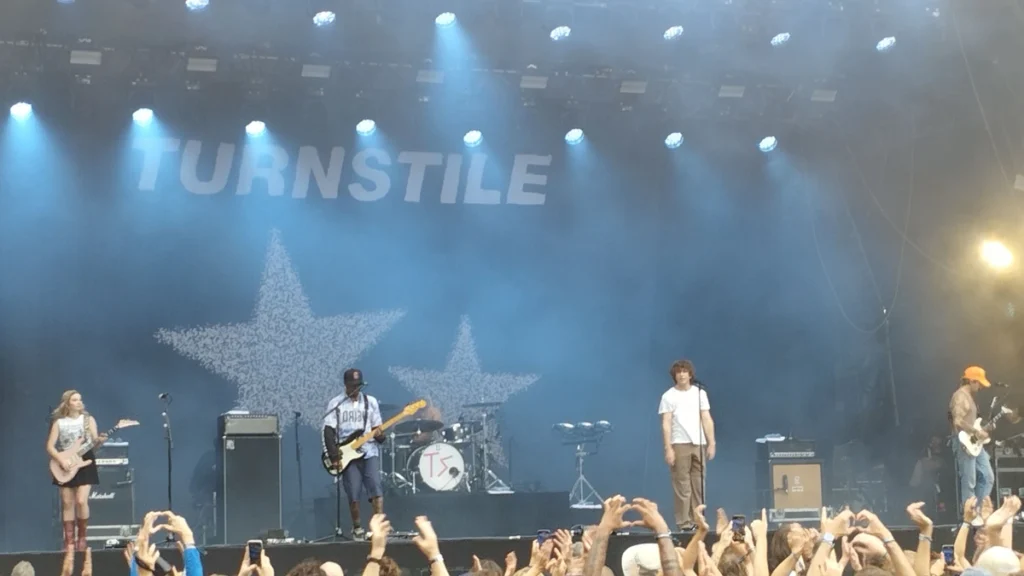
Turnstile Put Elton John and a Death Metal Band on the Same Album

Somewhere on the guest list for Never Enough: Versions, Elton John’s name sits a few lines away from Dying Fetus, a death metal band from Maryland whose song titles are not printable in most contexts. Both are reworking material from the same album. That single fact tells you more about where Turnstile have arrived than any chart position does.

The record is out today, 28 August 2026, and it reinterprets Never Enough, the band’s fourth album, which came out on Roadrunner in June 2025 and won Best Rock Album at the 68th Grammy Awards. More than twenty artists contribute. When the project was announced a week ago, the band had not said which guest had taken which song, and that omission looks deliberate.

The Guest List Is the Statement

Read it in full and the logic emerges. There are pop figures of the largest possible scale and there is extreme metal. There is electronic music from several unrelated corners: Four Tet, Floating Points, A. G. Cook, Kettama, Dan Deacon. There are songwriters working in confessional registers, Julien Baker and Mustafa and Faye Webster, alongside Blood Orange, Oklou, Porches, Alex G, Chanel Beads and Nourished by Time.

Then there are the Baltimore inclusions, which are the ones that explain the rest. Rod Lee is a Baltimore club producer. Brandon Woody is a Baltimore trumpeter. Angel Du$t is a band Turnstile members play in. A remix album assembled purely for reach would not bother with any of them, and their presence turns the project from a marketing exercise into something closer to a map of where the band actually come from.

What They Are Reworking

Never Enough runs fourteen tracks and forty-five minutes, produced by the band’s singer Brendan Yates, with Will Yip engineering and contributing additional production, and A. G. Cook adding production to Dull. It arrived after three singles: the title track in April 2025, then Seein’ Stars paired with Birds later that month, and Look Out for Me in May.

The album is already an unusual object for a hardcore band. Look Out for Me runs nearly seven minutes; Ceiling lasts seventy-three seconds. Kerrang! called it cinematic in scope and execution and made it their album of the year. The Guardian, giving it four out of five, described a profusion of ideas deftly handled. Metacritic settled at 83 from nineteen reviews. Pitchfork was cooler at 7.8, hearing 1980s nostalgia in it.

The structure is what makes it reworkable. A record built from uniform three-minute songs offers a remixer one obvious job: change the drums, extend the intro, deliver a version. Never Enough does not offer that. Its lengths run from Ceiling at seventy-three seconds to Look Out for Me at six minutes forty-four, and the album keeps interrupting itself with short instrumental passages that function as breathing room rather than transitions. Handing that to twenty-three artists produces twenty-three different problems rather than one repeated exercise, which is presumably the point.

Five reviewers gave it full marks, including Kerrang!, NME and The Arts Desk, while Rolling Stone stopped at three and a half out of five and AllMusic gave four and a half. That spread of enthusiasm without consensus is characteristic of records that cross over from a scene: the outlets closest to the genre were the most emphatic, and the general-interest press admired it at a slight distance.

A Hardcore Band at Number Nine

Commercially the record did something the genre rarely does. It entered the Billboard 200 at nine, the highest placing of the band’s career, on 38,000 album-equivalent units of which 27,500 were pure sales. It went to number one on both the US Top Hard Rock chart and the UK Rock and Metal chart, eleven in the UK overall, five in Australia and seven in Germany.

Then the year-end lists arrived and the spread was telling: first at Kerrang!, fourth at Exclaim!, eighth at NME, tenth at Billboard, fifteenth at The Guardian, eighteenth at Consequence, thirty-first at Rolling Stone. Publications with no shared readership all found room for the same hardcore record, which is the precondition for a guest list this wide.

Two Grammys, and Which Ones

At the 68th Grammy Awards the band won Best Rock Album, and Birds won Best Metal Performance. They were also nominated for Best Rock Performance for the title track and Best Alternative Music Performance for Seein’ Stars.

Those four nominations sit in three different genre families, which is the institutional version of the same point the guest list makes. Birds runs two minutes and twenty-six seconds and was judged metal; Seein’ Stars, from the same session and the same album, was judged alternative. The band did not change between tracks. The categories simply could not agree on what they were listening to.

Ninety-Four Shows and Counting

The touring has been relentless. The Never Enough Tour opened in Nashville on 15 September 2025 and ran to 94 shows across nine legs, through North America, Europe, Australia and New Zealand, Latin America and Asia, originally closing in Australia in January. Venues climbed accordingly, from clubs to Forest Hills Stadium in Queens, Alexandra Palace in London and the Palau Sant Jordi in Barcelona.

More than thirty-five support acts appeared across it, and the choices repeat the pattern: hardcore institutions like Hatebreed, Terror and Agnostic Front on some nights, Blood Orange, Yves Tumor, Clipse and Vince Staples on others. The 2026 festival run took in Coachella across both weekends, Lollapalooza in Chicago, Austin City Limits across two weekends in October, Fuji Rock, Outside Lands and Osheaga.

Ninety-four shows across five continents in roughly sixteen months is a workload closer to a legacy act’s than a hardcore band’s, and it explains why the reissue arrives when it does. The album has been played nightly for a year; the songs have already been reshaped once by the road before any guest touched them. A remix collection released at the end of that cycle is documenting a record that has stopped being fixed rather than one that was ever finished.

Pt. 2, and the Nonprofits

Never Enough Tour Pt. 2 opens on 9 September in Milwaukee, a sixteen-date headline run with curated bills rather than a single support act. The lineups again refuse to pick a lane, mixing Clipse and Vince Staples with Hatebreed, Pennywise, Ceremony, Cold World and Texas Is the Reason.

The detail worth noting is that the band are partnering with local nonprofit organisations at every date, with an on-the-ground presence at each stop. That is a hardcore-scene convention scaled up to amphitheatre level, and it is the clearest sign that the band’s growth has not come with a change of operating principles.

Why the Anonymity Matters

Withholding which artist took which track is the most interesting decision in the whole project. A remix album normally sells itself on exactly that information: you go to the track by the person you already like. Removing the index forces a listener through the record in order, which is how the band sequenced the original, with its seventy-three-second interludes and its seven-minute centrepiece.

It also protects the thing that made Never Enough work. This is a band who won a metal Grammy and an alternative nomination for two songs recorded in the same room, in the same way Leon Thomas took Best R&B Album for a record he produced himself after years of being credited on other people’s. Turnstile have spent an album cycle refusing to be sorted. Handing twenty-three artists the same fourteen songs, and declining to label the results, is the most consistent thing they could have done next.

Ezra Furman Made an Orchestral Emo Record About Losing Control

The first sound on Goodbye Small Head is a string section, and the second is a synth humming somewhere underneath it. Then a breakbeat arrives, skittering and slightly wrong-footed, and a voice starts asking to be let out of a moving car. Ezra Furman has a phrase for the combination: an orchestral emo prog-rock record sprinkled with samples. It is an unwieldy description, and it is accurate.

The album came out on Bella Union on 16 May 2025, produced by Brian Deck and recorded in Chicago, where Furman is from. Twelve songs run forty-two minutes. It reached number three on the UK Independent Albums chart, and in January she takes it across Europe and Britain for fourteen nights, opening at Arena Wien in Vienna on the 19th.

Where the Songs Came From

Furman has been open about the circumstances. The material arrived in a rush after a period of illness in early 2023, and she has described the writing as happening inside the experience rather than after it: “This poetry, my poetry, arrived in the midst of the storm. It was written as I teetered toward the edge.”

She is precise about what that does and does not mean for the songs. “They’re not about someone going off the rails,” she has said, “they are inside that person’s heart.” That distinction matters to how the record works. It is not a set of case notes written in retrospect, and it does not resolve, because it was not made from a position where resolution was available.

The Sound of Losing Control

The production carries the argument. Sweeping strings sit against low synths and chopped-up voice samples, and the rhythm section keeps declining to settle. Furman has said the twelve songs delineate a loss of control through means both conventional and not, listing weakness, heartbreak, mysticism, drugs, and living in society with your eyes open.

Set against that lyrical content, the arrangements are unexpectedly lush. Mojo called it her calmest record, flecked with ballads and strings, which is a fair reading of the surface and slightly misses what is underneath. The calm is the frame, not the subject. Putting an unravelling into an orchestral setting is a compositional decision that makes the unravelling more legible, not less.

Four Songs That Show the Method

Jump Out opens on buoyant strings and that low hum, with Furman wailing at a driver who has no intention of stopping. Grand Mal is the most developed of the openers in her catalogue, lush and swaying, and, as The Line of Best Fit observed, oddly lullabying for a song about a seizure.

You Mustn’t Show Weakness sets brooding breakbeats under a mantra Furman directs at herself, an instruction not to fold. A World of Love and Care is the album’s most affecting stretch, built on questions about what a society actually guarantees anyone. The record closes on I Need the Angel, the one song here Furman did not write, an electric reading of an Alex Walton composition delivered with heartland rock riffage.

The rest of the running order keeps widening the palette rather than settling it. Sudden Storm and Power of the Moon sit early, the latter the longest thing on the first half at four and a half minutes. Submission, Veil Song and Slow Burn run consecutively through the middle, and You Hurt Me, I Hate You is the bluntest title on a record otherwise inclined toward metaphor. Strange Girl follows it. The bossa nova influence that reviewers kept noting surfaces in the rhythmic feel of these central tracks rather than in any single arrangement, which is why the album can move between genres without ever sounding like a compilation of styles.

What the Reviews Landed On

The reception was strong and unusually consistent about why. DIY gave it four and a half out of five and called the lyrics some of her finest, unafraid of the darkest corners. Hot Press scored it eight out of ten and identified the theme precisely: the songs are explicitly about the act, and the art, of losing control.

The Line of Best Fit’s Dom Lepore gave it seven out of ten and framed it as a novel and necessary display of fervour in a hypervigilant era. MusicOMH went four out of five, describing Furman as one of the most exciting songwriters working. Nobody found it an easy listen, and nobody suggested it should have been.

The commercial pattern matched that critical one. Number three on the UK Independent Albums chart is a genuine result for a record on a label the size of Bella Union, and it sits alongside 23 on UK Album Downloads and 38 in Scotland. Those are the numbers of an artist with a committed audience rather than a broad one, which is the position Furman has occupied for most of a career now spanning more than a decade and a half, first with bands and latterly under her own name.

Fourteen Nights in Winter

The touring plan is dense. January runs Vienna, then Graz’s Dom Im Berg, Linz’s Posthof and Munich’s Strom on consecutive nights, followed by Prague, Berlin’s Columbia Theater, Hamburg’s Molotow, Amsterdam’s Paradiso Tolhuistuin, Antwerp’s Trix Club and Le Cabaret Sauvage in Paris. February brings Glasgow’s Art School, New Century Hall in Manchester, Bristol’s Electric, and the O2 Forum Kentish Town in London on the 4th.

Those are club and mid-size rooms rather than arenas, which suits material this intimate, and the routing is the compact European circuit an independent-label artist plays when the record has done well without crossing over. North American dates ran through the second half of 2025, so the UK and European leg is the album’s long tail rather than its launch.

Winter routing of that density also tells you something about how the show is built. Ten European dates inside eleven nights leaves no room for elaborate staging or a large touring party, which points to a set carried by the songs and a small band rather than by production. For a record this dependent on strings and samples, reproducing it live is the interesting problem, and the venues suggest the answer is rearrangement rather than replication.

Why It Reads as Queer Music

Furman is a trans woman and has written about faith, gender and belonging across her catalogue, but the reason this record belongs in that conversation is structural rather than topical. Very little of it is about identity in a declarative way. It is about being unable to trust your own footing, and about the gap between how you are managing and how you are required to appear.

That is a queer record in the sense that matters: it treats the pressure to present as composed as the actual subject, rather than as background. You Mustn’t Show Weakness is the clearest statement of it, an instruction delivered to oneself in a voice that plainly does not believe it.

An Artist Who Kept the Framing

What comes through across the album, the interviews and the reviews is how firmly Furman has held onto her own account of the record. She named the genre, defined the subject and drew the line between writing from inside an experience and reporting on it afterwards. Critics have largely adopted her terms, which does not always happen.

It puts her among a set of artists currently insisting on authorship over the frame as well as the music, in the way Leon Thomas spent two decades producing for other people before making the record with his own name on it. Furman’s version is quieter and harder to sell, and the fourteen January dates suggest an audience that turned up for exactly that.

Michael Kiwanuka Made Small Changes by Not Trying to Prove Anything

There is a particular problem that arrives after an album wins something. The next record has to answer it, and the usual answer is more: more production, more ideas, more evidence that the win was deserved.

Michael Kiwanuka went the other way, and was unusually explicit about why. “I wonder what an album will sound like when we’re not trying to be cool or anything, you know, we’re not trying to prove anything,” he told The Current. Small Changes is the record that came out of taking that question seriously.

What He Was Reacting Against Was His Own Record

Small Changes arrived on 22 November 2024 through Polydor and Interscope: eleven tracks, forty minutes and eighteen seconds, filed as psychedelic soul.

The album it is answering is Kiwanuka, which won the Mercury Prize, and his diagnosis of it is candid. “The production became, especially on Kiwanuka, like really, really relayed with so many ideas and so many sounds,” he said. He put both that record and 2016’s Love & Hate in the same category: “I definitely was in a different space of trying to prove a lot of things as an artist.”

Artists rarely say this about work that succeeded. Describing a prize-winning album as over-furnished is a real risk, and it only makes sense if the follow-up genuinely commits to the opposite. “I sort of went back to that, which was like, for me the right time,” he said. “Strip everything away and find out what it actually is.”

It is worth being precise about the record he is measuring himself against, because the modesty could read as false. Kiwanuka won the Mercury Prize. Following that with a quieter album is not the safe option dressed up as bravery — it is the option that forfeits the obvious way to capitalise on a win, which is to give the audience a larger version of what it just rewarded.

The Same Producers, a Different Instruction

The interesting decision is that he did not change the team. Danger Mouse and Inflo co-produced Small Changes, as they had Kiwanuka, and as Danger Mouse had Love & Hate before that — a third consecutive collaboration.

Changing your sound by keeping your producers is harder than changing your producers. It means the difference has to come from instruction rather than from personnel, and there is nobody new to blame if it does not land.

Kiwanuka’s account of what he learned is about restraint on his own side as much as theirs. “I’ve learned quite a few things that makes the process even a bit easier,” he said. “Just do what you do, which actually is easier for everyone.” On Danger Mouse specifically: “You can just ask any question, and you know you’re gonna get, like, a really interesting answer, or something you’ve never really considered.”

The writing credits show how deep the partnership runs. Every track is credited to Kiwanuka with Brian Burton and Dean Josiah Cover — Danger Mouse and Inflo’s given names — except the closer, “Four Long Years”, written by Kiwanuka and Burton alone.

What Understated Actually Means Here

His description of the goal is specific: “a lot more understated” than Kiwanuka, and “more about the voice, more about my voice, and more about the lyrics”.

That is a mixing brief as much as a writing one. Putting a voice forward is not a matter of turning it up; it requires everything else to stop competing for the same frequencies and the same attention. The eleven tracks are correspondingly compact — “Live For Your Love” at 2:29, “Lowdown (Part II)” at 2:40 — with only “Four Long Years” and “One and Only” pushing past four and a half minutes.

The two-part “Lowdown” is the tell. Splitting an idea into Part I and Part II rather than developing it across one longer track is a decision to let a thing be what it is and then stop, which is precisely the discipline he says he was after.

The rollout matched the thesis. “Floating Parade” appeared on 10 July 2024, the two-part “Lowdown” on 12 September, and “The Rest of Me” on 3 October — three months of singles that arrive and stop, rather than a campaign building toward a reveal. Nothing about the sequence asks the listener to wait for a bigger moment.

Jimmy Jam Is Playing the Organ, and That Is Not a Cameo

The personnel list contains a detail that is easy to skim past. Jimmy Jam — half of Jam & Lewis, one of the most decorated producers in American pop — appears on this record as a session organist.

Kiwanuka is blunt about the scale of it: “All the Hammond you hear, other than maybe one song, is Jimmy Jam. He’s on essentially a lot of the record.”

Engaging a producer of that stature to play rather than to produce is an unusual inversion, and it fits the record’s logic. A Hammond part is a texture decision, and having one player make all of them is how an album gets a consistent character without layering.

He is not the only heavyweight in a supporting role. Pino Palladino plays bass, James Gadson drums, James Payne slide guitar; Rosie Danvers arranged the strings with Pete Anthony conducting, and six named backing vocalists appear. Kiwanuka himself plays acoustic, electric and bass guitar, drums, piano and Wurlitzer, with Inflo on drums, piano, keyboards, Rhodes and synthesiser.

Kiwanuka also plays a great deal of the record himself, which is the other half of the same idea. When the person who wrote the song is the one playing the Wurlitzer part, the arrangement decisions and the writing decisions stop being separate stages that need reconciling.

The Reception Was Warmer Than the Modesty Suggests

Stripping back is usually the move that costs an artist their reviews. It did not here.

The album took a Metacritic score of 83. The Observer gave it five stars and called it “an exquisite return”; DIY and Uncut both went to four and a half; The Independent, Mojo and NME to four; Clash and The Line of Best Fit to 8 out of 10, the latter calling it “a beautifully crafted return”. Pitchfork was the coolest of the majors at 7.0, and AllMusic sat at three and a half.

Commercially it reached number two in the UK and number one in Scotland, with number two in the Netherlands, five in Flanders, six in Switzerland, eleven in Germany and fifteen in Austria. Those are not the numbers of a retreat.

Why the Experiment Worked

The reason a record made with “nothing to prove” did not simply sound smaller is that the restraint was applied to the arrangement and not to the ambition.

Everything expensive is still present — a legendary rhythm section, real strings, a full choir of backing vocals. What changed is that those elements take turns instead of stacking. That is a harder record to make than a dense one, because every part left in has to justify itself against the silence it is displacing.

It is the same instinct as a stable studio partnership: fewer new variables, more attention to each one. Our piece on why guitar bands went back to tracking live covers a related move, from a different direction.

Small Changes is out now.

Every Nilüfer Yanya Record Runs Through the Same Second Person

Most guitar-led songwriters accumulate collaborators the way they accumulate gear. A producer for the big single, someone else for the ballad, a mixer with a name, a co-write brought in when a chorus will not resolve. It is the default because it de-risks the record, and it is also why so many albums sound like several albums stapled together.

Nilüfer Yanya has spent three records doing the opposite. The credits keep returning to one other person, and the consequences are audible not in what the songs do but in what they decline to do.

The Second Person on Every Record

My Method Actor arrived on 13 September 2024 through Ninja Tune, eleven tracks, forty-four minutes, produced by Will Archer. Archer also records under the name Wilma Archer, which is why the same partnership appears under two names depending on where you read the credits, and it has been the constant across Yanya’s catalogue.

Her own description of the process is unusually blunt about its cost. She called it the most intense record she had made “in that respect. Because it’s only been us two.”

That is not a boast about purity. Two people in a room for a whole album means there is nobody to break a deadlock, no third opinion to defer to, and no way to attribute a bad decision elsewhere. It also means nobody arrives at track eight with a fresh idea about what the record should be. Both of those follow from the same choice.

The partnership predates this record. Yanya released Miss Universe in 2019 and Painless in 2022 before it, and the through-line across all three is less a sound than a way of deciding. Each album is recognisably by the same person without any of them repeating the last, which is the specific thing a stable collaboration buys: continuity of judgement rather than continuity of style.

What My Method Actor Cost Them

The album is about, in her framing, “entering a transition between one part of life into another”. That is a subject with an obvious trap: transition records tend to sprawl, because the writer is not yet sure which side they are writing from.

It does not sprawl. Eleven tracks, and the longest is five and a half minutes. “Keep on Dancing” opens at just over two minutes, and “Wingspan” closes at under two and a half. An album about not knowing where you are is not usually this disciplined about length, and the discipline is the tell: someone was in the room saying no.

Critics responded to it as a step up rather than a continuation. The album took a Metacritic score of 85 with an 8.1 at AnyDecentMusic?, Pitchfork gave it 8.5, and Under the Radar went to 9 out of 10 and later placed it second on its albums of the year. Pitchfork put it at 13, Exclaim! at 14.

What is notable is the breadth rather than the height of that response. The Line of Best Fit, Exclaim! and Clash all landed on 8 out of 10, while NME, AllMusic and MusicOMH each gave four stars. Publications with quite different tastes arrived at nearly the same verdict, which tends to happen when a record is doing one thing deliberately rather than several things hopefully. Uncut placed it 55th in its albums of the year.

The Independent Chart Tells the Truer Story

The commercial numbers are worth separating, because read carelessly they say the opposite of what happened. My Method Actor peaked at 53 on the UK albums chart. On the UK independent albums chart it went to number one.

Those two facts describe one audience. A record that tops the independent chart while sitting mid-table overall is being bought deliberately, by people who went looking for it, rather than picked up in passing. It also charted 11 in Scotland and 109 in Flanders.

For an artist working with one collaborator and no radio-shaped compromise, that is the outcome the method is designed to produce. It is not the outcome a label hoping for a crossover would have chosen, which is rather the point.

Dancing Shoes Is Where the Album’s Offcuts Went

The Dancing Shoes EP followed on 2 July 2025, again on Ninja Tune: four tracks, “Kneel”, “Where To Look”, “Cold Heart” and “Treason”.

Its origin is the interesting part. The EP was written alongside the album’s material and then set aside, and Yanya returned to it with Archer after touring My Method Actor. These are not B-sides in the old sense of weaker songs cleared out of a drawer. They are songs that did not fit a specific record and were given a second hearing by the same two people who rejected them the first time.

She has been direct about why one of them stalled. Of “Where To Look” she said: “We started writing this song for the album, but it was tricky to get it off the ground at that time.”

“At that time” is doing the work in that sentence. The song was not bad; the room was pointed elsewhere. A two-person partnership that persists across years can afford to shelve something and come back, because the people who understood the original intention are both still there. A rotating cast of collaborators cannot do that — the context leaves when they do.

The four tracks are short and none outstays its idea. That is consistent with the album it came from, where the longest song runs five and a half minutes and several stop well before three.

Why a Two-Person Room Sounds Different

The audible consequence is restraint, and restraint is the hardest thing to hear because it presents as absence.

Arrangements on both releases tend to withhold. Parts enter late or not at all. A song will sit on a figure rather than build the expected lift. That is very difficult to achieve with a large team, not because larger teams lack taste but because each new contributor arrives with something to add, and adding is how a contribution becomes visible. Nobody is thanked for the part they did not play.

Touring cuts the same way. Returning from the road with the songs still in muscle memory, and going back to the same collaborator, means the revision is informed by how the material actually behaved in front of people. That is a rare feedback loop; most records are finished before anyone has played them live. It is a close cousin of the argument for tracking a band together in one room rather than in isolation — see our piece on why guitar bands went back to tracking live.

What a Partnership Protects Against

The obvious risk of working this way is insularity: two people can talk each other into anything, and there is no outside ear to say a song has stopped working.

What it protects against is more valuable at this scale. An artist three albums in, with an independent-chart number one and no mainstream crossover, is exactly who gets advised to bring in a name producer and reach for a wider audience. That advice is easier to refuse when the alternative is not an empty room but a working method that has already produced a record placed second on a serious critics’ list.

The songs left off My Method Actor becoming Dancing Shoes a year later is the clearest evidence of the method’s value. Nothing was wasted, because nothing was handed to someone who did not know what it was for.

My Method Actor and the Dancing Shoes EP are both out on Ninja Tune.