
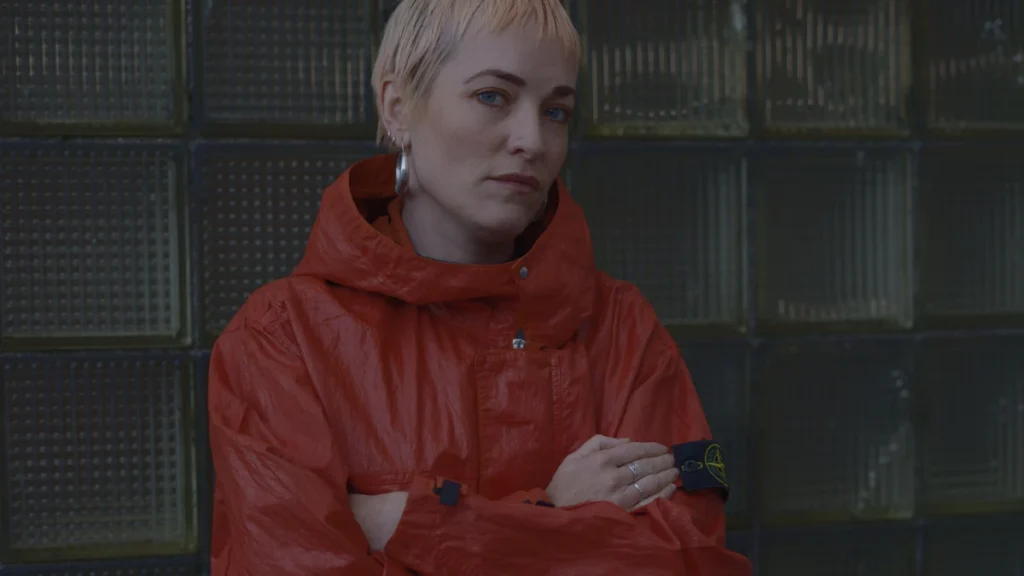
Radie Peat Made Her Solo Debut the Way Mike Oldfield Made Tubular Bells
In her twenties, Radie Peat watched a documentary about Mike Oldfield making Tubular Bells, and one idea from it never left. “When I was in my 20s I watched a documentary on Mike Oldfield making ‘Tubular Bells’ and the idea just stuck that I would like to try to record like that, where you write and play all the intersecting parts,” she told NME. About 15 years later, that idea has become No Human Tongue Can Tell, her first solo album, released on Friday 13 November through Rough Trade Records.
Most listeners will know Radie Peat as one of the four members of Lankum, the Dublin band whose 2023 album False Lankum was nominated for the Mercury Prize and an Ivor Novello. Her solo record is a quieter, more private thing: nine songs, most of them drawn from the folk tradition, made with John ‘Spud’ Murphy, the producer who has worked alongside Lankum for years. It is an album about old songs and the women inside them, and it was built one layer at a time by the person singing them.
An Idea That Waited 15 Years
Peat has been open about how long the record took to arrive. “It’s been ticking along in the background of my head for probably 15 years or so,” she said in the statement that announced the album. What drew her to the Oldfield method was not the grandeur of Tubular Bells but its limits. “I found the idea of being limited by your own mind and abilities, with all the blind spots and personal preferences, very appealing, and I felt it would make something definitively unique, for better or for worse,” she said, in the full statement published by Stereogum.
That is a striking choice for someone whose best-known work is collective. Lankum’s records are built by four people trading drones, harmonies and arrangements, and the band’s sound depends on how those parts lean on each other. Writing and playing every intersecting part yourself removes the other voices in the room, and with them the safety of someone else’s instinct. Peat chose that constraint deliberately, and she is candid that the result rests on her own taste, blind spots included.
She did not make the record entirely alone, and she says so. “I’d like to thank John Spud Murphy for making this album with me, without his talent and patience it simply wouldn’t exist,” she said. Murphy is Lankum’s regular collaborator, so the solo album keeps one familiar ear in the room even as it strips away the band.
Songs of Struggle, Strength and Endurance
The theme of the album was something Peat found after the fact. “The collection of folk songs on the album came together easily, and it’s only now I see a thematic link between them,” she said. “They are largely songs of female struggle, suffering, strength and endurance. But there are many about love as well, with all the complications that brings.” Dork notes that she only noticed the connection after assembling the tracklist.
The Line of Best Fit describes the collection as songs that lead with confidence, self-sufficiency and autonomy as they retell love stories from the folk tradition, with one woman’s voice standing in for the voices of many through the ages. Peat put the same idea in her own words when she described what singing these songs means to her: “communicating hundreds of years of other people’s experiences, that have been absorbed into the songs from generations and generations before you – binds you with a worldliness beyond the sum of your own experience.”
For a listener new to traditional music, that is the best way into the record. These are not museum pieces. They are songs that have been carried, changed and argued over for centuries, and Peat treats them as living material, rewriting where she needs to and leaving the old words alone where they still say what needs saying.
The Moon and Stars and a Scene From Sive
The clearest example of that approach is “The Moon and Stars”, the single that arrived with the album announcement in September. Peat rewrote parts of the traditional lyrics to channel anger, NME reports, and she has explained exactly what the new lines carry. “There are coded references to unwanted pregnancies and abortions within the song, as well as references to rue, a herb which was used to cause miscarriage,” she said. “I wanted to represent these experiences from the woman’s perspective – to connect us with her experience.”
The song also reaches into Irish theatre. “When I wrote the lines that refer to screeching and roaring, I was recalling the final scene of John B. Keane’s 1959 play, Sive,” Peat said. In that scene, as The Line of Best Fit explains, the young protagonist drowns herself in a bog hole after learning of her arranged marriage. Stereogum describes the track as haunting from the start before it builds into an electronic-speckled finale, and its video was directed by Peter Eason Daniels.
Willow Garden, a Ballad That Survived Across an Ocean
The final preview before release was “Willow Garden”, a murder ballad with a long and complicated history. It is best known as a 19th-century Appalachian song, also called “Down in the Willow Garden” and “Rose Connelly”, about a man put to death for killing his lover, Dork reports. Peat traced it back further.
“There is evidence of its existence in Ireland in 1810 when the tune was noted in the bunting collection, without lyrics, but with the title ‘Rose Connolly’,” she said. “We appear to have lost it since then in Ireland, but it survived very successfully in the Appalachian’s.” Her version includes a verse she has never found anywhere else, transcribed by Matt Kinman from an older man he lived with in the mountains for a while. “Thanks to Matt for writing it down for me in a dive bar in Sylva, North Carolina,” she said.
Lankum recorded a major-key version of the same song in 2017. Peat’s solo reading goes the other way, slow and solemn, closer to an elegy than a sing-along, as Dork describes it. Hearing the two side by side is a quick lesson in how much a single arranger’s choices can change a song that is centuries old.
Still I Love Him and the Rest of the Record
The first sign of the project came in July, when Peat released “Still I Love Him”, her interpretation of the traditional love song of the same name. It was her first solo release outside Lankum, and Dork notes that she sourced the song from fellow Irish singer John Francis Flynn.
The album opens with “Hares on the Mountain” and closes with “Cailín Deas”, with “The Moon and Stars”, “Willow Garden”, “Luisne”, “Same Old Man”, “Still I Love Him” and “Bonnie Boy” among the songs in between. Peat has named the music that shaped it: Shirley and Dolly Collins, Enya, Lal Waterson, Katie Kim, Jackson C Frank, Karen Dalton, Nellie Weldon and Liam Weldon. It is a list that runs from the English folk revival to Irish traditional singers to American outsiders, and it maps the ground the record covers.
Those names also explain the album’s pace. Shirley and Dolly Collins built arrangements that left space around the voice, and Karen Dalton sang as if every line cost her something. Peat’s record sits in that lineage: unhurried, close and focused on the singer rather than the band.
Where to Hear Radie Peat Live
The solo shows are already under way. Peat played London’s Union Chapel on 3 November and plays Vicar Street in Dublin on 20 November, with a Paris show in February and an additional London date in May, according to NME. For anyone who has only heard her inside Lankum’s dense, droning sound, the solo setting is a chance to hear the voice on its own.
The timing is good for new listeners, too. Lankum’s music has been reaching wider audiences on screen, with “Katie Cruel” and “The Granite Gaze” in Netflix’s House of Guinness and “Hunting the Wren” soundtracking the final scene of the Peaky Blinders film The Immortal Man, NME notes. The band also recorded a cover of The Specials’ “Ghost Town” for Oona Doherty’s dance show Specky Clark.
Records that come from one stubborn decision about method tend to be the most revealing, as we found when DIIV let A. G. Cook record the drums before the songs were done. For Radie Peat, the decision was made while watching a documentary in her twenties. No Human Tongue Can Tell is what happens when an idea is allowed to wait 15 years, and when the person who had it finally plays every part herself.